

Little Explorers, Ages 3 to 4
Your child is meeting sounds for the very first time. Lessons feel like play, with songs and sound cards, so the ear learns to notice sounds long before any reading begins.
Your child learns the sounds letters make and joins them straight into syllables, words, and stories. Verified tutors guide every step through seven measured levels, at your home in Surabaya or online.
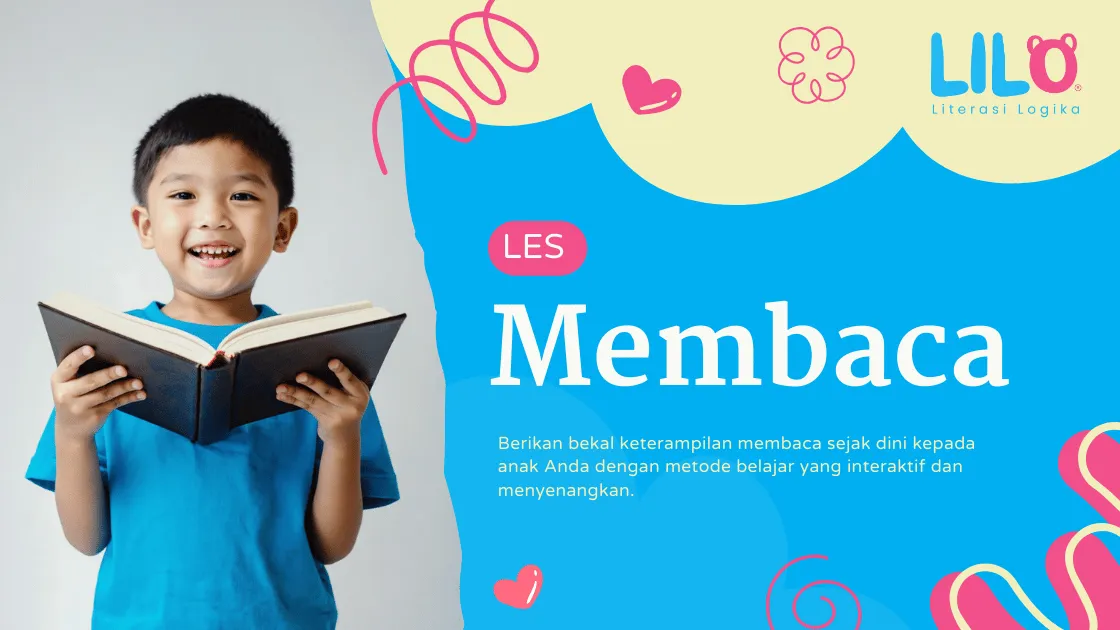
Reading Classes for Kids in Surabaya is Lilo's guided reading program for children aged 3 to 10, taught in English at your home, in a small group, or online. Your child learns the sounds letters make, then joins those sounds directly into syllables and words. Seven measured levels carry a child from first sounds all the way to reading short passages with real understanding.
Every child arrives at reading on their own timeline. The program meets your child exactly where they are today and builds from there, one mastered step at a time.
Your child is meeting sounds for the very first time. Lessons feel like play, with songs and sound cards, so the ear learns to notice sounds long before any reading begins.
Your child is getting ready for primary school. This is the heart of the journey, where letter sounds click together into syllables, then into first words and short sentences.
Your child can read a little and now needs smoothness. Lessons build fluent sentences, expression, and understanding, so reading turns from effort into something enjoyable.
Your child is at school but reading has stayed hard. The placement assessment finds the exact gap, and a private tutor closes it patiently, with zero shame and steady wins.
Surabaya is the capital of East Java Province and one of the largest cities in Indonesia. It is widely known as the City of Heroes, an honored title born from the courage of its people and still a source of pride today. Surabaya has also long grown as a major trading and port city, with the historic Jalan Tunjungan among its most storied streets.
Your child learns at home with a teacher experienced in guiding young learners. Schedules are agreed together, and you can watch your child's progress directly from session to session in Surabaya.
Lessons climb in small steps that begin at the simplest point. Your child moves to the next level once the current one truly makes sense, which keeps reading, writing, and counting firmly grounded from day one.
Your child first handles real objects, then looks at pictures, and later meets numbers and letters. Each idea arrives in an order that feels natural, so every lesson makes sense and stays fun for your child.
The Lilo team arranges everything. You describe your child, and the team prepares the tutor, the schedule, and the materials.
The consultation is free. Share your child's age, what they read so far, and your area in Surabaya, such as Mulyorejo. The team uses this to estimate a starting stage.
Pick a home tutor or an online class, sessions of 60, 90, or 120 minutes, and a monthly package: Starter, Regular, Intensive, or Complete. You pay per package, and larger ones cost less per session.
The tutor comes from a national network of more than 5,000 active tutors, many trained in primary teaching, early childhood, psychology, or mathematics. You view the profile before the first session.
The tutor finds the starting point through play, with no written test, then sums up what your child mastered and sets one small task of about ten minutes for home.
If the first tutor is a poor fit for your child, Lilo replaces them free of charge.
Ask any provider these questions before enrolling. The answers show whether your child gets a clear sequence and sensible home practice.
A coded sequence shows where your child is, what is done, and what comes next, and keeps material from jumping around. Lilo uses a ladder from L0 to L6 within 122 coded modules.
Long homework makes a young child resist, and aimless homework feels like punishment. Good homework is short and tied to the session. Every Lilo session ends with one task of about ten minutes.
Unfamiliar sounds push a child into guessing, a stubborn habit. Texts built from known sounds let your child read alone. Lilo worksheets come from the module your child is studying now.
Reports full of general praise are hard to act on. Lilo's weekly report lists the stage practised, what is mastered, what needs repeating, and one activity for home.
A young child learns most eagerly with the right match. Ask whether a change is possible and what it costs. Lilo replaces tutors free of charge, and you see the profile before the first session.
The method rests on a simple idea. When a child knows what each letter sounds like, joining those sounds into a syllable feels natural, and reading follows on its own.
Before the first lesson, the tutor checks which sounds and syllables your child already knows. Lessons then begin at the level that fits, never too easy and never discouraging.
Your child learns that m says mmm and a says ah, through songs and sound cards. Sounds are the raw material of reading, so they come before anything else.
There are no spelling chants of letter names. The sounds slide together, m and a become ma, and your child reads the syllable whole, the way real reading actually works.
Steady practice built level by level keeps each session light and repeatable. Your child moves up only after truly mastering a stage, so confidence grows with every level.
Each stage carries its own mark of completion, so progress stays visible.
Your child meets the vowel and consonant sounds through sound cards and letter tracing, training the ear and the hand together before any word appears.
Sounds slide together into open syllables, then into words of 2 to 3 syllables. Timed reading sheets make the practice feel like a friendly game.
Your child conquers syllables with consonant endings, then the trickier digraphs, clusters, and diphthongs, with generous practice at the stage children find hardest.
Reading grows from single words into sentences of 4 to 10 words, with punctuation, intonation, and rhythmic reading that makes sentences sound alive.
Mini stories invite your child to answer who, what, when, where, and why, find the main idea, and retell the tale in their own words.
These are the signature techniques our tutors bring to every session in Surabaya, refined across Lilo's own curriculum of 122 leveled modules.
A child who joins sounds into whole syllables from day one never has to unlearn the habit of chanting letter names.
Your child learns what each letter says before learning what it is called. Sounds are what words are built from, so lessons start there and reading arrives sooner.
Two sounds melt into one syllable in a single breath. Your child reads ma as ma from the start, which is exactly how fluent readers process words.
Leveled readers contain only the patterns your child has already mastered. Every page is genuinely readable, so each little book ends in success instead of frustration.
Combinations like ng, ny, and tr are where most children stumble. The curriculum slows down here on purpose, with extra practice and extra encouragement until it clicks.
Each rung is a real stage in Lilo's own curriculum, and your child climbs one rung at a time.
Most reading struggles trace back to a handful of well-meaning habits. Knowing them early saves your child months of frustration and keeps the joy in learning.
Why it happensChanting bee ah to read ba forces the child to hold names in mind while hunting for the sound, and blending stalls under the extra load.
How Lilo helpsTeach the sounds first and let them join directly. In our lessons ba is read as one whole syllable from the very beginning.
Why it happensA child who can name every letter but knows no sounds has a collection of pictures, and pictures alone cannot be blended into words.
How Lilo helpsPair every shape with its sound from day one, using sound cards and songs, so recognizing a letter means hearing it too.
Why it happensA book full of unlearned patterns turns reading into guessing, and repeated guessing quietly teaches a child that reading is something they are bad at.
How Lilo helpsUse leveled readers that contain only mastered patterns. Every page your child opens should be a page they can genuinely conquer.
Why it happensYoung children learn through delight. Endless identical drills drain the fun, and a bored child starts dodging the reading table altogether.
How Lilo helpsKeep portions small and playful, with songs, cards, and timed games. Steady practice built level by level works best when it stays light.
Why it happensCombinations like ng, ny, and tr are the most common sticking point, and rushing past them leaves cracks that show up in every longer word later.
How Lilo helpsSlow down exactly here. Our Level 4 gives these combinations extra sessions, extra practice sheets, and extra patience until they feel easy.
Every young reader meets unknown words in stories. How the tutor responds decides whether your child keeps hold of the meaning.
Reading is two jobs at once. The eyes turn letters into sounds while the mind holds the start of the sentence. At 6 or 7 that holding space fills fast, so a minute-long explanation often erases the sentence's beginning. Your child then reads every word correctly and loses the meaning. So the tutor first sorts the stumble. A sound problem, like reading pangan as pan and gan, is fixed by pointing at ng and rereading.
A meaning gap looks different: your child reads lumbung smoothly, then looks puzzled. If the sentence offers clues, the tutor lets your child read on to the full stop. In Kakek menaruh padi di lumbung lalu menutup pintunya, the words padi and pintu point to a storage place. The tutor then asks what a lumbung might be, and guessing from clues builds active reading.
When the word carries the story and nothing nearby explains it, the tutor pauses, gives the meaning in five to seven words, and your child rereads the sentence from the start to reconnect it. Other new words get a pencil dot and wait until the paragraph ends. At home, watch for two signs: your child reads past unknown words and asks afterwards, and new words turn up in conversation.
These are real pages from Lilo's own curriculum, printed on A5 with generous practice portions. Have a look at what lands on your child's table, from first sound cards to a full passage with comprehension questions.
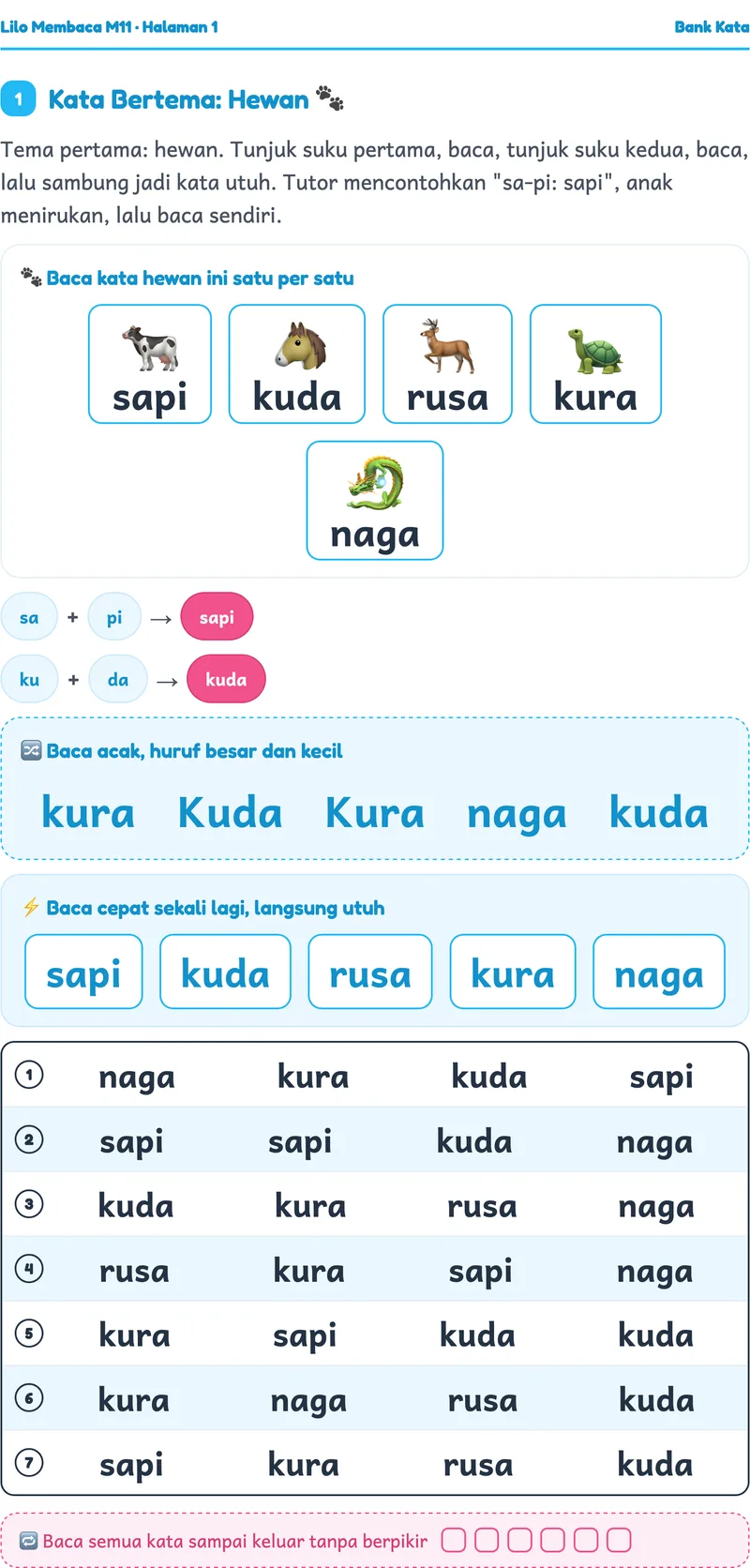
Sa-pi joins up to become sapi. That is how children work through this Level 1 sheet from module 11: pointing to each syllable, reading it aloud, then blending the pieces into whole themed words, with a speedy reading round at the end.
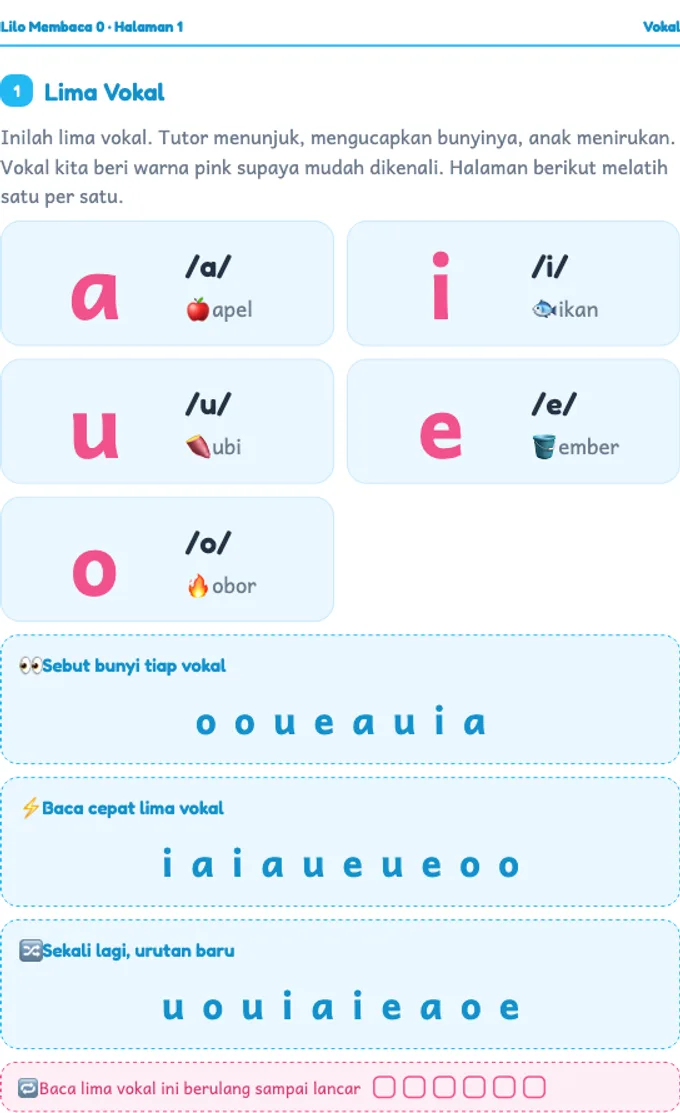
At Level 0, children meet letter sounds through simple cards: the vowels a i u e o and the consonants m, b, s. Each card is voiced again and again until it flows, then a quick reading drill locks it in.
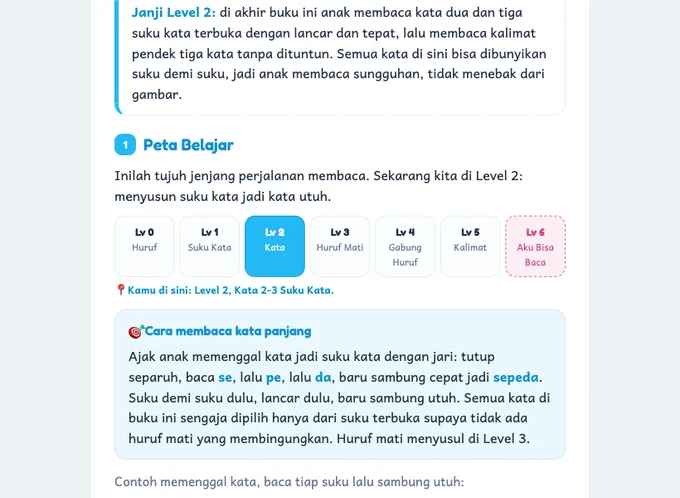
The seven-level map and how to break a word into syllables. The tutor models the whole syllable, your child joins them into a meaningful word without spelling out.
These samples are a small slice of 122 original modules, arranged step by step from letter sounds to full comprehension.
60, 90, or 120 minutes per session
Contact us
duration of 60, 90, or 120 minutes
Contact us
60, 90, or 120 minutes
Contact us
Readiness shows in small daily habits. These signs tell you when your child can begin and when a stage is secure enough to climb past.
Surabaya and its surroundings have 500+ tutors for young readers.
Graduates and active students.
Every application reviewed
Role and city are checked first.
Documents verified
Identity and diploma are matched.
Tutor profile filled in
Teaching history goes into the portal.
Trained before teaching
The step-by-step method is learned first.
Matched to your child
Candidates answer questions about the child.
Tutor not quite right? See our free tutor replacement promise
The first notes show which rung your child stands on, what is already solid, and what gets practised first.
Your child names the sounds on the cards while the tutor notes which come instantly and which hesitate. This shows whether your child should begin at L0.
Your child joins /s/ and /a/ into sa. Saying sa in one breath means L1 or higher. Two separate sounds mean those sounds get strengthened first.
The tutor watches where your child stumbles: a final consonant, a combination like ng, or a pause at punctuation. That point sets the starting code, such as L2 or L4.
Each report lists the stage practised, what is mastered, what needs repeating, and one home activity. Items moving from repeating to mastered mean your child is moving forward.
The profile is a 6-year-old starting primary school soon, who knows some letter sounds and learns on the Intensive package of 12 sessions a month, about three a week. New sounds stay fresh between sessions.
Wobbly sounds get firmed up, then lessons move into syllables like ba, bu, and sa. Three meetings a week make each sound pop out the moment its card appears.
Syllables join into words like meja, sepatu, and kelapa. Numbered reading sheets use only known sounds, so every line ends in a small success.
Makan, tidur, and pasar are read with their last sound intact. Pairs like kaki and kakak train the eyes to travel all the way to the final letter.
The hardest month. Your child meets ng, ny, kh, and sy in bunga, nyanyi, akhir, and syukur, and the tutor slows down on purpose until each one feels easy.
Your child stops at full stops, lifts the voice at question marks, and starts on short stories with who, what, where, when, and why questions.
Grade 1 entry needs no reading, writing, or counting test, since selection is by age under Permendikdasmen 3/2025 Article 11 paragraph 5. Solid reading simply helps your child feel at ease.
Laundry piles and shopping lists are full of words your child knows. Each activity practises one clear stage.
| Activity | Time | What you need |
|---|---|---|
First-sound guessing while foldingSay only the first sound of each item, such as /k/ for kaos or /s/ for sarung. Your child guesses the item and folds it. The ear trains at L0 while busy hands hold attention. | 5 minutes | a basket of clean, dry clothes |
Paper labels for the folded pilesWrite baju, topi, dasi, and sepatu on slips. Your child reads each one and sets it on the matching pile. Every word uses mastered sounds, so L1 and L2 grow with a win on every slip. | 10 minutes | small paper slips and a pencil |
A warung list in open syllablesWrite gula, kopi, roti, and susu on a list. Your child reads it to the shopkeeper and ticks each item off. Reading gets a real job, and that pride carries your child through L2. | 10 minutes | paper, a pencil, a little change |
Hunting for ng at the marketWrite bawang, kangkung, pisang, and jagung, then your child reads each name while pointing at it on the stall. This suits L4, where two letters make one sound. | 10 minutes | a short list of produce names |
Your child never chants letter names to decode a word. Sounds join directly into syllables, which is a shorter, kinder road to real reading.
You always know exactly where your child stands, what they have mastered, and what comes next. Progress is visible, level by level.
Lessons draw on Lilo's original library of 122 leveled modules, with concrete objects and pictures leading the way to symbols, the Singapore Math way of building understanding.
Tutors visit homes across Surabaya, from Gubeng and Tegalsari to Rungkut and Wiyung, so lessons happen where your child is most comfortable.
Instruction runs in English, and bilingual guidance in Indonesian and English is available, a natural fit for national-plus and bilingual families.
Your child advances only after truly owning a stage. Nothing is rushed, nothing is skipped, and confidence compounds with every level completed.
Each reading tutor is matched to your child's phonics level and temperament, chosen from more than 500 active tutors in and around Surabaya. Sessions start at IDR 76,865 each, and payment covers a whole monthly package at once. Lessons run at home or online, and a report on your child's reading reaches you every week.
Your child points at letters in books, curious about how they sound.
IDR 461,190Your child knows several letter sounds and is ready to join them weekly.
IDR 907,172Your child can read syllables yet pauses long in the middle of words.
IDR 1,337,947Your child loves reading and is eager to climb every phonics level.
IDR 2,539,026Written into the Lilo Terms of Service.
Just tell us, any time.
Here is how:
A full report follows each month.
Alesha is the type of child who gets bored easily. Somehow with her Lilo tutor she stays engaged, she says learning feels like playing. Now she sounds out every bit of writing she sees on the street.
Reading classes at Lilo helped my child understand the content of a book really well. Their reading skills improved, very satisfying.

One free consultation on WhatsApp is all it takes to begin. Tell us about your child, and we will suggest a starting level and a lesson format that fits your family in Surabaya.
Start with a free consultation
Keep exploring while we teach around Wiyung and Mulyorejo.