
Ages 3 to 4: First Sounds Through Play
Your little one is still far from books, and that is fine. At this stage children simply meet sounds through songs, cards, and play, so letters feel like friends long before reading begins.
A structured reading program in English for children aged 3 to 10. Your child starts from letter sounds, climbs seven measured levels, and gets extra care at the exact stages where young readers usually stumble.
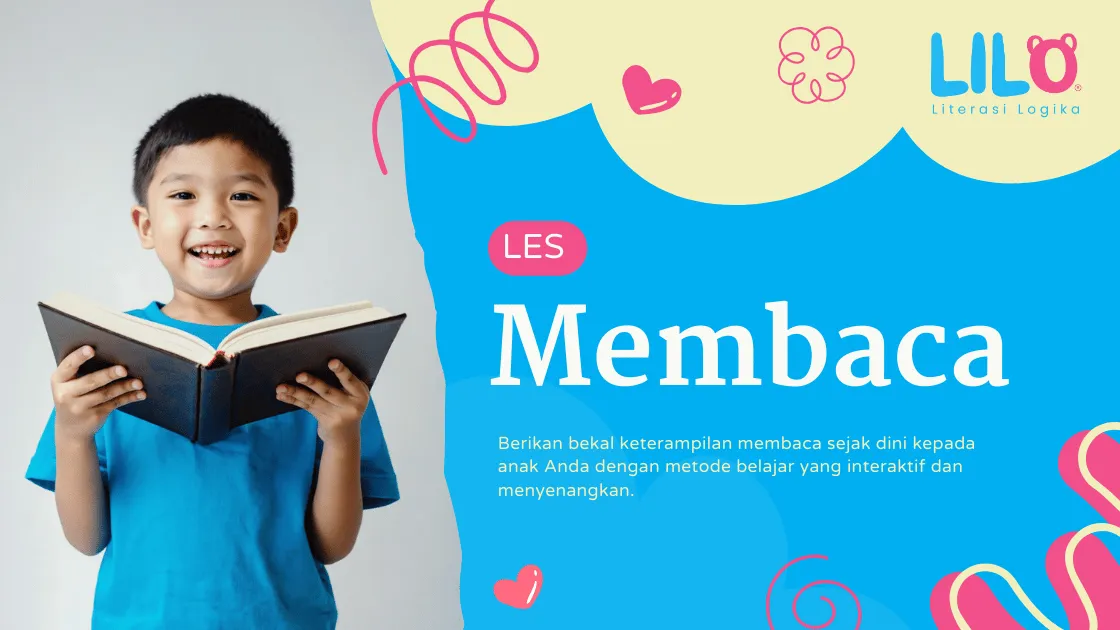
Reading Classes for Kids in Tangerang is Lilo's guided reading program for children aged 3 to 10, taught in English at home, in small groups, or online. Your child learns the sound each letter makes, blends sounds into syllables and words, and works through seven measured levels until consonant endings, letter combinations, and full passages feel easy. A placement assessment sets the right starting point.
Every child arrives at reading from a different door. The placement assessment finds where your child stands, and the program meets them exactly there.
Your little one is still far from books, and that is fine. At this stage children simply meet sounds through songs, cards, and play, so letters feel like friends long before reading begins.
Your child knows some letters and is curious about words. This is the golden window to blend sounds into syllables properly, so they walk into primary school already comfortable with reading.
Your child can read simple words but slows down or guesses at longer ones. The upper levels strengthen consonant endings, letter combinations, and full sentences until reading flows with confidence.
Some children pass through school without reading ever settling in. The program finds the exact level where things broke down and rebuilds from there, calmly and without any shame.
Every stage stands on the one before it, so the foundation has no gaps.
Readiness shows in how your child plays and listens. These signs are grouped by age, so you can guess roughly which stage your child will start from.
Children in Tangerang learn from 70+ selected reading tutors.
Some still studying, others graduated.
Every application reviewed
Each file is read by our team.
ID card and diploma verified
Identity and diploma are matched.
Tutor profile filled in
Available hours are noted down.
Trained before teaching
The step-by-step method is learned first.
Matching per child
The team scores every answer.
Want a different tutor? See our free tutor replacement promise
The first session feels like playing together, with no written test. The tutor raises the challenge gently and notes which game starts to feel hard.
The first week runs in the same order whether a tutor visits your home in Tangerang or your child joins online.
You share your child's age, their habits with books, and whether home or online suits you. From there the team finds a tutor who fits.
You can view the tutor's profile before the first session. For online classes, the link and worksheets arrive in advance through app.lilo.id.
Your child meets the tutor through sound games and cards. The level found that day becomes the starting point for every session after it.
The session ends with a recap and one task of about ten minutes, such as naming three things that start with /s/. Session two opens by talking it over.
The method is simple to explain and careful in practice: sounds first, one mastered stage at a time, with steady practice your child can actually enjoy.
Before any lesson, the tutor sits with your child to find their true starting level. Nobody repeats what they already know, and nobody is pushed past a gap that will hurt them later.
Your child learns the sound each letter makes, like /m/ and /a/, and blends those sounds straight into syllables. Spelling out letter names is skipped entirely, because it slows real reading down.
Progress is earned, never rushed. Your child moves to the next level only after the current one is solid, through steady practice built level by level, in small daily portions.
At the upper levels your child reads whole sentences and short passages, answers who-what-where questions, and retells stories, so reading becomes understanding instead of sound alone.
These four signatures shape every lesson, and they exist because the curriculum was built around the places where young readers genuinely struggle.
Every letter is taught as a sound your child can hear, say, and play with. Because sounds come first, blending into real words happens naturally instead of through memorized letter names.
Sounds are merged into complete syllables from the very beginning. Your child reads ma and bu as living units, which makes longer words feel like familiar building blocks.
The leveled readers contain only patterns your child has already mastered. Every page can be read independently, and that daily taste of success is what keeps a young reader going.
The stage with ng, ny, tr, and friends is the hardest in the whole journey, so the curriculum slows down here on purpose, with more practice, more patience, and more encouragement.
Each rung is a real stage in Lilo's own leveled curriculum, and your child climbs one rung at a time.
Many reading struggles come from well-meaning habits at home. Here are the ones we correct most often, and what to do instead.
Why it happensLetter names like a, bee, cee are labels, and labels refuse to blend. A child who says the names first has to translate twice before a word appears.
How Lilo helpsTeach the sound each letter makes and blend the sounds directly. The word emerges in one smooth motion, which is exactly how Lilo lessons work.
Why it happensA child can point to every letter on a poster and still read nothing, because shape recognition alone carries no sound to blend.
How Lilo helpsPair every shape with its sound from the first meeting, using sound cards and songs, so seeing a letter means hearing it too.
Why it happensA book full of unlearned patterns forces the child to guess. Guessing becomes a habit, and confidence quietly drains away.
How Lilo helpsUse leveled readers that contain only patterns already mastered. Your child reads every page alone, and success builds appetite for the next level.
Why it happensMonotony teaches a child that reading is a chore. A bored reader stops trying long before ability runs out.
How Lilo helpsKeep portions small, vary the activities with cards, songs, and stories, and let steady daily practice stay light enough to feel like a win.
The foundation of everything. Your child meets vowel and consonant sounds through cards and tracing, so every letter carries a sound they can actually hear and say.
Sounds join hands here. Your child blends open syllables, builds words of 2-3 syllables, and practices reading them smoothly until blending feels automatic.
The heart of this program's promise. Closed syllables, digraphs, clusters, and diphthongs are taken apart patiently, so the endings that trip most children become your child's strength.
Words grow into sentences of 4-10 words. Your child learns to honor punctuation, find natural intonation, and read aloud with a comfortable rhythm.
Mini stories bring it all together. Your child answers 5W questions, names the main idea, and retells what happened, proving the words truly landed.
A 4-year-old cannot yet stay with one thing for long. Tutors work with this by splitting each session into small activities that change quickly.
At four, a child's ability to steer their own attention is only beginning to form. They can be absorbed in something they love, then drop it the moment they tire. The signs are easy to spot: the body sways, the eyes wander, answers turn random. Holding a child in place past that point ties the new sound to boredom, so a session at this age is built from short activities threaded on one sound.
Take a session on the sound /m/. Your child sings a short song full of /m/, then stands up to hunt for things that start with it, like meja, a table, or mangkuk, a bowl. Next comes tracing m on a worksheet with one finger, then matching sound cards to pictures. Each switch changes posture and the way the sound is used, so attention refreshes while /m/ returns a dozen times without feeling repeated.
Throughout, the tutor reads those small signals. The activity changes before boredom arrives, and your child always stops while still succeeding, which is why the next session feels welcome. At home you will notice your child saying the new sound outside class, perhaps at the writing on a milk carton, and asking for the song again. Online, activities that get your child out of the chair keep the screen feeling like a playground.
These are real A5 pages from Lilo's own curriculum, exactly as children use them: sound cards from Level 0, syllable building from Level 1, reading sheets from Level 3, and a full passage with 5W questions from Level 6.
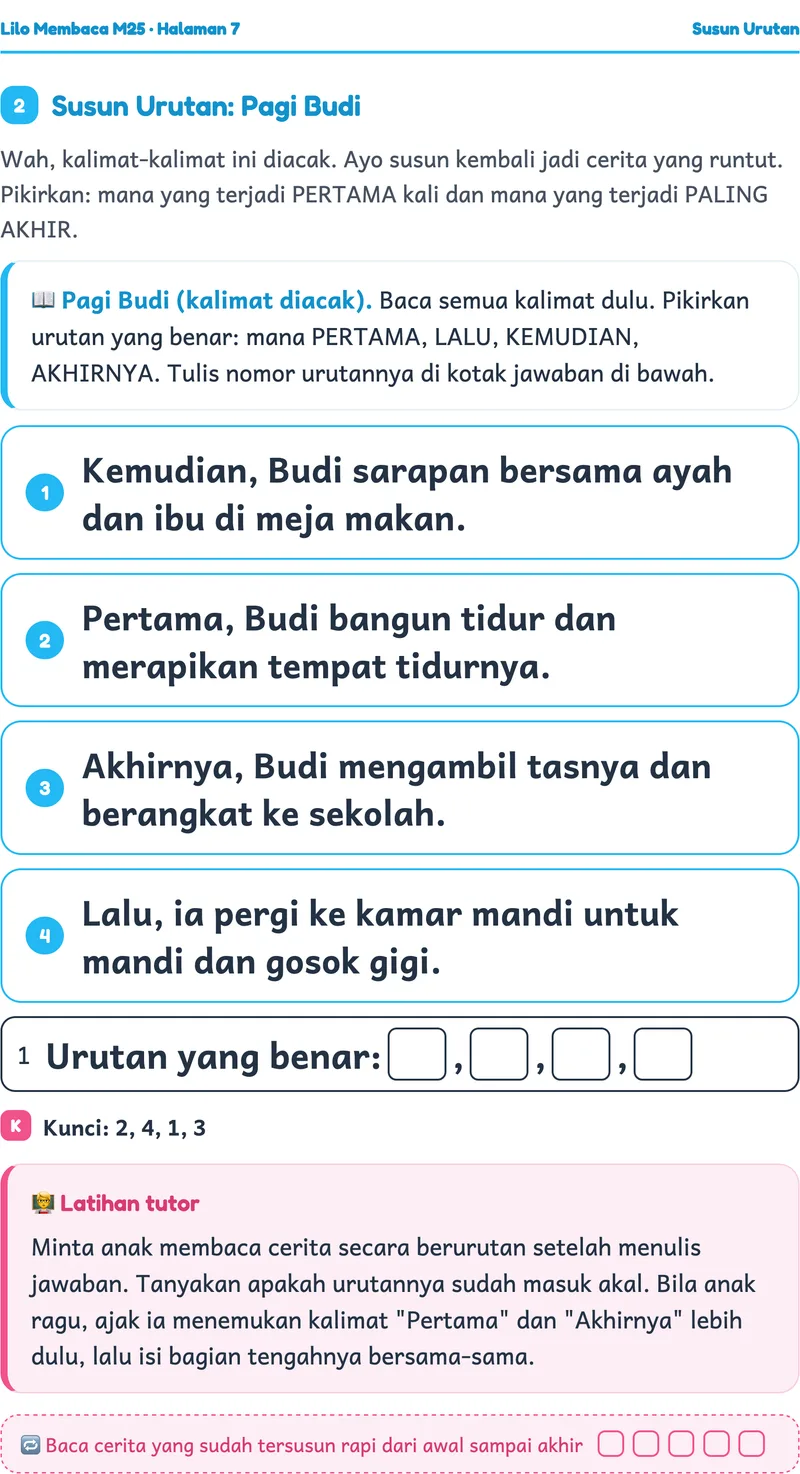
A real page from module 25: your child puts the events of a short story in order, training real comprehension before the independent reading graduation.
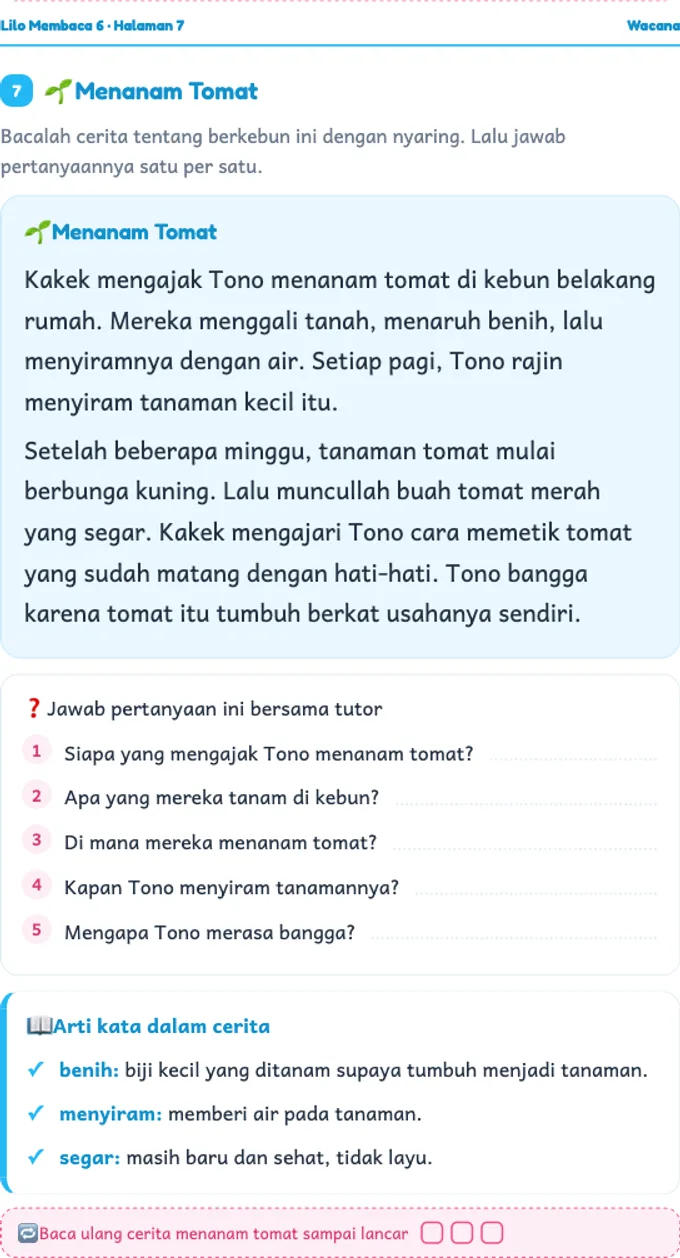
Grandma's Garden
That morning Tono went to the garden with Grandma. Grandma planted spinach and tomatoes. Tono watered the plants. They garden every Sunday. Tono is happy because Grandma's garden is thriving.
Children read a short passage, then answer five questions: what, who, where, when, and why. This Level 6 exercise builds real understanding of the text and the ability to retell the story in their own words.
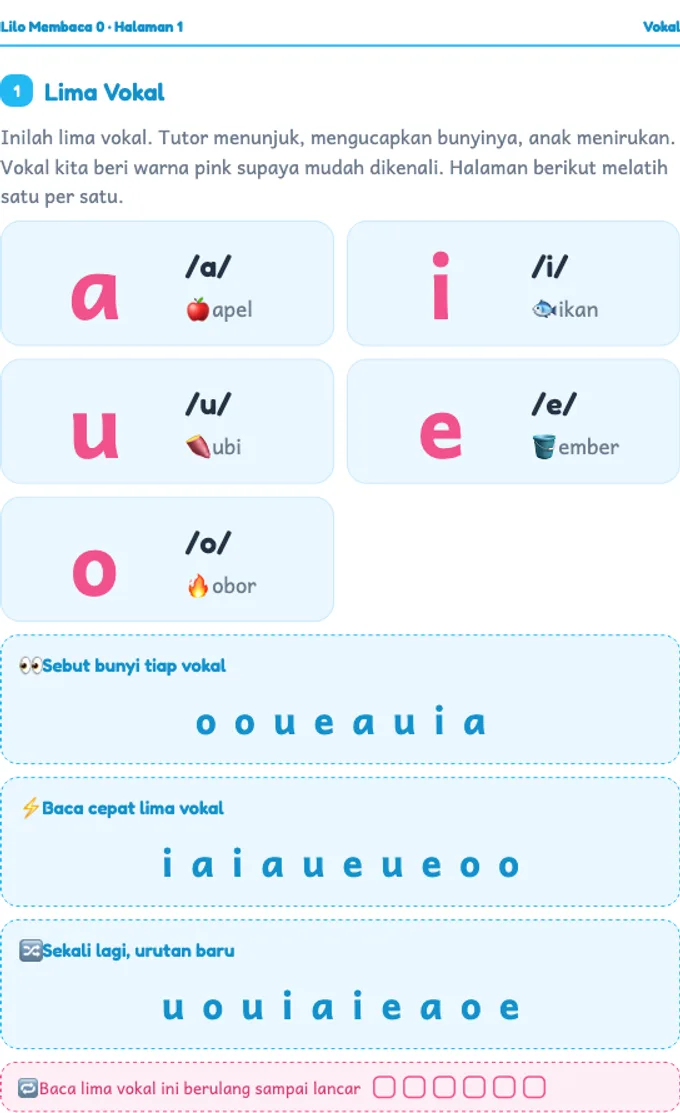
At Level 0, children meet letter sounds through simple cards: the vowels a i u e o and the consonants m, b, s. Each card is voiced again and again until it flows, then a quick reading drill locks it in.
Every sheet belongs to Lilo's original leveled curriculum of 122 modules, with hearty practice portions that grow with each child.
These four activities use things almost every home already has. Each one trains a clear reading stage in just a few minutes.
Write a, m and s in big letters. You say /m/ and your child jumps onto that letter, then you swap roles now and then. This L0 game ties sound to shape through movement.
chalk and a patio floor or board
Draw five boxes in a row holding ma, mi, mu, sa and su. Your child steps from box to box reading each aloud, practising the L1 skill of merging two sounds.
chalk and a long stretch of floor
Hold up one item and ask for its first sound: baju gives /b/, kaus gives /k/, topi gives /t/. A right answer earns the job of folding it, training the ear for L0.
a basket of dry laundry
Write cards for baju, rok, topi and kaus. Your child reads a card and lays it on the matching pile. Words ending in a consonant, like rok, suit a child at L3.
paper, a marker and folded clothes
This picture follows a 4-year-old learning online on the Regular plan, eight sessions a month, roughly twice a week. Your child starts from letter sounds and climbs Lilo's official ladder.
Your child meets a, i, u, e and o on screen and points to the right card when the tutor says it.
The sounds /m/, /b/ and /s/ join in. Your child fetches something from the room that starts with one and shows it to the camera.
Your child merges sounds into ma, bu and sa without naming letters, using worksheets printed at home.
Syllables link into mama, bola and sapu. Your child lights up on realising a card names something familiar.
More consonants are known, and a three-word sentence such as ini bola adik becomes your child's first whole read.
A child who already knows some sounds may pass through Month 1 faster, since the first session sets the starting point.
60, 90, or 120 minutes per session
Contact us
duration of 60, 90, or 120 minutes
Contact us
60, 90, or 120 minutes
Contact us
Families in Tangerang have several good ways to help a child read. Here is a fair side-by-side view, so you can choose with clear eyes.
| Aspek | Lilo | Learning Apps | Big Group Classes |
|---|---|---|---|
| How reading is taught | Letter sounds first, blended straight into syllables by a live tutor | Games and taps that introduce letters in a fun, self-paced way | One teacher presents to the whole room at a single pace |
| Measured levels | Seven defined levels with a placement assessment at the start | Progress bars, though levels rarely match a full reading journey | Usually one shared curriculum for every child in the class |
| When your child gets stuck | The tutor sees the exact stumble and fixes it in the same session | The app repeats the exercise and hopes the pattern clicks | Help arrives when the teacher can reach your child among many |
| Practice material | Leveled readers containing only patterns already learned | Colorful screens, with reading time competing with game time | Shared worksheets aimed at the middle of the class |
| Attention per child | 1-on-1 at home or a small group where every child is heard | Full attention from the screen, none from a caring adult | Attention divided across a large room of children |
A reading session can run one hour, an hour and a half or two hours, with prices beginning at IDR 76,865 per session. Payment covers a monthly package at once, sized by how many sessions suit your child. A tutor visits your home, or your child joins online through app.lilo.id, and each week's report shows the phonics level your child has reached.
Once a week, a gentle first taste of letter sounds with the tutor.
IDR 584,174Twice a week, the most chosen rhythm for steady progress through phonics levels.
IDR 1,149,085Three times a week, close practice that can climb several phonics levels.
IDR 1,694,733Six times a week, reading with the tutor almost every day.
IDR 3,216,100At home or online, the same.
Just tell us, any time.
How it works:
A full report follows each month.
Lilo teaches from its own original curriculum of 122 leveled modules across its programs. Every lesson your child receives was designed, tested, and sequenced on purpose.
Your child learns what each letter says and merges those sounds into syllables right away. Reading grows from hearing and blending, the way fluent readers are truly made.
A placement assessment finds the right start, and your child advances only when a stage is solid. Gaps never get carried forward to haunt harder levels later.
Verified tutors teach 1-on-1 at your home across Tangerang, from Karawaci to Ciledug, or meet your child online in lively interactive sessions.
Lessons move from real objects to pictures to symbols, the Singapore Math way of building understanding, so your child grasps ideas instead of memorizing shapes.
Lessons can be delivered in English or Indonesian, which suits bilingual and national-plus families who want reading taught in the language of their home.
Tangerang is a city in Banten Province, sitting right beside Jakarta on its western edge. It is widely known as Indonesia's air gateway, home to Soekarno-Hatta International Airport, the country's main door to the world. The Cisadane River flows through the city, and the historic Pasar Lama area carries a heritage the city proudly preserves. Its neighborhoods stretch from Karawaci and Cipondoh to Ciledug.
Lessons happen where your child already feels at ease. A Lilo teacher arrives at your Tangerang home carrying worksheets and hands-on learning tools, and sets the pace of each session by what your child can already do.
Children grasp ideas through objects they can touch, then pictures, then numbers and letters. This gradual path helps them truly understand, feel confident, and enjoy practicing every day.
If your child in Tangerang prefers learning through a screen, Lilo's online classes run live with a teacher, complete with worksheets sent to your home and regular progress updates for you.
Oliver read the writing on a cereal box by himself the other day, then gave the proudest smile. Little moments like that make me feel the lessons truly matter.
After classes here my child can now read fluently thanks to patient and professional guidance, and their confidence has grown too.
These questions are fair to ask any provider. The answers quickly show whether the classes fit your child's school and suit your child's age.
Children get confused when two methods clash, such as letter names at school and letter sounds in class. Ask how the teacher bridges them. Lilo's seven-level ladder keeps your child's position clear.
Kindergarten children learn through movement, while early primary children start needing table time to write. At Lilo the balance follows age, and young children alternate between moving and sitting.
Written tests make young children tense, so results drift. Look for a method that keeps your child relaxed. At Lilo, the starting point is found through games in the first session.
Early reading moves in small steps that are easy to miss. At Lilo the tutor's weekly report names them, for example ng now flowing while ny gets more practice.
Young children open up to someone who makes them feel safe. At Lilo you can view the tutor's profile first, and the tutor is replaced free of charge if the match is wrong.

Tell us about your child on WhatsApp and we will arrange a free consultation, find their true reading level, and match a tutor near you in Tangerang.
Free consultation, home or online