

Ages 3 to 4, meeting sounds through play
Your little one is still far from books, and that is perfectly fine. At this stage children meet letter sounds through songs, cards, and play, so sounds become familiar friends long before reading begins.
Your child learns to read step by step, starting with letter sounds and growing into sentences read aloud with natural pauses, clear punctuation, and a voice full of meaning.
Reading classes for kids in Tasikmalaya are Lilo lessons that teach children aged 3 to 10 to read, beginning with letter sounds and ending with whole stories read aloud with intonation and punctuation. Lessons run at home, in small groups, or online, and every child starts at the level that truly fits them after a short placement assessment.
Every reader starts somewhere different. The placement assessment finds the honest starting point, and these are the children we welcome most often.
Your little one is still far from books, and that is perfectly fine. At this stage children meet letter sounds through songs, cards, and play, so sounds become familiar friends long before reading begins.
Kindergarten years are the sweet spot for blending sounds into syllables and first words. Your child builds real reading skill calmly, so the first day of primary school feels exciting instead of scary.
Your child can read words but still sounds flat or choppy. This stage polishes longer sentences, punctuation, and intonation, so reading aloud becomes smooth, expressive, and genuinely enjoyable.
Some children reach school age before reading clicks. We meet them warmly, place them at the right level without shame, and rebuild the steps carefully so confidence returns along with skill.
The path is simple and honest: sounds first, then syllables, then sentences read with expression. Each step is mastered before the next one opens.
Before the first lesson, we check what your child already knows about sounds and letters. The result decides the exact level to begin at, so nothing is skipped and nothing is repeated needlessly.
Your child learns the sound each letter makes, like /m/ and /a/, instead of chanting letter names. Sounds blend straight into syllables, which is why reading clicks faster and feels logical.
Once sounds are solid, your child joins them into syllables, words, and short sentences. Leveled reading sheets contain only patterns already learned, so every page can be read successfully.
At the upper levels your child learns to pause at commas, stop at periods, and lift the voice for questions. Whole sentences turn into expressive reading and real understanding of the story.
The sequence is tight, so nothing gets skipped as your child moves up.
Reading readiness rarely arrives as one big moment. It shows up in small behaviours you can spot at home in Tasikmalaya, while your child chats, plays or points at print.
Tasikmalaya belongs to our West Java network: 800+ reading tutors. Some of them already live in Tasikmalaya.
Graduates and active students.
Application screening
Each file is read by our team.
ID card and diploma verified
Identity and diploma are matched.
Tutor profile filled in
Teaching experience and hours are recorded.
Trained in the Lilo method
Lilo guides and materials are provided.
Matching per child
Each candidate answer is reviewed.
Not the right fit? Read the tutor replacement guarantee
Children of four to six show what they can truly do when they feel relaxed. So the first session feels like play, and the tutor observes while joining in.
A child who feels tested often goes quiet or guesses wildly. Inside a game they dare to try, and the tutor sees what is already secure.
The tutor shows cards and asks for each letter's sound. A confident child is invited to blend two sounds into syllables like ba or mi.
Once syllables come easily, the game moves to whole words, then words ending in a consonant such as ikan. Where your child hesitates, lessons begin.
The level found sets your child's first module and worksheets. They start with reading they can conquer, so a feeling of being capable grows early.
Starting reading lessons in Tasikmalaya follows a clear order, so you know what happens from your first message to the first written update.
Share your child's age, the letters they know, and whether you prefer home visits or online classes. This free chat guides the tutor match.
Before the first session you can view the profile of your child's matched tutor, then agree a schedule that suits your home.
The tutor plays sound cards and word guessing to find the starting level, then sums up what your child knows and sets one small task.
A week later the first report reaches you. It might note that your child now blends /m/ and /a/ into ma without hesitating.
Tasikmalaya is a city in West Java widely known by its honored nickname, the city of santri. A living tradition of Quranic study gives daily life here a warm and devout atmosphere. The city is also proud of its reputation as a city of artisans, home to the famous payung geulis umbrellas and mendong woven crafts admired far beyond the region. Its areas include Cihideung, Cipedes, Tawang, Mangkubumi, Kawalu, Indihiang, Cibeureum, and Tamansari.
A Lilo teacher visits your house anywhere in our Tasikmalaya service areas. Your child settles in at the spot where they feel most at ease, and each session lets you see their growth up close.
Lessons are arranged in careful stages from the very basics. Children start with real objects, then pictures, then symbols, so they truly understand each step before moving up to the next one.
Each session uses structured worksheets with just the right amount of practice. Children build a steady learning habit, grow in confidence, and enjoy the process without ever feeling overwhelmed.
Lilo built its own leveled reading curriculum, and these signatures are the reasons children who learn with us read smoothly and with expression.
A child who follows punctuation with their voice is a child who truly understands what they read.
Every letter is introduced by its sound, never by chanting its name. Because your child hears /m/ and /a/ as sounds, blending them into syllables happens naturally instead of feeling like a puzzle.
Sounds flow straight into whole syllables without spelling drills in between. This keeps reading fast and logical, and it is the reason our learners rarely get stuck sounding out word by letter.
Our leveled readers contain only patterns your child has already mastered. Every page is a page they can finish alone, which turns each reading session into a quiet victory for their confidence.
Combinations like ng, ny, and tr trip up more children than any other stage, so our curriculum slows down here on purpose, with extra practice and extra patience until it truly sticks.
These seven rungs come directly from Lilo's own curriculum, and your child climbs them one mastered step at a time.
Most reading struggles trace back to a handful of well-meaning mistakes. Knowing them early saves your child months of frustration.
Why it happensA child who chants letter names has to translate them back into sounds before blending, and that extra step is exactly where many readers stall.
How Lilo helpsTeach the sound first. Once your child hears /m/ and /a/, joining them into a syllable is one natural motion.
Why it happensRecognizing shapes looks like progress, but a shape without a sound cannot be blended into anything, so reading never actually starts.
How Lilo helpsPair every shape with its sound from day one, using sound cards and tracing so eye, ear, and hand learn together.
Why it happensA book full of unlearned patterns turns reading into guessing, and repeated guessing quietly teaches a child that reading is scary.
How Lilo helpsUse leveled texts that contain only mastered patterns, then climb one level at a time as each stage is secured.
Why it happensYoung children learn through delight. When practice is monotonous, attention drifts, and the child starts avoiding books altogether.
How Lilo helpsKeep portions small and playful, with songs, cards, and short wins, so the daily routine feels like a game your child asks for.
Why it happensCombinations like ng, ny, and tr are the most common sticking point of the whole journey, and rushing them leaves a permanent gap.
How Lilo helpsSlow down at this stage on purpose. Generous, patient practice here is what separates hesitant readers from confident ones.
Your child meets vowel and consonant sounds through sound cards, songs, and letter tracing, building a strong ear for sounds before any reading is asked of them.
Sounds are joined into open syllables and then into words of 2 to 3 syllables, with timed reading sheets that make daily progress easy to see.
Your child conquers syllables with consonant endings, then the trickiest territory of digraphs, clusters, and diphthongs, taken slowly with generous practice at every step.
Sentences grow from 4 to 10 words while your child learns to follow punctuation, keep a steady rhythm, and read aloud with lively intonation.
Mini stories invite your child to answer who, what, when, where, and why, find the main idea, and retell the story in their own words.
At L6 Wacana, reading changes purpose and your child reads to understand. Here is what happens in their mind and the signs you can see yourself.
The first sign is that attention moves. At the early levels almost all of a child's effort goes into joining sounds. Once that becomes automatic, the effort is free for meaning. So an L6 reader can read "Kucing itu bersembunyi di bawah meja karena takut petir" and at once ask why cats fear thunder. That question is good news, because the mind is working on meaning while reading.
The second sign is self-correction. When your child misreads pasar as pasir, they pause because the sentence feels odd, then reread without being told. Tutors grow this habit through short stories and questions about the characters, the place, the time and the reason behind events. Your child also retells each story in their own words, since retelling demands holding both the order of events and the main idea.
The third sign appears at home. Your child picks up a book unprompted, reads easy parts silently and speaks again at a hard word. They can find the main idea of a paragraph and explain it in one sentence. Tutors check this with a short passage your child has never seen. Reading it smoothly, answering content questions accurately and retelling it in order marks an independent reader.
This picture describes a five-year-old who already recognises some letters or numbers and learns on the Regular package, about twice a week. The tutor tunes the pace to your child.
Your child pairs each familiar letter with its sound and fills in the vowels and first consonants still missing.
Ma, pi and bu are read as single sounds, then joined into short words such as mata and buku.
Every consonant sound is in place. Your child reads two and three syllable words and a first sentence of three words.
Closed syllables arrive in words like ikan and kapal, and your child learns to separate near twins such as kata and katak.
Words such as nyanyi and bunga get extra practice. The tutor slows down here until your child reads them steadily.
After L4 your child moves on to fluent sentences at L5 and story understanding at L6, as readiness allows.
These are real pages from Lilo's own curriculum, printed on A5 with generous practice portions. From letter sound cards to a full passage with comprehension questions, this is exactly what your child will hold and read.
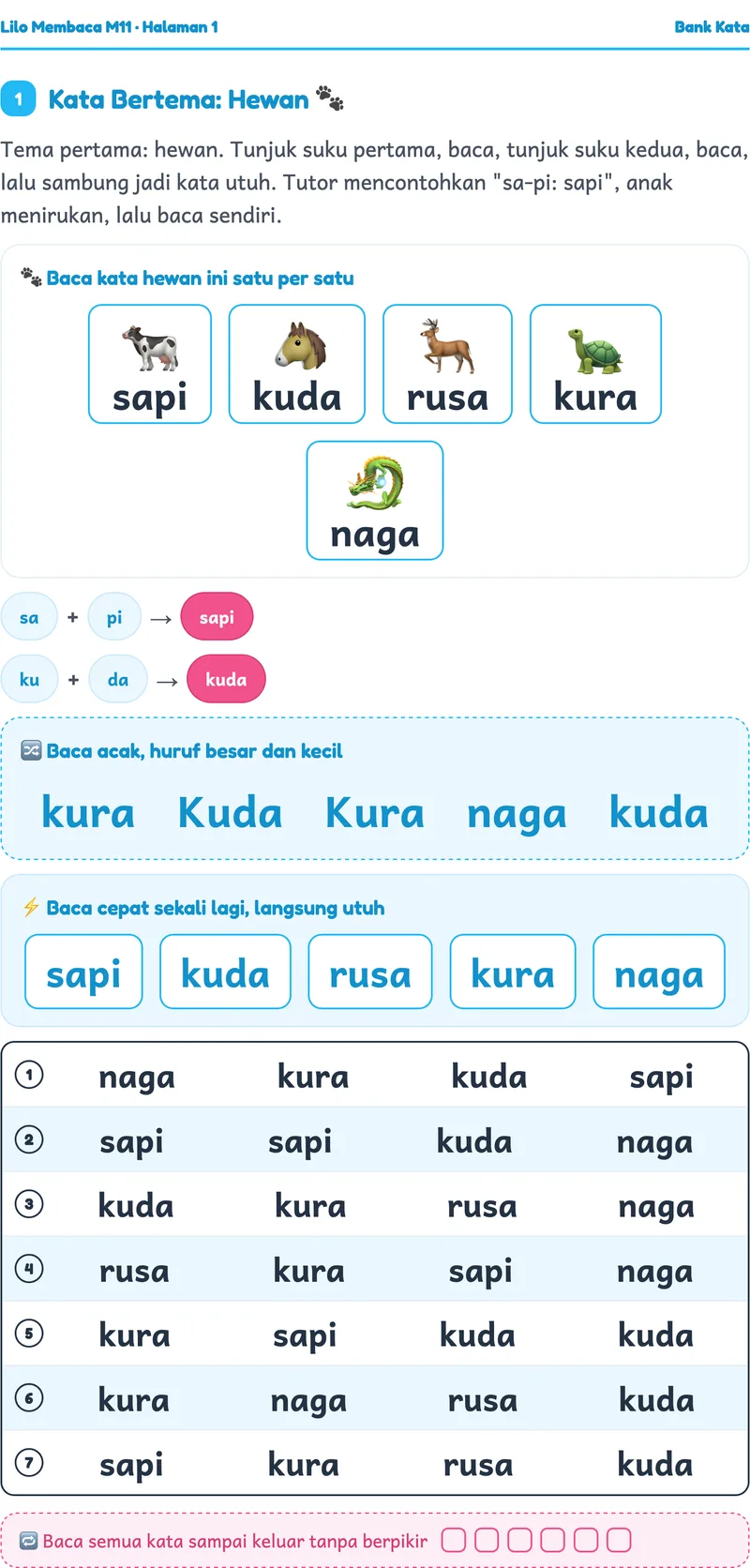
Sa-pi joins up to become sapi. That is how children work through this Level 1 sheet from module 11: pointing to each syllable, reading it aloud, then blending the pieces into whole themed words, with a speedy reading round at the end.
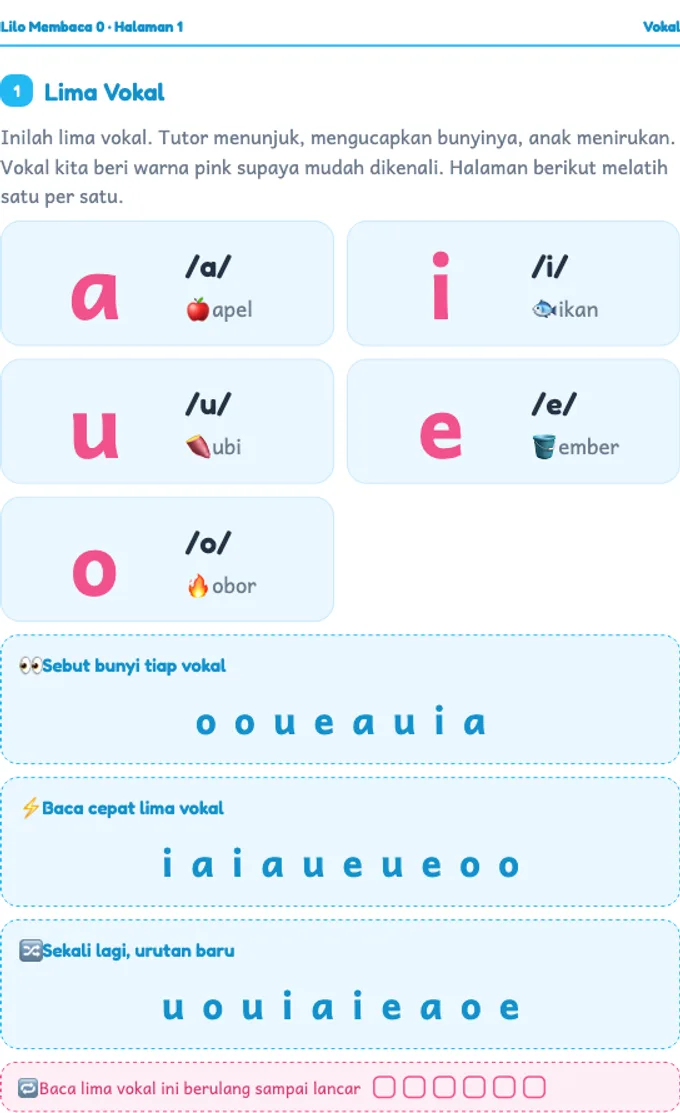
This Level 0 sheet shows cards for the vowels a, i, u, e, o plus the starting consonants m, b, and s. Children say each letter sound out loud, then practice quick reading. It is the foundation of our phonics method.
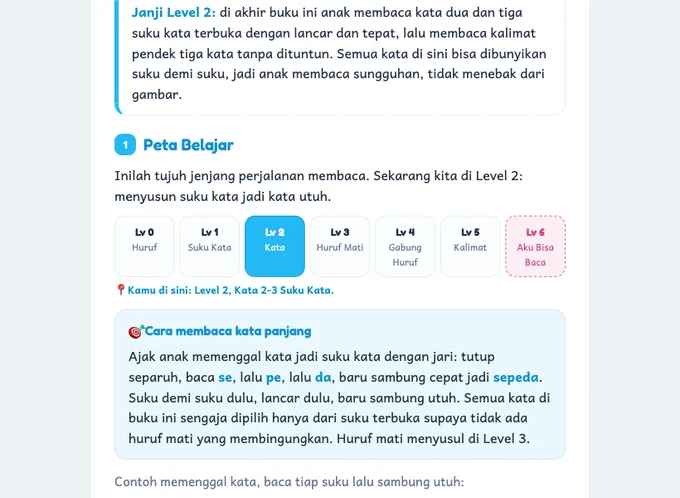
This Level 1 sheet is full of syllable pieces ready to be joined. From bo-la comes bola, from ma-ma comes mama. After hearing whole syllables from the tutor, children combine them into real words on their own, with no spelling out.
Every sheet belongs to Lilo's original leveled curriculum of 122 modules, with hearty practice portions that grow with each child.
The plants on your porch, the cat passing by and a busy kitchen hold plenty of words. These four activities use things already in your home.
Your child helps write plant names on labels, such as jahe or selada, then reads them at every watering. This strengthens L2, reading whole words of two or three syllables.
paper, marker, tape, plant pots
Say a first sound like /k/ and let your child find animals whose names begin with it: kucing, kura-kura, kelinci. This quick game tunes the ear at L0.
animal picture cards or toy animals
Write a three line recipe, such as kupas pisang, potong kecil, campur susu. Your child reads each line, then you do it together. Sentences with real purpose suit L5 well.
short handwritten recipe, banana, milk
Ask your child to find words with ng or ny on packaging, such as minyak, bawang or kangkung. Each find is circled and read aloud, a light way to support the demanding L4 stage.
spice packets, packaging, pencil
choose 60, 90, or 120 minutes
Contact us
60, 90, or 120 minutes per session
Contact us
duration of 60, 90, or 120 minutes
Contact us
These two points are easy to overlook when comparing lessons. Put the questions below to any provider before you enrol.
| Question to ask | Why it matters |
|---|---|
How often will I hear about my child's progress, and in what form? | Rare updates let problems surface months late, while regular ones help you practise along at home. At Lilo, every session closes with the tutor summing up what your child has mastered. |
Is progress measured against stages I can understand? | A vague "doing better" is hard to act on. Named stages show exactly where your child stands, and at Lilo the seven levels from L0 to L6 do that job. |
How do the lessons connect with the way reading is taught at my child's school? | Children get confused when school and lessons pull apart with no bridge, so ask how the tutor links them. At Lilo, learning through sounds and whole syllables prepares your child for reading in any classroom. |
Does the provider explain primary school entry rules honestly? | Entering grade 1 in Indonesia requires no reading, writing or arithmetic test, because selection uses age. Good lessons prepare a child calmly, and Lilo sets reading goals on that basis. |
What happens if the tutor is a poor fit for my child? | Fit shapes how bravely a child reads aloud, so ask how tutor changes work. At Lilo, a tutor who does not yet suit your child is replaced free of charge, a firm service promise. |
Every path can work for some families. Here is a fair look at how Lilo sits beside two common alternatives.
| Aspek | Lilo | Learning Apps | Big Group Classes |
|---|---|---|---|
| Who guides the child | A verified tutor who listens, corrects gently, and adjusts on the spot | The app itself, with no live ear for mispronounced sounds | One teacher shared among many children |
| Starting point | A placement assessment finds the exact level to begin | Usually one fixed starting path for everyone | The class starts wherever the group is |
| Reading aloud practice | Plenty of guided reading aloud, with intonation and punctuation coached live | Mostly tapping and listening, little speaking practice | Limited turns per child in each session |
| Pace | Your child moves up only after mastering a stage | Pace depends on the child's own taps and streaks | The group pace decides, ready or otherwise |
| Screen time | Learning happens at a real table with paper and a caring adult | Every minute of learning is a minute on a screen | Varies by class and school |
After a month of practice, your child brings home the habit of joining sounds into words and a few short texts they can read alone. Each meeting starts at IDR 76,865, and online classes are available at IDR 76,865 a session. Payment is made for one monthly package at a time, and a bigger package brings a lighter per-session price.
When your child simply wants to try reading with a tutor first.
IDR 307,460Already sure of the method, your child practises phonics twice a week.
IDR 604,782With a reading target in sight, three sessions a week keep momentum.
IDR 891,965To finish several levels, your child practises about six times a week.
IDR 1,692,684Included in every lesson package.
We find a replacement for free. Valid for as long as the package runs.
Here is how:
Topped up by a monthly report.
Lilo teaches from its own library of 122 leveled modules, built in-house. Every worksheet your child touches was designed for exactly the stage they are standing on.
We do not stop at recognizing words. Punctuation and intonation are taught openly at the upper levels, so your child reads aloud with a voice that carries meaning.
Following the Singapore Math way, ideas start with real objects, move to pictures, and only then to symbols. Your child understands what letters and words stand for.
Small daily portions, done consistently, beat occasional marathons. The routine is gentle enough for a young child and strong enough to build a lasting habit.
Verified tutors teach at home across Tasikmalaya, from Cihideung and Tawang to Mangkubumi and Kawalu, and bilingual instruction in Indonesian or English is available.
Each level must be genuinely mastered before the next opens. This protects your child from the quiet discouragement of facing texts they cannot yet handle.
Nadhira is getting fluent at sounding out syllables. What puts me at ease is that the lessons go step by step without pushing her. She actually looks forward to her lesson every week.
Reading classes at Lilo helped my child understand the content of a book really well. Their reading skills improved, very satisfying.

Start with a free consultation on WhatsApp. Tell us about your child, and we will suggest the right level and format for your family in Tasikmalaya.
Your child begins at the stage that fits today