
Ages 3 to 4: Meeting Sounds Through Play
Your child is curious about books but has never studied letters. We introduce sounds through songs and games, so the very first steps toward reading feel like playtime.
Your child begins with letter sounds, blends them into syllables, and climbs seven clear levels until short stories feel easy. Every stage mastered adds a little more courage to open the next book.
Reading Classes for Kids in Tegal is Lilo's phonics program that guides children aged 3 to 10 from their first letter sounds to reading whole passages on their own, through seven measured levels. A placement assessment finds the right starting point, and your child moves up only after truly mastering each stage, so confidence keeps growing with every step.
Every child arrives at reading on their own timeline. These are the stages we meet most often, and each one has a clear place in our seven levels.
Your child is curious about books but has never studied letters. We introduce sounds through songs and games, so the very first steps toward reading feel like playtime.
Kindergarten years are the sweet spot for learning to read. Your child builds from letter sounds to syllables to short sentences, arriving at first grade already comfortable with a book.
Your child can read but still stumbles, reads slowly, or skips understanding. We polish smooth sentences, punctuation, intonation, and real comprehension of what the words mean.
Some children reach school age before reading clicks. The placement assessment finds exactly where the gap is, and your child catches up step by step, with zero shame and plenty of encouragement.
Tegal is a city on the northern coast of Central Java, sitting along the pantura route, one of the key roads that links cities across Java. It is widely known for its warm poci tea tradition and its distinctive, friendly ngapak dialect. The city covers Tegal Barat, Tegal Timur, Tegal Selatan, and Margadana, with familiar areas such as Kejambon, Kraton, Pacul, and nearby Mejasem. Pasar Pagi remains one of the city's best known landmarks.
Your child learns at home within Lilo's Tegal service areas. A familiar setting helps children stay calm, and you can watch their progress up close in every single session.
Every lesson sits on a ladder of levels built for ages 3 to 10. Your child begins on the rung that suits them today and moves up slowly, so each idea settles in firmly.
Your child handles real things and looks at pictures first, then meets the numbers and letters. Seeing why a skill works helps it stay with them for good.
Each stage carries its own mark of completion, so progress stays visible.
Our method rests on a simple idea: children read confidently when every step is small enough to master completely before the next one begins.
Every child begins with a placement assessment. The tutor listens, observes, and places your child at the level where learning feels achievable from day one, never too easy and never overwhelming.
Your child learns the sound each letter makes, like /m/ and /a/, and blends those sounds straight into syllables. We skip letter-name spelling drills entirely, because sounds are what reading is built from.
Sessions use short, structured exercises with generous practice, steady practice built level by level, warm and playful. Small daily portions build skill without tiring your child out.
Your child only advances after truly mastering the current stage. Each level completed is a visible win, and that steady chain of wins is where reading confidence really comes from.
60, 90, or 120 minutes per session
Contact us
duration of 60, 90, or 120 minutes
Contact us
60, 90, or 120 minutes
Contact us
Five fair questions for any reading lesson provider.
| Question to ask | Why it matters |
|---|---|
Does the material follow coded levels I can see? | A coded sequence shows where your child stands and what comes next. At Lilo, your child climbs from L0 Bunyi Huruf to L6 Wacana. |
Where do the worksheets and texts come from? | Materials built on the sequence hold only mastered sounds. Lilo writes its own 122 coded modules, each worksheet drawn from the current one. |
How is the starting point decided? | The right start avoids repeating the known or skipping the shaky. At Lilo, the first session is a game with no written test. |
What does my child take home from each session? | A clear close shows progress. Lilo tutors sum up what was mastered and set one task of about ten minutes. |
What if my child and the teacher do not click? | The right match helps a child read aloud bravely. At Lilo, the tutor is replaced free of charge until it fits. |
These are the signatures of Lilo's reading program, refined across our own original curriculum and carried into every session in Tegal.
Children stop fearing books the moment every page in front of them contains only patterns they have already mastered.
Your child learns what each letter says, like /m/ and /a/, before learning what it is called. Sounds are the raw material of reading, so we start there and everything else follows naturally.
Sounds merge directly into whole syllables without a spelling detour. This keeps reading flowing forward, so your child experiences the joy of reading real words early in the journey.
Our leveled readers contain only patterns your child has already learned. Every book they open is a book they can conquer, and that quiet certainty is what builds a fearless reader.
Combinations like ng, ny, and tr are the hardest stage for nearly every child. We slow down here on purpose, with more practice and more patience, so no one gets stuck.
Every rung on this ladder is a real stage in our published curriculum, and your child climbs it one mastered level at a time.
Most reading struggles trace back to a handful of well-meaning mistakes. Knowing them early saves your child months of frustration.
Why it happensSpelling out letter names, like saying b-u-k-u, forces the child to translate names into sounds before every word, which stalls blending and makes reading feel like decoding a puzzle.
How Lilo helpsTeach the sound each letter makes and blend those sounds directly into syllables. The word appears in one smooth motion, and reading starts to feel natural.
Why it happensA child can recite the whole alphabet and still be unable to read, because shapes alone carry no sound. Reading only begins when a shape connects to what it says.
How Lilo helpsPair every letter with its sound from the very first lesson, using sound cards, songs, and tracing so the shape and the sound arrive together.
Why it happensA book full of unfamiliar patterns turns every page into a wall of defeats. Children conclude that reading is hard and that they are bad at it, which is the opposite of the truth.
How Lilo helpsUse leveled texts that contain only patterns your child has mastered. Every finished page becomes proof that they can read, and appetite for books grows on its own.
Why it happensCombinations like ng, ny, and tr are the single most common sticking point, because they break the one-letter-one-sound pattern the child has just learned to trust.
How Lilo helpsTreat this stage as its own level with extra time, extra practice, and extra patience, exactly as our Level 4 does, instead of pushing through it quickly.
Why it happensRepetition without joy makes a young child associate reading with boredom, and a bored child stops trying long before they stop being capable.
How Lilo helpsKeep portions small and mix structured practice with songs, cards, and games. Steady daily practice works beautifully when the child actually looks forward to it.
Near twin sounds cause the most stubborn early reading slips.
The sounds p and b come from two lips pressing and opening, while t and d come from the tongue tip on the ridge behind the top teeth. Only a buzz in the throat separates each pair, and young ears barely catch it, so dadu turns into tadu. The eyes struggle too, since b, d and p are one shape flipped, so bola becomes dola.
Double letters set another trap. In maaf, saat and taat, twin vowels sit side by side, and children melt them into one long sound, so maaf becomes maf. Each letter belongs to its own syllable, ma and af. Endings mislead as well, because jawab and abad are spoken like jawap and abat.
The tutor separates ear from eye. Your child touches the throat to feel the buzz of ba vanish in pa, while b and d are taught in different sessions until one is secure. The weekly report notes which pairs are steady, and at home you will see your child pause and self correct.
Your child meets vowel and consonant sounds through sound cards and letter tracing, building the ear for sounds that all later reading stands on.
Sounds join into open syllables, then into words of 2 to 3 syllables, with timed reading exercises that make blending quick and automatic.
Your child tackles closed syllables, then the trickiest patterns in reading: digraphs, clusters, and diphthongs, with plenty of guided practice at each one.
Reading grows from single words into smooth sentences of 4 to 10 words, with punctuation, intonation, and rhythmic reading that sounds natural and alive.
Mini stories bring everything together. Your child answers who, what, when, where, why questions, finds the main idea, and retells stories in their own words.
These are real pages from Lilo's original curriculum, printed on friendly A5 sheets with generous practice portions. Take a look at what your child will actually hold in their hands, from first sound cards to full passage comprehension.
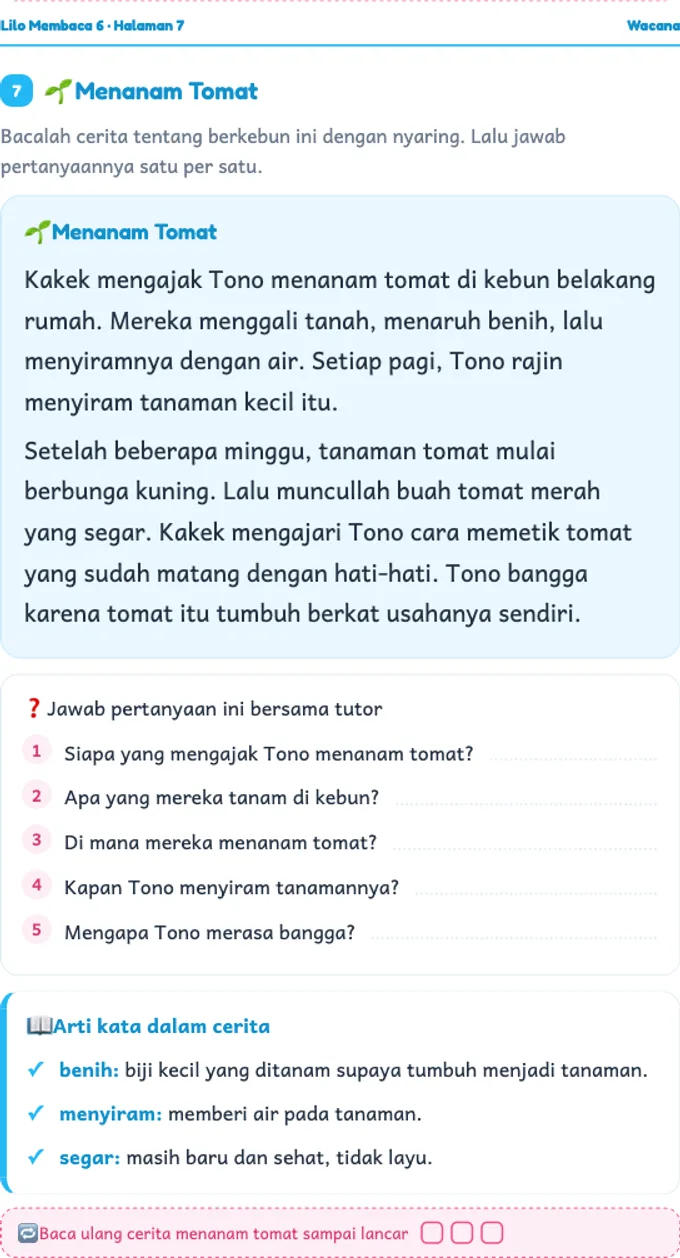
Grandma's Garden
That morning Tono went to the garden with Grandma. Grandma planted spinach and tomatoes. Tono watered the plants. They garden every Sunday. Tono is happy because Grandma's garden is thriving.
A short story sits beside 5W comprehension questions at Level 6. After reading, children work through what happened, who was involved, where, when, and why, then practice retelling the whole passage clearly.
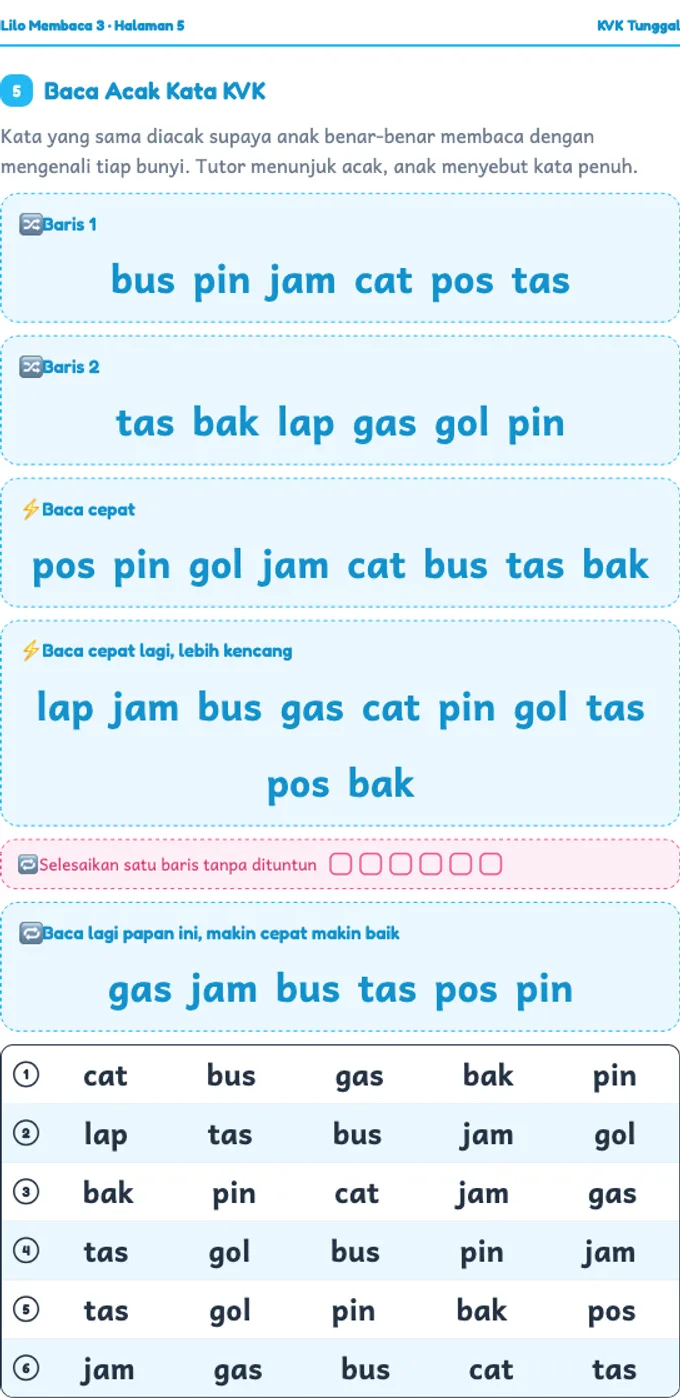
This Level 3 sheet challenges children to read a word grid quickly and repeatedly, with time recorded. Words such as tas end in a consonant, so children learn to notice the last letter while their reading grows smoother.
Children split and join open syllables, turning ma-ma into mama and bo-la into bola. The tutor models each whole syllable first, then the child blends them into a meaningful word, reading it straight through without spelling letter by letter. Level 1 practice.
Every sheet belongs to Lilo's original leveled curriculum of 122 modules, with hearty practice portions that grow with each child.
Look alike sounds stick fastest through the body and real objects.
At bath time, a palm on the throat feels ba buzz and pa stay still. Repeat with da and ta. Stage L0.
your child's palm
After a warm bath, finger write tu, du, pa and ba on the mirror for your child to read and wipe. L1.
a misted bathroom mirror
Your child finds garden things starting with b or p, like batu, bunga, pot and pasir, sorting each into a bucket. L2.
two small buckets
Chalk sebab, abad, jawab and sabtu outside. Your child jumps to each word you call, learning that an ending heard as p may be spelled b. L3.
chalk and a paved yard
Small habits in play and talk show when your child can begin and when a stage is firm enough to leave.
Tegal belongs to our Central Java network: 750+ early reading tutors. Online classes in Tegal are always open.
Graduates and current students alike.
Every application reviewed
Suitable applicants move forward.
Documents verified
Identity and diploma are matched.
Experience and hours recorded
We know when each tutor is free.
Trained before teaching
Teaching starts after training.
Matching per child
Candidates answer questions about the child.
Want a different tutor? Free tutor replacement, here is how
A little preparation makes day one easy, at home in Tegal or online.
You can view the tutor's profile before day one. Show your child the photo so the visitor feels familiar.
A low table, side light and the television off make small differences like p and b easier to hear.
Note three to five words where your child stops or swaps letters, so the tutor knows where to look.
The link and worksheets arrive before class. Print the sheets and test sound and camera a little early.
The first session is a game with no written test, and the tutor watches it closely.
When the b card appears, does your child say a short b sound or the letter name? It reveals a settled habit.
Near twins like paku and baku, dua and tua hide in a guessing game. Mixing them earns listening practice first.
Many children read smoothly to a point, then guess from the first letter. That point is where lessons begin.
Some children self correct, others go quiet. The tutor uses this to set the pace and the amount of praise.
A seven year old who reads simple words and wants fluency, on Intensive: 12 sessions a month, about three a week.
Words like sabtu, kapal and jawab are read whole, and jawap spellings fade.
Your child practises ng, ny, kh and sy in nyamuk and khusus until they stick.
Four to six word sentences come with pauses at commas and a lift at questions.
Ten word sentences flow in one calm breath, even on snack wrappers.
Your child reads a one page story and retells it in their own words.
The tutor tunes the pace each session to fit this general path.
Every path can work for some families. Here is an honest look at how a guided, leveled program differs from two common alternatives.
A verified tutor who listens and adjusts in real time
A placement assessment finds the exact right level
The tutor notices immediately and gives extra care
Moves up only after mastering each of 7 levels
Leveled readers built from patterns already learned
Once a week, twice, three times or as often as six times, your child's reading schedule can be as close as needed, and twice a week is the rhythm chosen most. Payment covers one monthly package at a time, with each session priced from IDR 76,865. Along the way your child climbs the phonics levels L0 through L6 with one tutor.
An introductory step, once a week, while your child settles in with the tutor.
IDR 307,460Twice the meetings of Trial, keeping word-building practice steady through the month.
IDR 604,782One step closer than Regular, three times a week to climb phonics levels steadily.
IDR 891,965Double the pace of Intensive, nearly daily, the longest runway toward reading stories.
IDR 1,692,684Written into the Lilo Terms of Service.
One WhatsApp message is enough. Valid for as long as the package runs.
Here is how:
Plus a monthly progress report.
Lilo teaches from its own curriculum of 122 leveled modules across all programs. Your child follows a tested path, and you can see exactly where they stand on it.
New ideas start with things your child can touch and see, move to pictures, and only then become letters and words. This is the Singapore Math way of building real understanding.
Our tutors are verified before they ever meet your child, and they teach at your home across Tegal, from Tegal Barat and Tegal Timur to Margadana and Mejasem.
Your child never gets rushed past a shaky stage. Each level is fully mastered before the next begins, so confidence is built on solid ground instead of gaps.
Sessions can run in Indonesian or English as the language of instruction, a natural fit for bilingual and national-plus families who want reading skills to grow in both worlds.
At first I was unsure about online lessons for a child Mazaya's age. It turns out she stays focused and clicks with her tutor. Now she knows her letter sounds and is starting to blend simple words.
Sharon loves having us read the first page, then she reads the next one herself. It is so sweet to see her that confident now.

Start with a free consultation on WhatsApp. Tell us about your child, and we will recommend the right level, format, and schedule for your family in Tegal.
Free WhatsApp consultation, no obligation