

Little listeners, ages 3 to 4
Your child is at the pre-reading stage and meets sounds through play. Songs, sound cards, and short playful moments introduce the five vowel sounds long before any pressure to read appears.
Lilo teaches children aged 3 to 10 to read through letter sounds, gentle blending, and short daily practice, so reading becomes something your child does happily every single day.
Reading classes for kids in Yogyakarta from Lilo are guided lessons that teach children aged 3 to 10 to read, beginning with letter sounds and growing into full passages. A tutor meets your child at home, online, or in a small group, and short daily practice portions turn each lesson into a reading habit that lasts.
Every child arrives at reading from a different place. A placement assessment at the start finds the exact stage, so lessons feel comfortable from day one.
Your child is at the pre-reading stage and meets sounds through play. Songs, sound cards, and short playful moments introduce the five vowel sounds long before any pressure to read appears.
Your child is getting ready for primary school. Lessons move from letter sounds to blending syllables and reading simple words, with small daily portions that feel like a game and quietly become a habit.
Your child can read a little and now needs fluency. Practice moves through letter combinations, longer sentences, and short passages, so reading aloud becomes smooth, expressive, and enjoyable.
Some children reach school age before reading clicks. The placement assessment finds the missing stage and rebuilds from there, so your child catches up steadily and without shame.
Readiness shows differently at each age. Watch how your child plays, talks and notices print, then find the matching group.
Our Yogyakarta network holds 1,400+ tutors for young readers.
Graduates and active students.
Application screening
Our team reads every application.
ID card and diploma verified
Diploma and ID are reviewed.
Teaching profile completed
Teaching history goes into the portal.
Learning the Lilo method first
Phonics and CPA come first.
Chosen for your child
The team scores every answer.
Tutor not quite right? Read the tutor replacement guarantee
The first session is a game with no written test. Its short notes show which stages are solid and where your child begins.
The tutor says /s/ and your child finds a picture that starts with that sound. The notes list which sounds come easily.
Your child joins bu and ku. Saying buku straight away marks L1 as solid, and spelling it letter by letter gets noted.
Words like sambal and nyanyi test L3 and L4. The letter where your child pauses marks the starting point.
A smooth word reader gets two sentences and a question about them, so the notes can separate sounding out from understanding.
Every session follows the same path, at your home in Yogyakarta or online, so your child knows what comes next.
Easy chat first, then a quick sound game from the last stage that wakes up memory before anything new arrives.
The tutor introduces one pattern, say ny, and your child builds nyamuk and nyala. One pattern leaves time to master it.
Your child reads a worksheet built only from sounds already mastered, so every line can be finished without help.
The tutor names what your child mastered today and sets one small task of about ten minutes for home.
Our method keeps every step small and clear. Your child masters one stage, feels the win, and comes back tomorrow wanting a little more.
Before the first lesson, we check exactly where your child is on the reading journey. Lessons then begin at the right stage, so practice feels doable instead of discouraging from the very first day.
Your child learns the sound each letter makes, like /m/ and /a/, so blending comes naturally later. We skip letter-name spelling drills entirely, because sounds flow straight into syllables.
Sounds join into syllables, syllables into words, and words into sentences. At the upper levels your child reads whole sentences and passages with real understanding, and moves up only after mastering each stage.
Steady practice built level by level, served in small daily portions. A short, friendly session each day builds the reading habit far better than one long, tiring weekly marathon.
Every stage stands on the one before it, so the foundation has no gaps.
Your child meets the sounds of language first, through vowel and consonant sounds, sound cards, and letter tracing, building the ear before the eye.
Sounds join into open syllables and grow into words of 2 to 3 syllables, with timed reading that makes daily practice feel like a friendly game.
Your child conquers closed syllables, then the trickiest patterns in reading: digraphs, clusters, and diphthongs, taken slowly and with plenty of encouragement.
Practice moves to sentences of 4 to 10 words, with punctuation, intonation, and rhythmic reading, so your child sounds confident and natural aloud.
Mini stories bring everything together. Your child answers 5W questions, finds the main idea, and retells the story, proving true understanding of what was read.
These are the signature techniques our tutors bring to every session, drawn from Lilo's own original curriculum of 122 leveled modules.
A child who reads a small amount successfully every day will outgrow a child who struggles through long lessons once a week.
Your child learns what each letter says, like /m/ and /a/, before anything else. This gives blending a solid floor, so words later feel like puzzles your child already knows how to solve.
Sounds glide straight into whole syllables, with zero letter-name spelling drills along the way. Reading becomes one smooth motion, which is exactly what daily practice needs to feel light.
Our leveled readers contain only the patterns your child has already mastered. Every page can be read independently, and that daily taste of success is what keeps the habit alive.
Combinations like ng, ny, and tr trip up more children than any other stage. We slow down here on purpose, giving extra practice and patience until these patterns feel easy.
Each rung is a real stage in Lilo's curriculum, and your child climbs to the next one only after truly mastering the current one.
Most reading struggles come from a handful of well-meaning habits. Knowing them early saves your child months of frustration and keeps the daily habit joyful.
Why it happensReciting names like 'em' and 'a' adds an extra step the brain must undo before blending, so reading stalls right at the start.
How Lilo helpsTeach the sound each letter makes and blend those sounds directly into syllables. This is how every Lilo lesson works from day one.
Why it happensA child who recognizes shapes without sounds is naming pictures. When words appear, there is nothing to blend, and confidence drops fast.
How Lilo helpsPair every letter with its sound from the first meeting, using sound cards and songs, so shape and sound arrive together.
Why it happensA book full of unlearned patterns forces guessing. Guessing feels like failing, and a child who feels like a failure avoids books.
How Lilo helpsUse leveled readers that contain only mastered patterns. Your child reads alone, succeeds daily, and asks for the next book.
Why it happensMonotonous drilling without play makes reading feel like a chore, and children quietly resign from chores.
How Lilo helpsKeep portions small, mix in songs, cards, and timed games, and stop while it is still fun. Tomorrow's session then feels welcome.
Why it happensThese combinations are the most common sticking point in the whole journey, and rushing them leaves cracks in everything built afterward.
How Lilo helpsSlow down at this stage on purpose. Lilo gives Level 4 extra care, extra practice, and extra patience until the patterns feel easy.
The first book a child finishes without help leaves a lasting mark. The key is a match between the book and the sounds already mastered.
While reading, your child holds sounds in short-term memory while blending them, and that memory holds only a little. If a page carries four words your child cannot yet sound out, the space fills with guessing and the story slips away. A page of mostly readable words leaves room for meaning, so a good first book feels slightly easy to an adult.
You can test a book yourself in the shop. Open a middle page, ask your child to read it aloud and count the words that cause a long stop. One or two means the book fits. More means save it for reading together first. At L2, words like mata and sapu flow, while nyanyian and traktor turn friendly after L4.
The tutor works the same way. Numbered reading sheets use only mastered sounds, so finishing a page alone becomes normal. Once your child reads them without pausing, the tutor suggests storybooks with similar patterns. You will see the sign at home: the book comes off the shelf again the next day, and your child laughs at the funny part.
These are real A5 pages from Lilo's original curriculum, with generous practice portions on every sheet. From letter sound cards to a full passage with 5W questions, this is exactly what your child will hold each day.
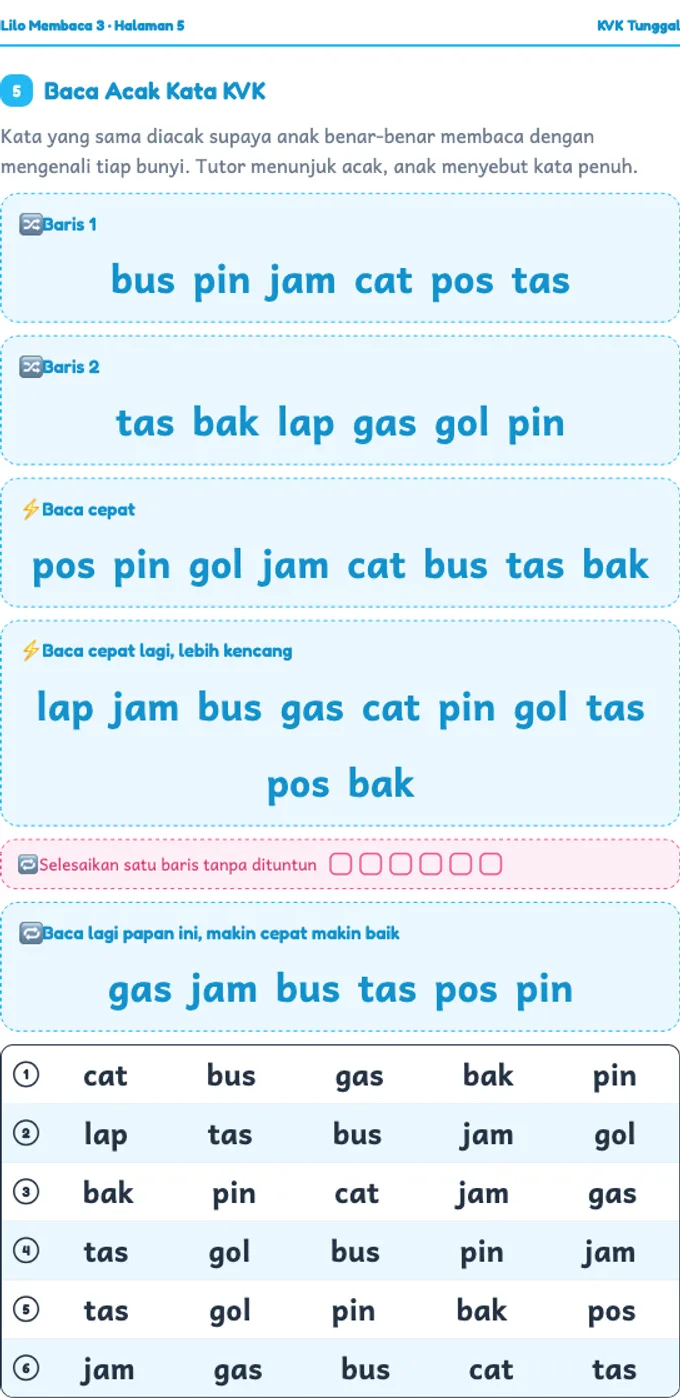
This Level 3 sheet challenges children to read a word grid quickly and repeatedly, with time recorded. Words such as tas end in a consonant, so children learn to notice the last letter while their reading grows smoother.
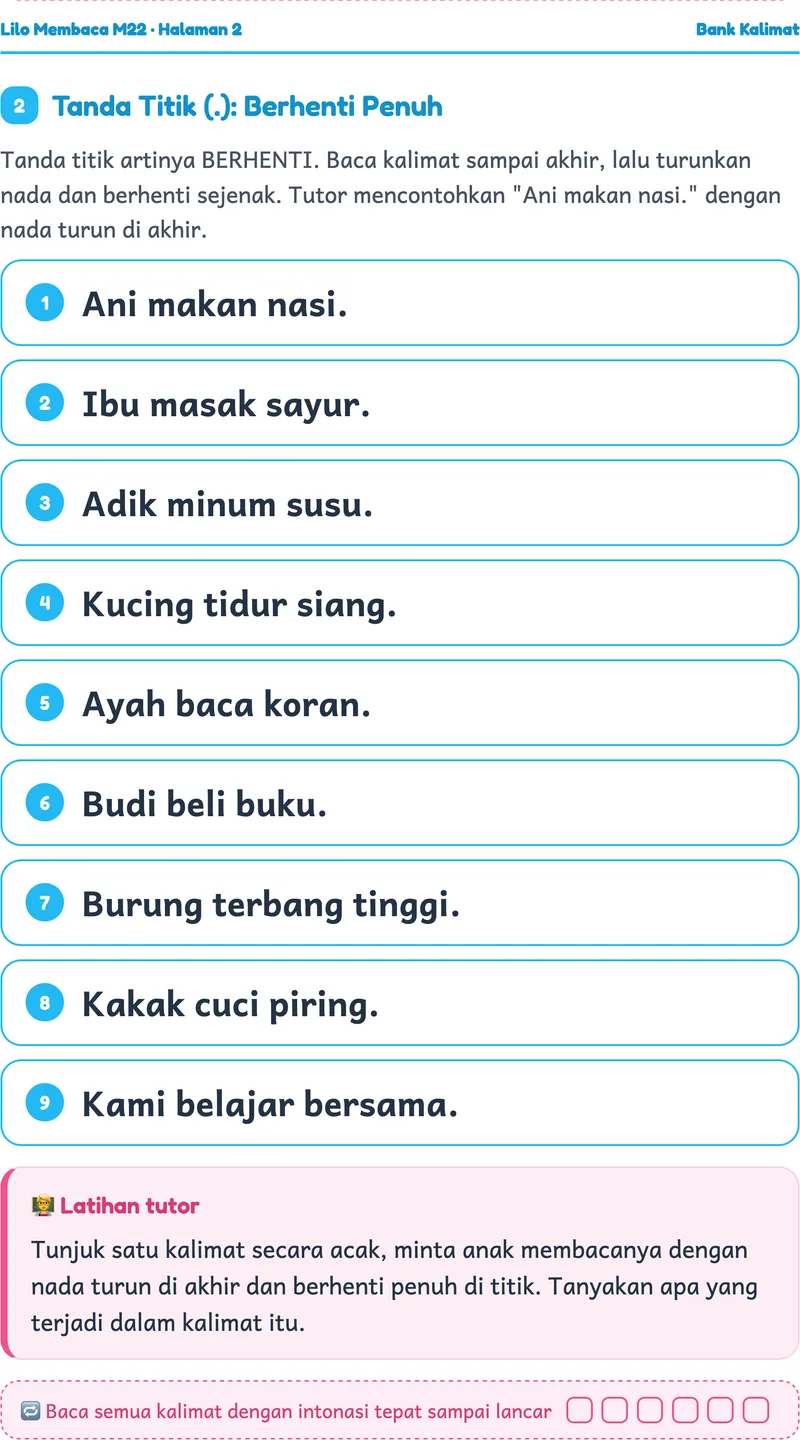
Stop fully at the period, then carry on with a lively voice. That is the heart of this module 22 sheet at Level 5, where children read sentences with expression as a bridge to fluent reading.
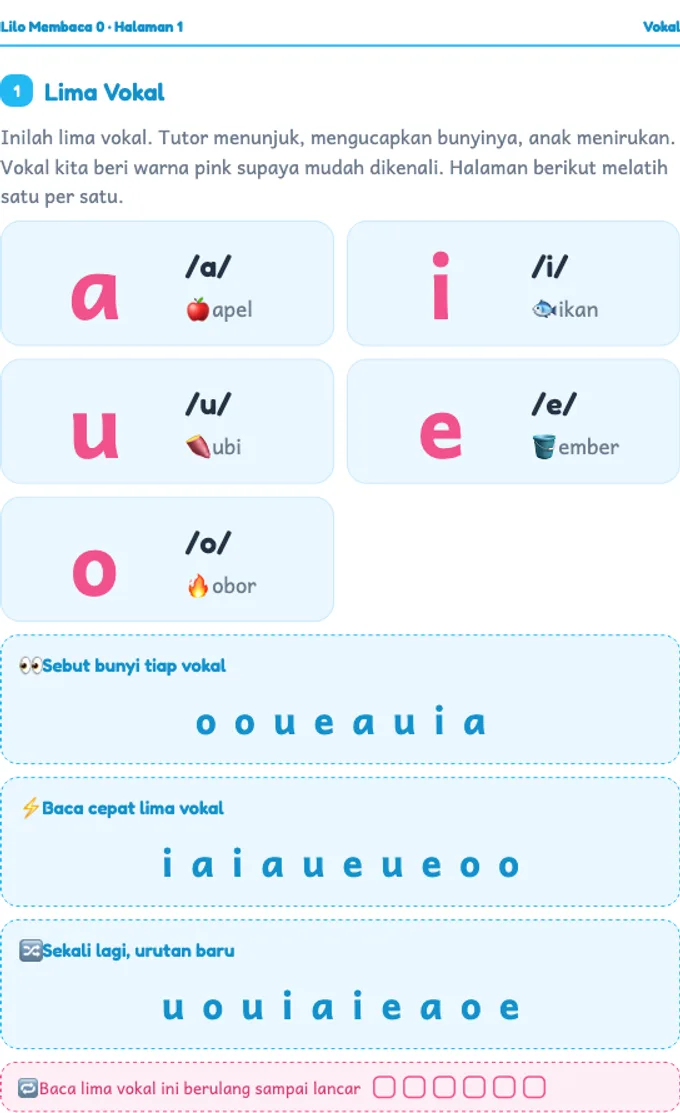
Five vowels with their sounds plus fast reading. Your child learns each letter's sound, /a/ and /m/, before its name. This is the heart of the phonics method.
These samples are a small slice of 122 original modules, arranged step by step from letter sounds to full comprehension.
The garden and the dining table are full of sounds and words. Each activity trains one clear stage.
| Activity | Time | What you need |
|---|---|---|
Sound hunt in the gardenSay one sound, like /b/, and send your child round the garden to find things that start with it: batu, bunga, bambu. This trains L0. | 10 minutes | Things in the yard or garden |
Plant name sticksWrite open-syllable plant names on sticks, like cabe, sawi and labu. Your child reads each one and plants it in the right pot. Suits L1 and L2. | 15 minutes | Ice cream sticks, marker, plant pots |
Reading packets at mealsPoint to one word on a packet at the table for your child to read. Words like minyak and bawang suit a child at L4. | 5 minutes | Soy sauce bottle, tea or biscuit packet |
A sentence about today's mealWrite one sentence about the meal, like Kakak menggoreng tempe tadi pagi. Your child reads it aloud and answers one question about it. Targets L5. | 10 minutes | Small paper and a pencil |
A picture for an 8-year-old who reads words but stumbles on letter combinations and long sentences, on the Regular package of eight sessions a month.
Back to ng, ny, kh and sy. Your child reads bunga and khusus until they flow without a pause.
Words like truk and plastik join practice, each cluster read as one blended sound.
Sentences of eight to ten words, with a pause at each comma and a lift at each question.
Your child reads a paragraph aloud. Any word that causes hesitation becomes the next warm-up.
Your child reads a story alone, answers questions about the characters and their reasons, then retells it.
Each code passed marks a skill that is now solid, so the next level starts on firm ground.
60/90/120 minutes
Contact us
choose 60, 90, or 120 minutes
Contact us
60, 90, or 120 minutes per session
Contact us
These are fair questions for any tutoring provider. The answers show how closely a teacher follows your child.
Small slips in reading aloud, like ng read as n, are caught by an ear tuned to one child. At Lilo, private lessons are one tutor, one child.
Background shows how a teacher understands children. Many Lilo tutors studied primary or early childhood teaching, psychology or maths, and profiles are open beforehand.
Regular reports tell you early when your child stalls at a stage, so home practice can aim there too. Lilo tutors report every week.
A comfortable child dares to read aloud and make mistakes, so ask how a teacher is changed. At Lilo, the tutor is replaced free of charge.
Texts that leap to new patterns push a child into guessing and tiredness. Lilo worksheets come from 122 coded modules of its own curriculum.
Yogyakarta serves as the capital of DI Yogyakarta, and across Indonesia people call it the City of Students. The name comes from a long history of schooling. The Tamansiswa movement began here, and it treats knowledge as something a person carries for life. Students from every corner of the country have come to Yogyakarta for decades, and that love of learning still runs through its streets. You can see it each day in Gondokusuman, Umbulharjo, Kotagede, and Depok Sleman. Lilo helps your child in Yogyakarta grow in reading, writing, and math. A teacher can visit you at home, or your child can learn in online lessons.
Children in Yogyakarta learn through a steady sequence: real objects first, then pictures, then letters and numbers. This order helps a child grasp the reason behind each idea, so the learning truly sticks.
Lessons are arranged in levels from the simplest skills to more challenging ones. A child moves up only when truly ready, so every step feels light and confidence grows naturally along the way.
Each meeting includes short, structured practice, pitched at your child's current level and delivered with warmth. Small daily portions help a child's skills grow steadily and comfortably.
Every approach can help a child. Here is an honest look at how guided, leveled lessons compare with two common alternatives.
| Aspek | Lilo | Learning Apps | Big Group Classes |
|---|---|---|---|
| How reading is taught | Letter sounds first, blended step by step through 7 measured levels | Fun taps and games, though the path can jump around | One lesson plan delivered to the whole room at once |
| Attention on your child | A live tutor watches, listens, and adjusts in the moment | The screen responds, and a screen cannot hear blending mistakes | Teacher attention is shared among many children |
| Daily practice rhythm | Small daily portions designed to become a habit | Easy to open daily, easy to close after one minute too | Practice usually happens only on class days |
| When your child gets stuck | The tutor finds the exact stage and rebuilds from there | The app repeats the same hint it gave before | The class moves on according to schedule |
| Measuring progress | Placement assessment plus clear level-ups after real mastery | Stars and streaks, which measure taps as much as reading | Report cards at the end of a term |
A free WhatsApp consultation comes first: tell us how your child reads today, and we match a tutor from our Yogyakarta network. Payment is made one monthly package at a time, with sessions priced at IDR 76,865 and up. Across the package your child moves from one phonics code to the next, L0 up to L6, as readiness allows, at home or online.
The tutor listens to how your child hears sounds and sets a starting code.
IDR 307,460Twice a week, the tutor practises blending with your child and logs each gain.
IDR 604,782Three weekly sessions of reading aloud help your child climb several codes in close succession.
IDR 891,965The tutor reads alongside your child almost daily, from first sounds to storybooks.
IDR 1,692,684At home or online, the same.
One WhatsApp message is enough. Valid for as long as the package runs.
Here is how:
Topped up by a monthly report.
Lilo teaches from its own original curriculum of 122 leveled modules. Every lesson your child receives was designed as one step in a complete, carefully ordered journey.
Small practice portions, texts your child can read alone, and a clear next level. Everything is designed so your child wants to come back to reading tomorrow.
We teach the Singapore Math way, said simply: your child touches and sees ideas before meeting them as letters on a page, so understanding comes before memorizing.
Every Lilo tutor is verified, and instruction is available in Indonesian and English. Your child gets a warm, capable guide who fits your family's language at home.
Tutors visit homes in Gondokusuman, Umbulharjo, Kotagede, Depok Sleman, and surrounding areas. Online sessions reach every family in Yogyakarta, wherever you live.
The placement assessment shows where your child starts, and each level-up marks real mastery. You watch the journey happen instead of wondering whether lessons are working.
Sharon loves having us read the first page, then she reads the next one herself. It is so sweet to see her that confident now.
Lilo Reading Classes made such a difference for my child. The method really works, and their reading has come on so much. We're so happy with it.

Tell us about your child in a free WhatsApp consultation. We will suggest the right starting level and the learning option that fits your family in Yogyakarta best.
Free consultation, start anytime