
Is new to letters
- Names the letters without knowing their sounds
- Has never blended two letters into one sound
- Is four or older and curious about print
One complete reading path, from recognising letter sounds to reading a story alone and answering questions about it.
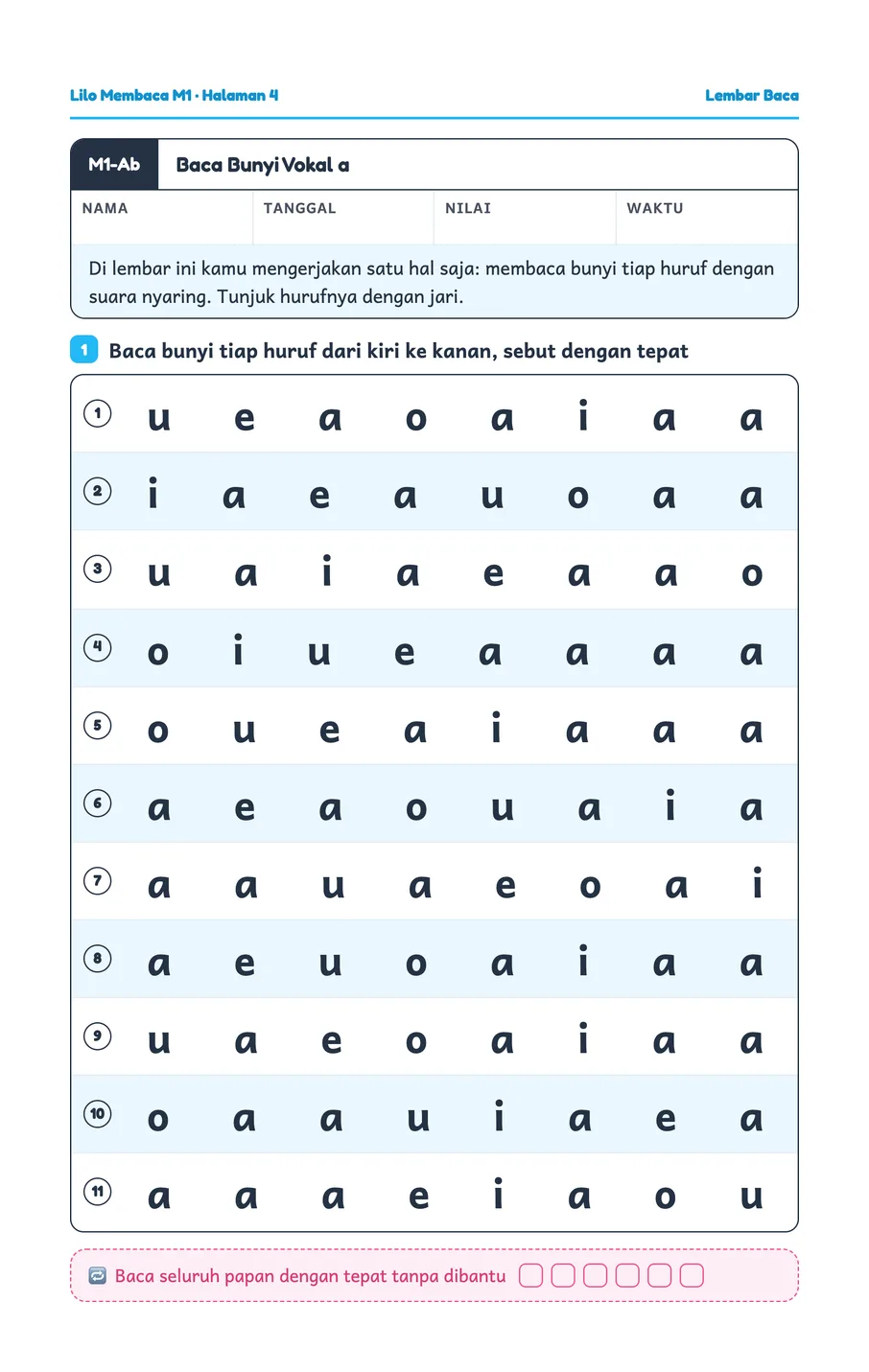
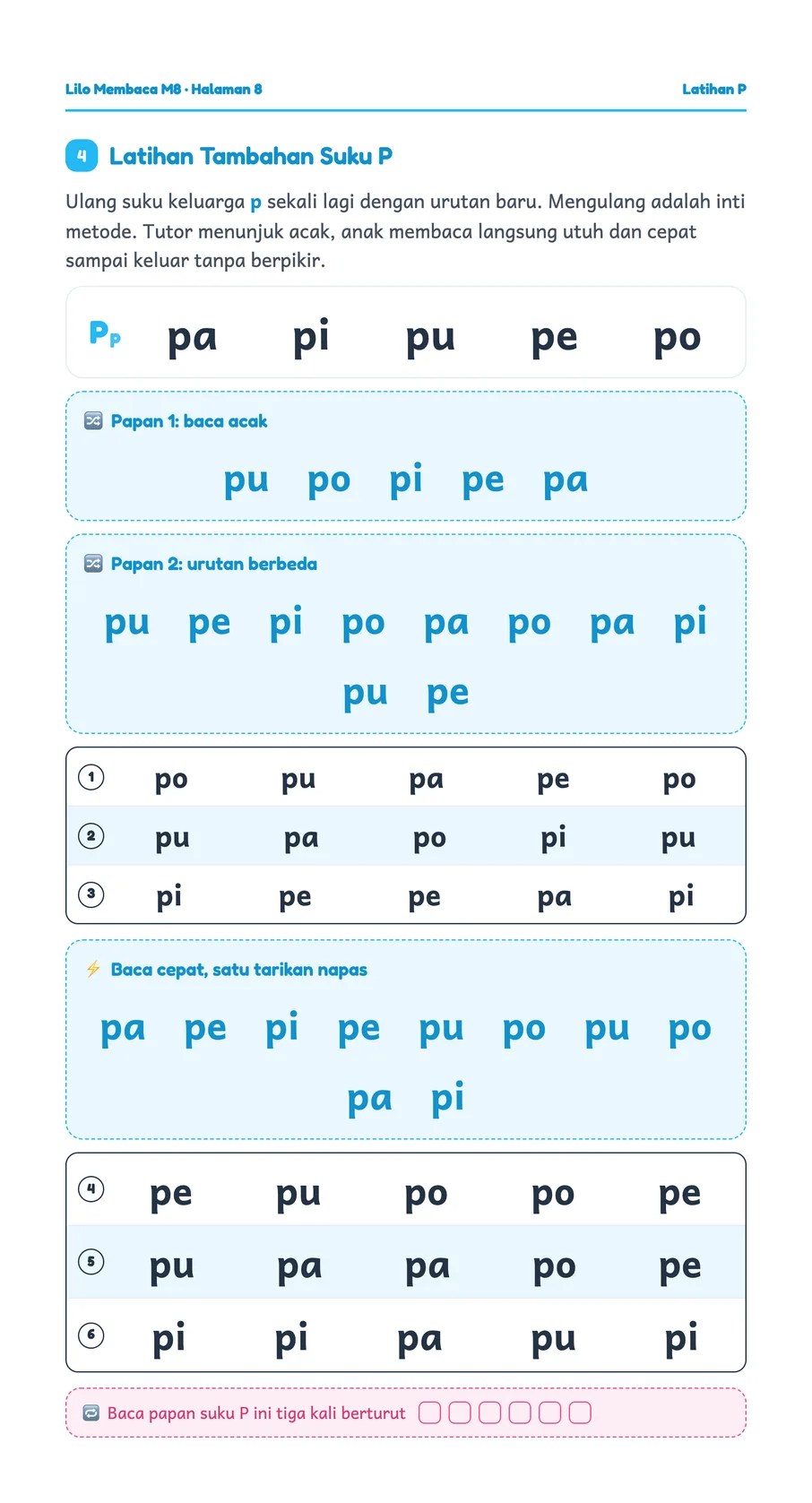
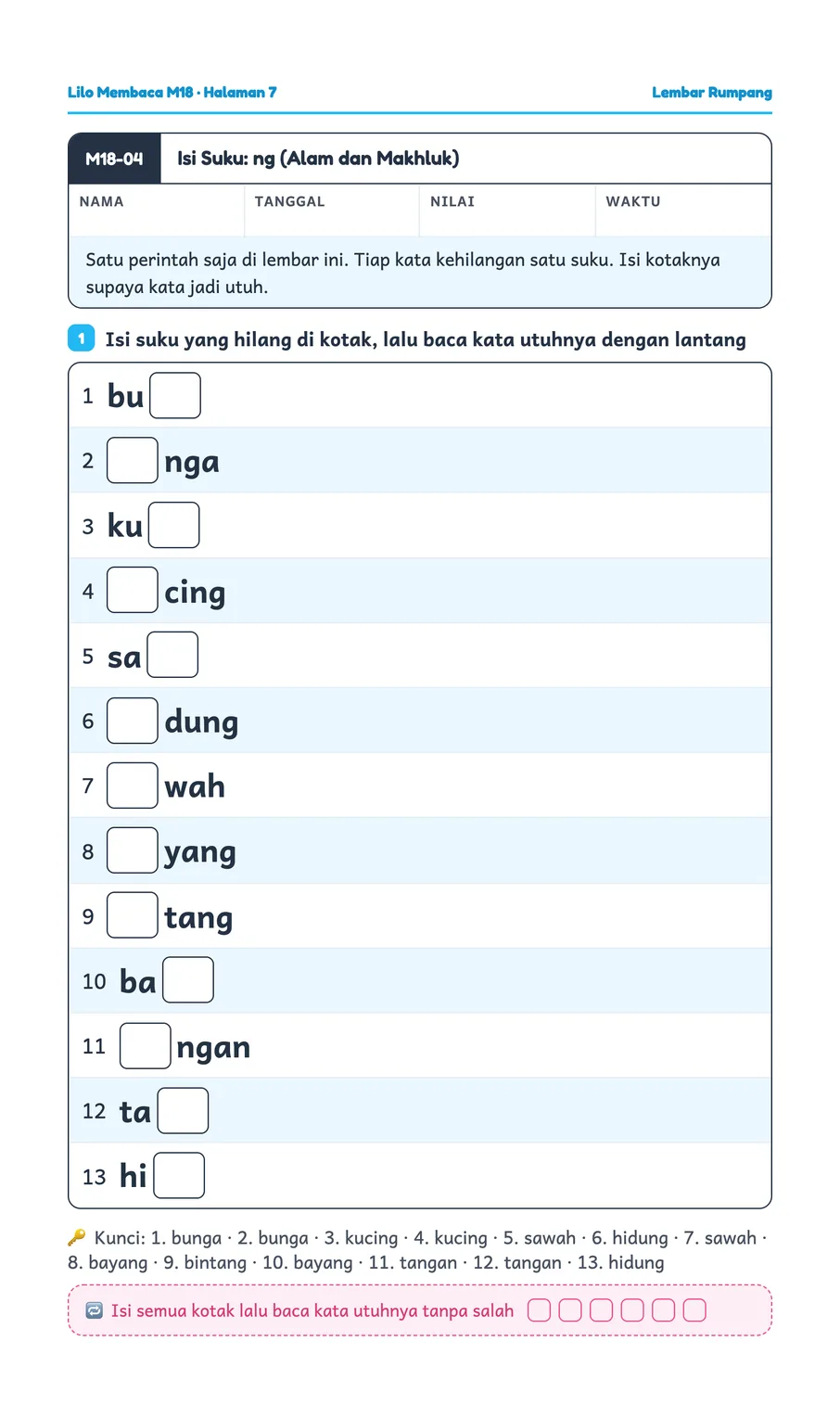
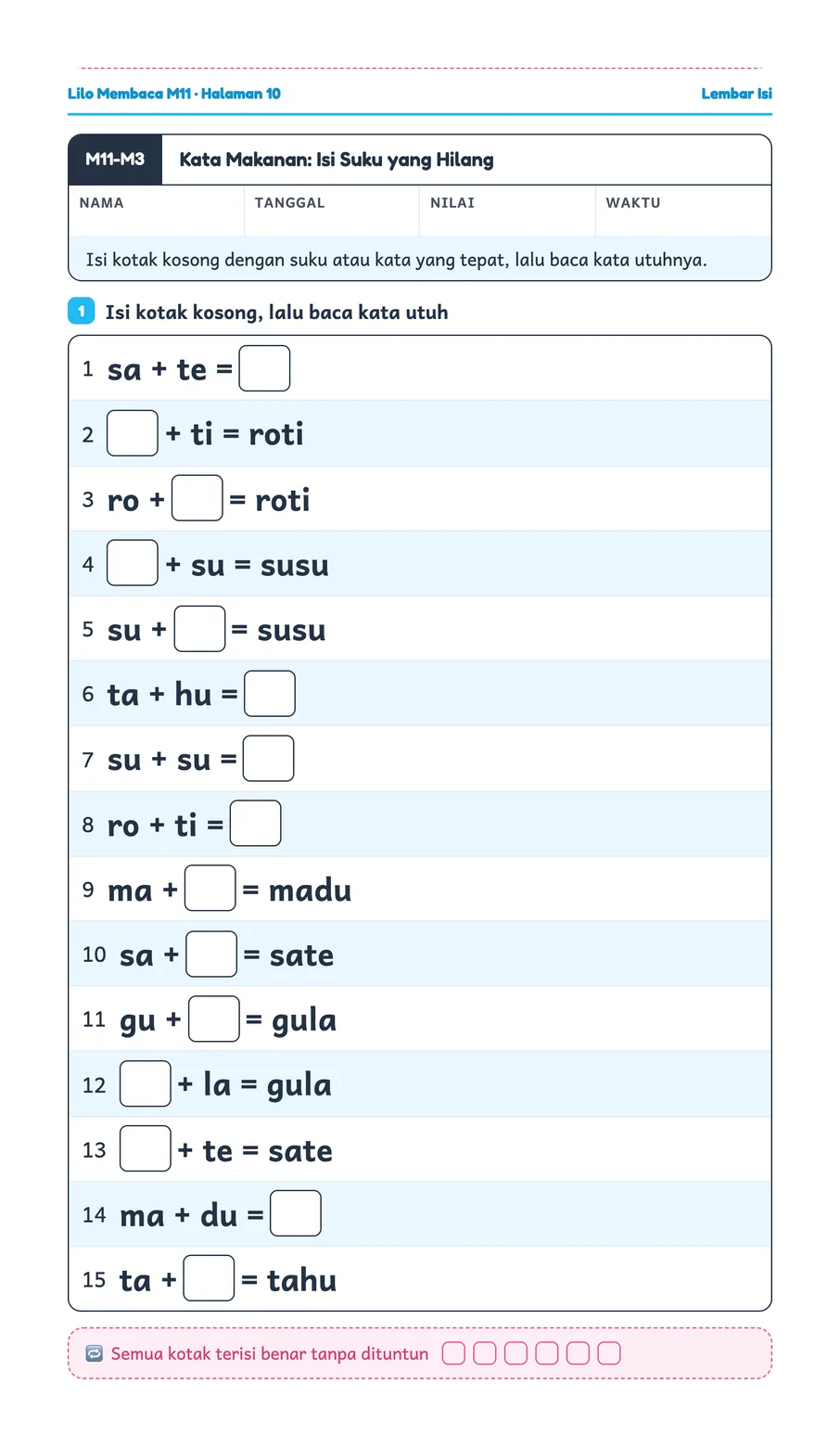 Real sheets from inside the pack
Children read most smoothly when guided by level: recognising letter sounds, blending syllables, reading words of two and three syllables, mastering tricky consonants, then moving into sentences and short stories. This bundle supplies practice material for every one of those stages.
Some children know every letter yet cannot read a single word. Some read short words fluently then freeze the moment ng, ny, kh, or sy appears. Others read aloud beautifully, and go silent when asked what the story was about.
Those three moments belong to three different stages, and each one needs its own practice. This bundle supplies that practice in order: letters and their sounds, the syllable drill across twenty one consonants, flashcards to sharpen recognition, two syllable words, three syllable words and words ending in consonants, tricky consonants, high frequency words, themed sentences, five levelled stories, and comprehension questions.
Before any of it, there is a five minute reading check. The result tells you which stage is holding your child back, so you never spend the first week reviewing what your child already owns.
Three common signs that your child is ready for this material.
The order is visible: letter sounds, syllables, words, tricky consonants, sentences, then passages.
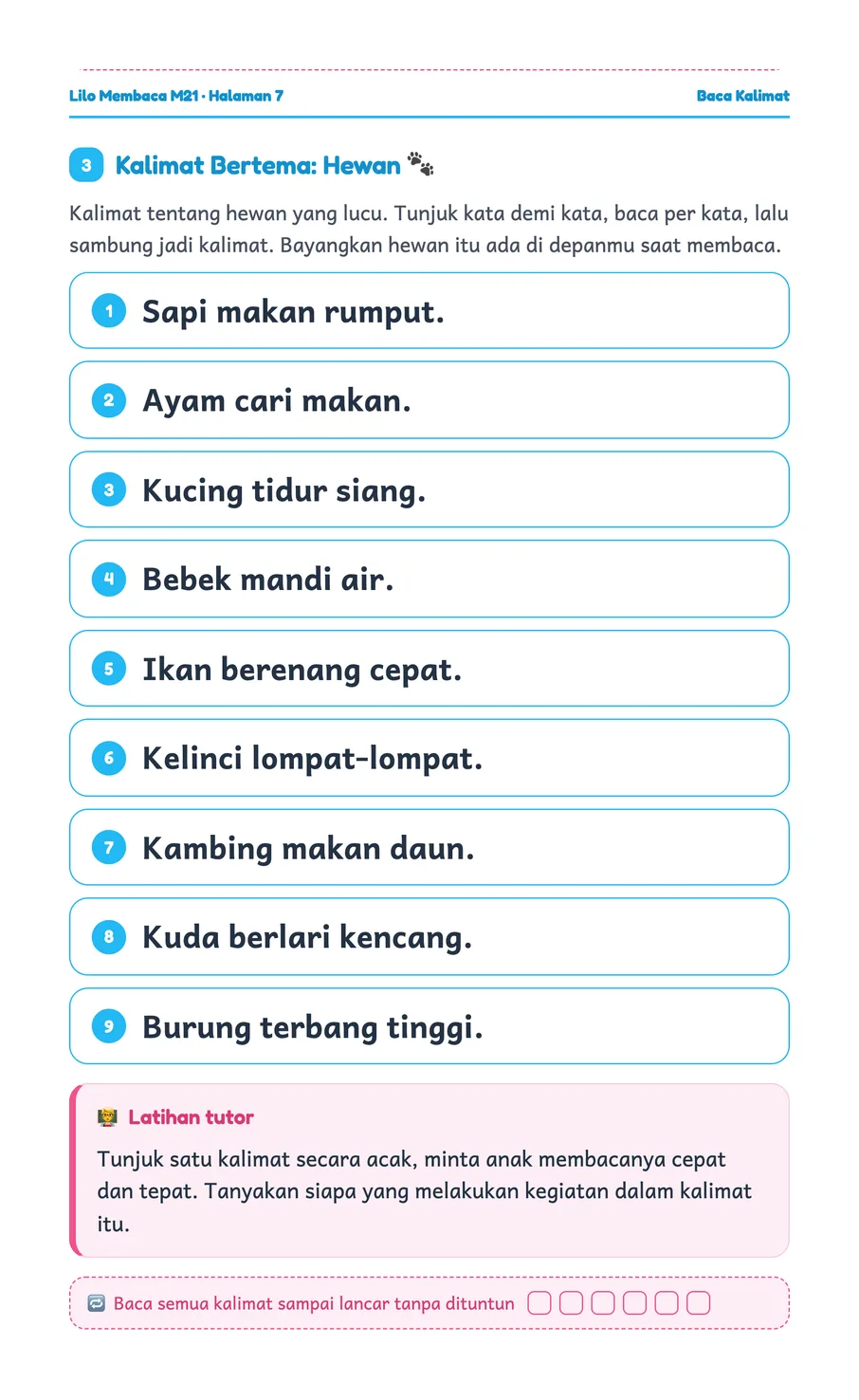
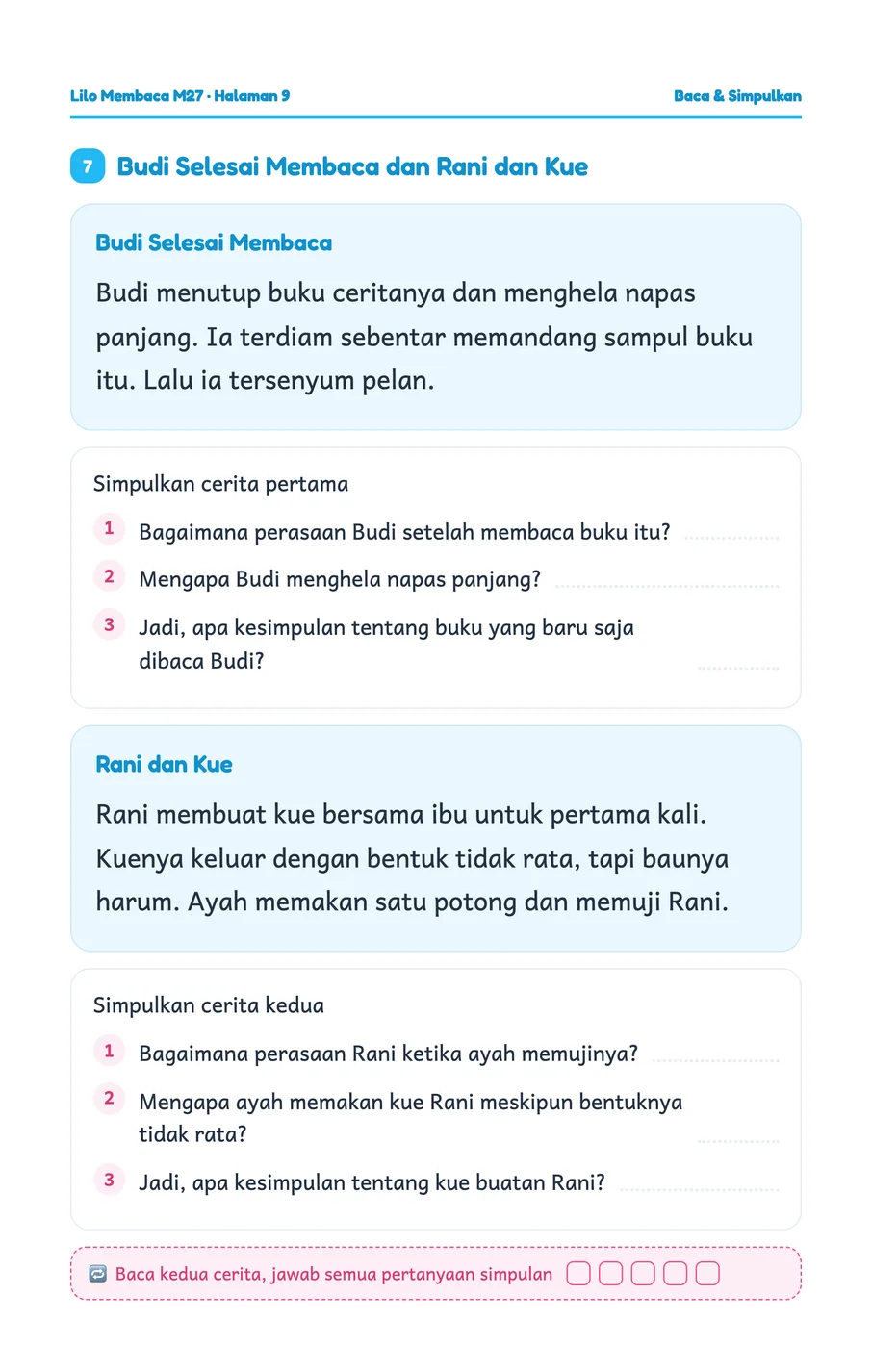
Everything is arranged as one reading staircase, with support for the adult sitting alongside.
Capital and lower case letters, the sounds of Indonesian letters with a pronunciation guide, and a wall poster that lasts the whole year.
Syllable drills from ba, bi, bu through za, zi, zu across all twenty one consonants, plus more than one hundred flashcards for rapid practice.
Two syllable words, three syllable words and words ending in consonants, then dedicated practice on ng, ny, kh, sy where children often stall.
Illustrated short sentences, one hundred high frequency words, five levelled stories, and comprehension question practice.
A twenty minute guide to teaching reading calmly, thirty shared reading activities, and a progress map your child can cover in stickers.
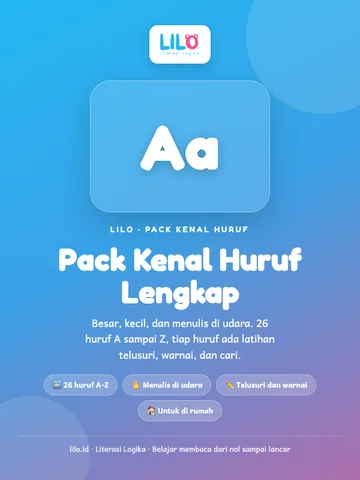 Pack Kenal Huruf Lengkap
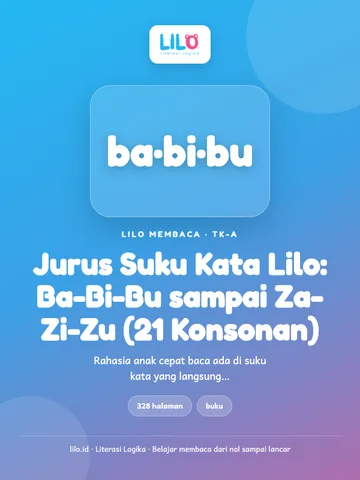 Jurus Suku Kata Lilo
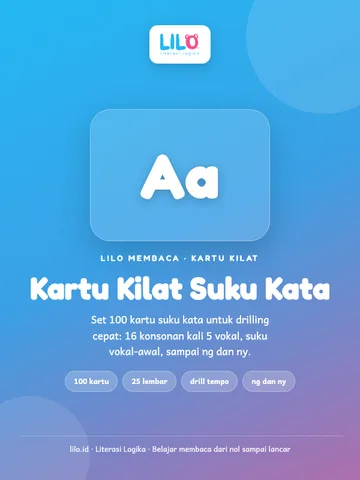 Kartu Kilat Suku Kata untuk Drilling Cepat (100+ Kartu)
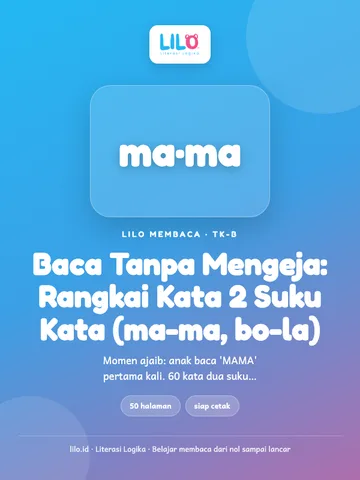 Baca Tanpa Mengeja
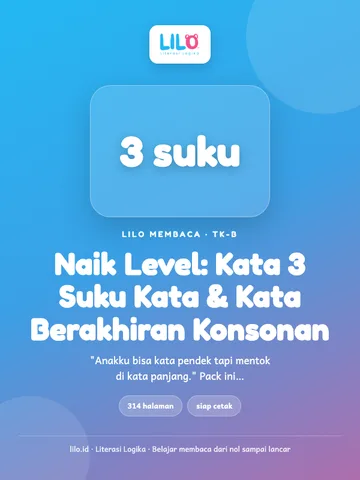 Naik Level: Kata 3 Suku Kata dan Kata Berakhiran Konsonan
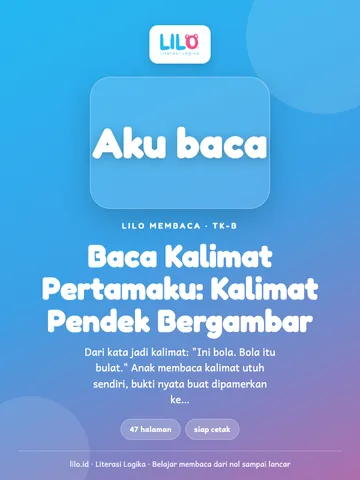 Baca Kalimat Pertamaku
 Kata yang Sering Muncul
 Aku Bisa Baca Sendiri
 Membaca Lancar 30 Hari
 Baca dan Jawab
 Peta Membaca 0 sampai Lancar
 Resep 10 Menit Baca Bareng
 Ajari Anak Baca Tanpa Drama
 Diagnostik Baca 5 Menit
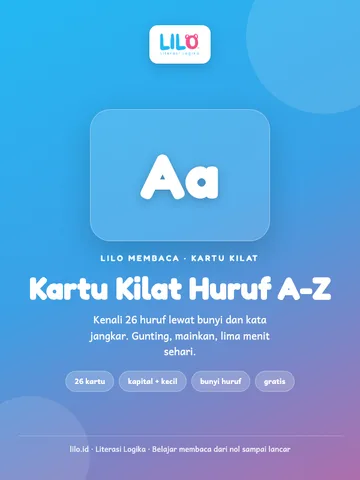 Kartu Kilat Huruf A-Z Lilo
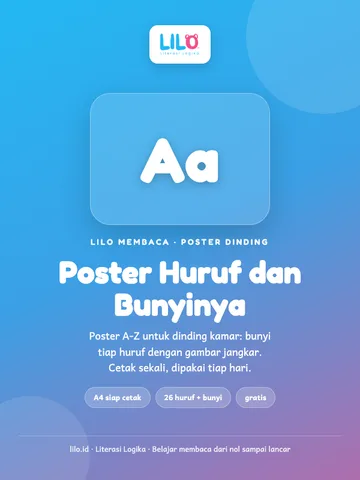 Poster Dinding Huruf dan Bunyinya
Three of the materials are free samples you can try first: the five minute reading check, the letter flashcards, and the letter sound wall poster.
This material rewards short sessions repeated daily.
Note the stage where your child stalls. That becomes your starting point, and everything below it needs only a quick review.
A short two part session keeps children fresh. Flashcards sharpen syllable recognition without feeling like work.
When three syllable words come without long pauses, open the levelled stories. Finishing a whole story builds the sense of being a reader.
The sticker progress map gives your child visible proof of movement, which often works better than spoken praise.
Lilo uses a sound based approach shaped around the Indonesian language.
Children practise the short sound of b, so meeting ba produces ba immediately. Naming letters slows that moment down.
Indonesian is highly regular at syllable level. Training whole syllables lets a child read words never seen before.
Levelled stories use only words your child has already mastered, so the reading succeeds and confidence grows.
This bundle works best when your child can sit with a sheet for a little while and you can tell when to climb a stair or step back one. The three groups below help you read those moments each week.
These are the steps you actually walk through once the bundle is yours, from opening the materials to deciding that your child is ready for the next stage.
Once payment is complete, every material sits in your Lilo account at app.lilo.id, linked to the email you entered at checkout. Keep the files together in one folder, then read the twenty minute guide before you sit down with your child. The guide shows you how to say each sound, so from day one your child hears the same steady sounds from you.
Invite your child to read the check sheet as if it were a game, at a time of day when they feel fresh, perhaps after breakfast. Note the line where long pauses, guessing or letter naming begins. That line is your child's first stair. The stages below it only need a quick hello as a warm up, so your child spends their energy where it counts.
Print the sheets for the starting stage, plus the matching flashcards. A thin pile of paper feels finishable to a young child, and it makes progress easier for you to see. Keep the next stage in the folder for now. The letter sound poster can go straight onto the wall at your child's eye height, ready for a quick glance whenever a sound slips away.
Pick the same time each session, such as after the evening bath. Give every session two parts: a little reading from the sheet, then a little play with the flashcards. Finish while your child is still keen, right after they have read something well. A steady rhythm brings your child to the table without coaxing, because reading has become an ordinary part of the day.
Each time a stage feels light, your child adds a sticker to the reading map. Roughly every two weeks, run the five minute check again to see whether the stalling point has moved. If it has, print the next stage. If it has stayed put, your child repeats the same sheets through a different game. Rechecking keeps your child on the stair that suits them.
Three short sessions arranged with care can carry your child steadily up the reading staircase. The secret lies in the spacing, in giving each session its own character, and in how each one ends.
Young children learn to read through repetition with gaps in between. When your child practises syllables on Monday and meets the same syllables again on Wednesday, they have to pull back something that was starting to fade, and that small effort of remembering is what makes a sound stick. So the three core sessions work best with a day between them, for example Monday, Wednesday and Friday. The days in between get light touches with no worksheet at all, such as glancing at the letter poster or reading a shop sign on a walk. If your household can manage a brief session every day, that is good too, and these three sessions become its backbone.
Boredom usually comes from sessions that always look the same. Give each one a different job. The first session of the week is new material day: your child meets the syllables or words of the current stage, and you introduce them slowly. The second session is game day: the same material returns through flashcards, sound hunts or circling sheets, so your child repeats it without feeling the repetition. The third session is story day: your child reads sentences or a levelled story built from words they already own, then adds a sticker to the reading map. The week closes with a feeling of success.
Inside a single session, order matters a great deal. Open with two or three cards your child is sure to read, so they arrive at the table feeling capable. Only then bring in the new material, for about ten minutes, because attention runs out quickly at this age. Close with one small success that your child says out loud. Stop while your child still wants more. A child who leaves the table curious comes back gladly, while a child kept there until tired starts to remember the table as a heavy place.
Watch for early signs of boredom: yawning in the first minutes, careless guessing, or a sudden need for the bathroom whenever the sheet comes out. When those signs appear, change the form of the activity and keep the material. The same syllables can be read from cards hidden under a cushion, written on a steamy mirror, or spoken in turns with robot voices. If the boredom lasts longer than a week, run the five minute check again. Often your child is ready to climb and finds the material too easy, or is stuck on material that is still too heavy and needs to step back one stair.
These short activities fill the days between worksheet sessions. Each one uses materials from the bundle or things you already have at home.
You say one sound, such as sss, and your child hunts for kitchen things whose names start with it: sendok, sapu, sabun. Once something is found, your child runs to point at the letter S on the wall poster. The game trains your child's ear to pick out the first sound of a word, the doorway into blending syllables on the sheets.
Letter sound poster, everyday kitchen items
Take ten syllable cards from the stage your child is working on. Your child reads them one at a time, and every card read without naming letters goes into the winning bowl. Cards that still cause hesitation go into the tomorrow bowl. Play a second round and let your child watch the winning bowl fill up. Your child practises seeing a syllable at a glance while feeling like a winner.
Syllable flashcards, two small bowls
Gather a few food packets from the cupboard. Your child searches for words containing ng or ny, such as pisang or minyak, and circles them with a coloured pencil. Read each find together out loud. The sounds that used to cause freezes become a fun hunt, and your child discovers that these tricky sounds are everywhere in daily life.
Empty food packets, coloured pencils
Copy one short sentence your child has already mastered onto a sheet of paper, then cover one word with a sticky note. Your child reads the sentence, guesses the hidden word, then lifts the note to check. The game invites your child to follow the meaning of a sentence, building the habit of thinking about what the words are saying while reading.
Themed short sentence sheet, sticky notes, pencil
After your child reads a levelled story, swap roles. Your child holds the sheet and asks you questions about the story. Now and then give a wrong answer and let them correct you by pointing to the right sentence. Making questions and checking answers requires your child to understand the story they just read, and they do it while laughing.
Level one story
This timeline pictures a child who starts from letter sounds and practises in short sessions a few times a week. A child who enters halfway up the staircase will pass some milestones sooner, and every child keeps their own pace.
The five minute check shows where your child stalls. Your child begins saying letter sounds, such as buh for b and mmm for m. They circle letters on the sheet and start pointing to the same letters on the wall poster. This week the main win is that your child enjoys sitting down with the sheets.
Your child starts blending a consonant with a vowel, so ba, bi and bu come out as single sounds. Syllable flashcards get answered with growing confidence because your child recognises them at a glance. Now and then they still name letters, which is perfectly normal. Many children start reading syllables on shop signs during walks.
Words like buku, mata and sapi come out in one breath. Your child grows brave enough to try three syllable words, sometimes pausing in the middle. The reading map on the wall now holds a few stickers, and your child loves showing it to anyone who visits.
Your child works directly on the letter pairs that used to cause freezes. Words like nyanyi and bunga begin to flow, and words ending in a consonant, such as ikan and kapal, stop causing long pauses. Your child begins reading short themed sentences and filling in the missing word.
Your child reads a level one story from beginning to end, then answers questions about it. High frequency words are recognised at a glance. Reading starts to feel like something your child chooses, and you may find them asking for the next story.
This picture follows the order most children travel through. The pace differs for every child, and the five minute check stays your guide.
Many reading materials look alike from the cover. These questions help you judge whether a set will truly carry your child forward week after week.
| Question to ask | Why it matters |
|---|---|
Is there a way to find my child's stage before starting? | A child already fluent with syllables gets bored when sent back to single letters, while a child who has yet to learn letter sounds feels overwhelmed by word sheets. Good material gives you a tool to find the right starting point on day one. The Lilo bundle opens with a five minute reading check for exactly that purpose. |
Does the order move from sounds to syllables and then to words? | Indonesian is very regular at the syllable level, so a child who masters sounds and syllables can read words they have never seen. Material that jumps straight to whole words leaves a child leaning on memory. In the Lilo bundle, letter sounds and the syllable drill come first, and words build on them. |
Are the ng, ny, kh and sy sounds practised on their own? | Many children read short words fluently and then freeze at exactly these letter pairs. Without dedicated practice, a child keeps tripping in the same place and starts to feel like a poor reader. The Lilo bundle gives these four sounds their own sheets, full of everyday words. |
Do the stories use words my child has already mastered? | Stories full of unfamiliar words force a child to stop on every line, and their confidence slowly crumbles. Levelled stories built from words already practised give your child the experience of finishing a text alone. The five stories in the Lilo bundle are written that way. |
Does the adult at the table get a pronunciation guide? | Your child copies the sounds they hear from you. Without a pronunciation reference, the sounds you teach can drift from day to day and confuse your child. The twenty minute guide in the Lilo bundle shows how to say each sound with example words, giving you a steady reference. |
Can home practice continue with a tutor if that is ever needed? | There are seasons when a child benefits from a guide beyond the parents, perhaps when home schedules get busy. Home material that matches the tutor's class keeps every bit of your child's work useful. Lilo's reading programme follows the same staircase, with tutors whose profiles you can view before the first session. |
It is used most often with children aged four to six. Grade 1 children who still stumble also benefit, because the staircase can be entered from the middle.
Run the five minute check first. If syllables are solid, begin at three syllable words and tricky consonants, then move into sentences.
The twenty minute guide inside sets out how each sound is made along with an example word, giving you a consistent reference while you sit alongside your child.
There is no need to print everything at once. Many parents print a single stage, use it until fluent, then print the next.
This material is levelled and paired with a placement check, so you know which stage your child belongs in. It also covers tricky consonants, which general books rarely address.
The Lilo Reading programme follows the same staircase with a tutor, so the work already done at home continues to count.
No, it is not required. Grade one admission is based on age, and Permendikdasmen 3/2025 Article 11 paragraph 5 states that entering grade one does not require a reading, writing and arithmetic test. Even so, a child who already knows letter sounds and syllables usually feels calmer meeting writing on the classroom board. This bundle helps your child build that footing at home, relaxed and free of deadlines.
Put the sheets away for two or three days and switch to sound games or flashcards. Refusal often appears when the material is too heavy or the session too long. Once your child is settled, run the five minute check again and restart from an easier stage with shorter sessions. Bring the sheets back gradually, and end each session with something your child reads successfully.
Guessing from pictures is a normal habit for beginning readers, and it simply needs gentle steering. When your child guesses, cover the picture with your hand and invite them to read the first syllable. The flashcards in this bundle show syllables without pictures, so your child grows used to reading the letters. Over time the picture becomes a check after reading, which is a fine reader's habit.
About once every two weeks is enough, or whenever you are unsure whether your child is ready to climb. The recheck shows whether the stalling point has moved to the next line. If it has, print the next stage. If it has stayed put, your child practises the same material through a different game. Keep a note of each check so you can see your child's journey month by month.
A dip after a holiday is normal and usually recovers quickly. Start again with the five minute check to see where your child stands now, then repeat that stage with lighter sessions for a few days. Flashcards help a lot in this period because they are short and feel like play. A child who once mastered a stage generally finds fluency again faster than the first time.
Your child can start right away, even before writing. Most sheets ask your child to circle, point, read aloud and answer, so a child who is just learning to hold a pencil can follow along. If you would like writing and counting to grow alongside reading, the Calistung Komplit 3 in 1 bundle and the Paket Lengkap Siap SD add both of those skills.
The materials are in your Lilo account at app.lilo.id and open with the email you entered at checkout. That is why it matters that the email address is active and typed correctly. From the account you can download and print the sheets whenever you like, one stage at a time. If anything gets in the way of opening them, the Lilo team is ready to help through a free WhatsApp consultation.
Keep the flashcards, and change how you play with them. Hide the cards around the room and ask your child to read each one they find, or say a syllable aloud and let your child search for its card. The cards train your child to recognise syllables at a glance, the skill that makes sentences and stories feel light. Changing the game keeps that benefit flowing without the boredom.
This pack trains reading at home. If you would rather have a teacher alongside your child, the classes below teach the same path with a tutor, and the two packs beside them add writing and counting.
Begin with the five minute check, then climb the staircase until whole stories are within reach.