
Preschool and kindergarten beginners
- Knows a handful of letters and numbers
- Hands still need practice holding a pencil
- Enjoys learning through card games and colouring
Reading, writing, and counting in one connected bundle, opened by three short placement checks so you know exactly where your child begins.
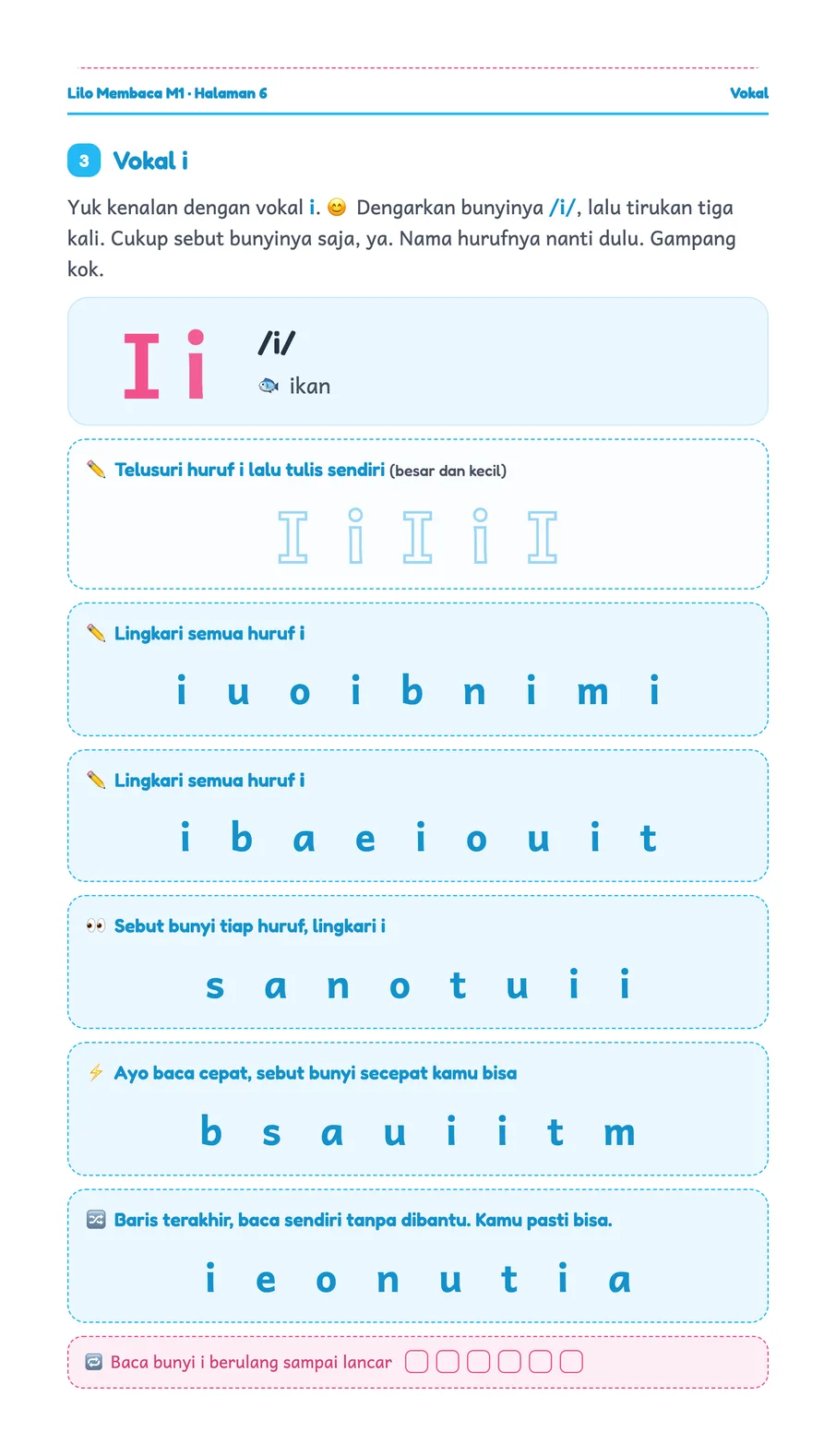
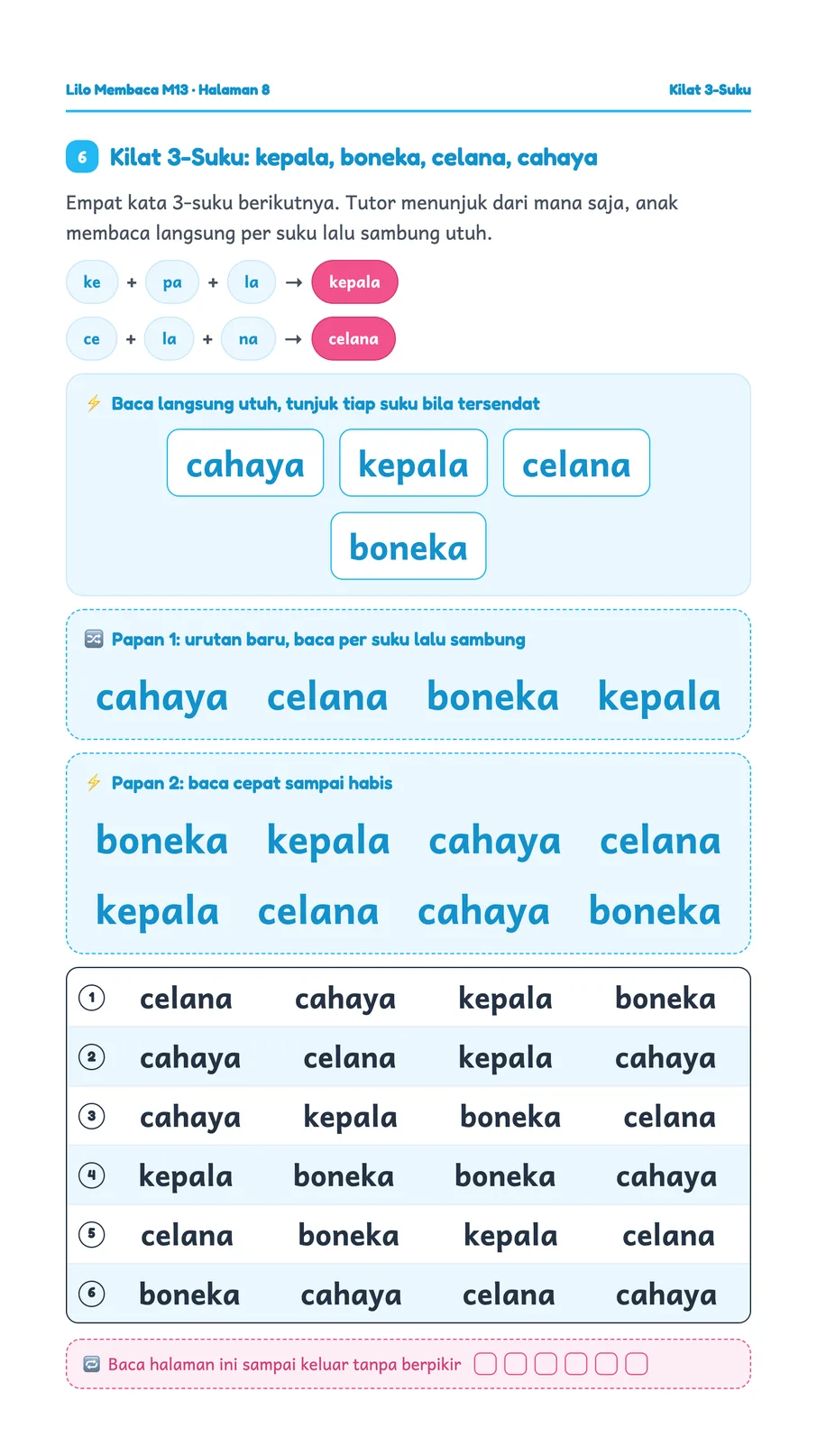
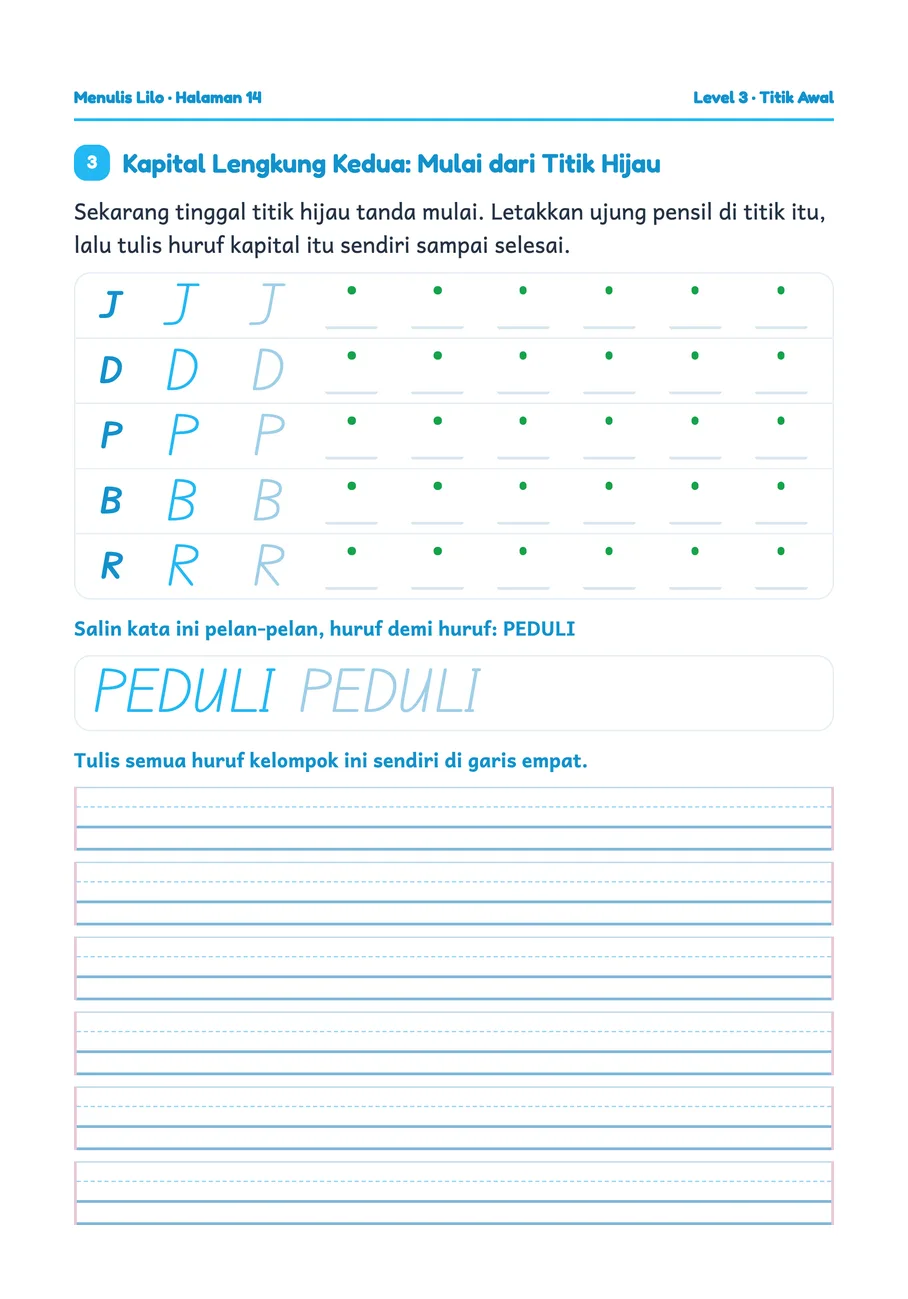
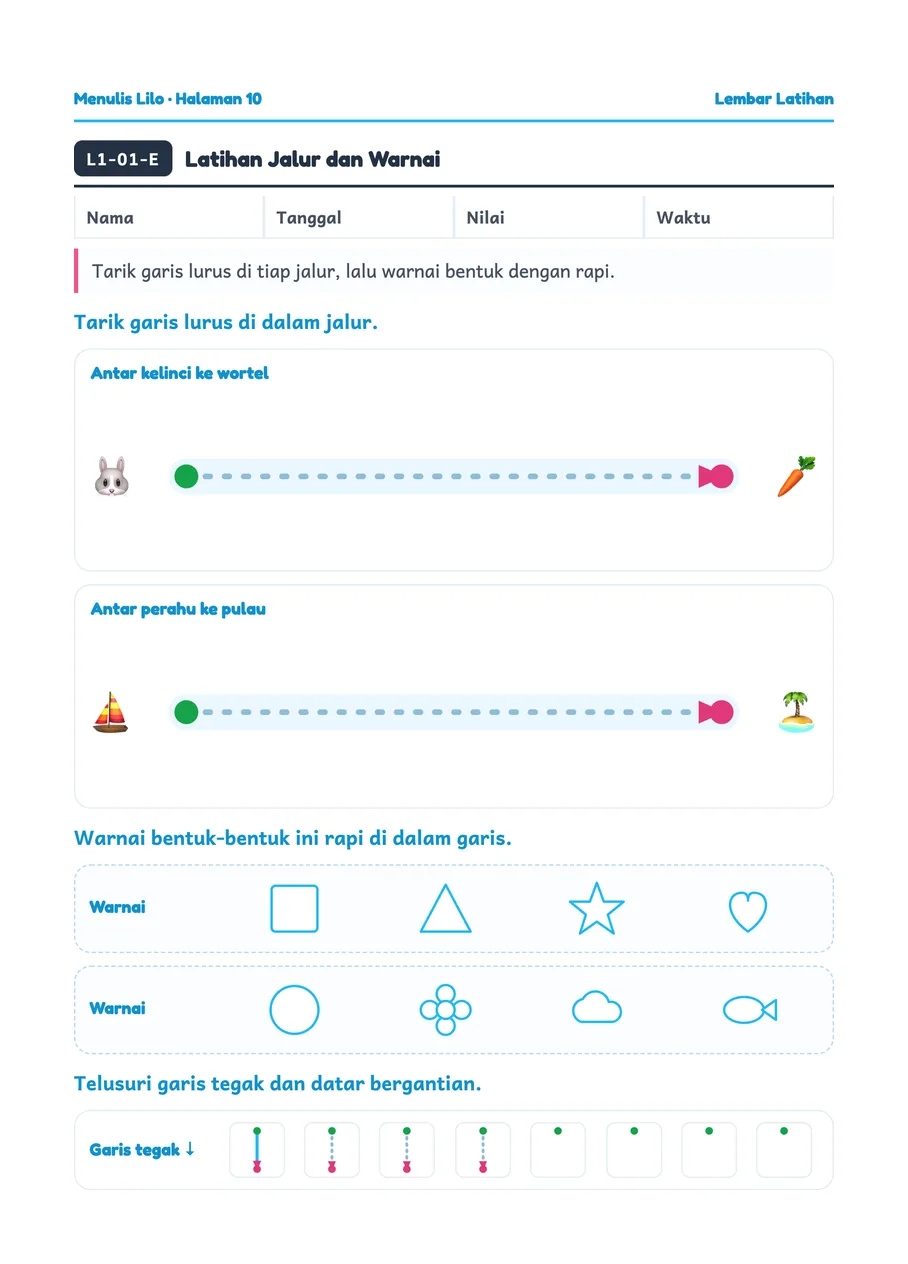 Real sheets from inside the pack
It is a downloadable Lilo bundle joining three foundational tracks: reading from letters to sentences, writing from pre writing patterns to copied sentences, and counting from one to one hundred. Each track opens with a short placement check.
Many parents buy a reading book in one shop, a handwriting book in another, and counting sheets somewhere else. The child then jumps between levels that never quite match, reading sentences while still tracing letters with full dotted guides.
This bundle puts all three on one staircase. Reading begins with letter recognition, the syllable drill covering twenty one consonants, flashcards for quick practice, then short themed sentences. Writing moves from sixty line and pattern exercises, through tracing at three levels of dot thickness, to copying fifty everyday sentences. Counting starts at numbers one to twenty, rises through picture based addition and subtraction, and lands on the hundred board.
What makes the bundle feel different in daily use is its three diagnostic tools: a five minute reading check, a fifteen minute writing readiness check, and a counting test that produces a simple report. You never guess where your child stands. Run the check, then begin at the matching sheet.
Three situations we hear about most often from parents.
Two reading sheets, two writing sheets, two counting sheets, all taken from the materials inside.
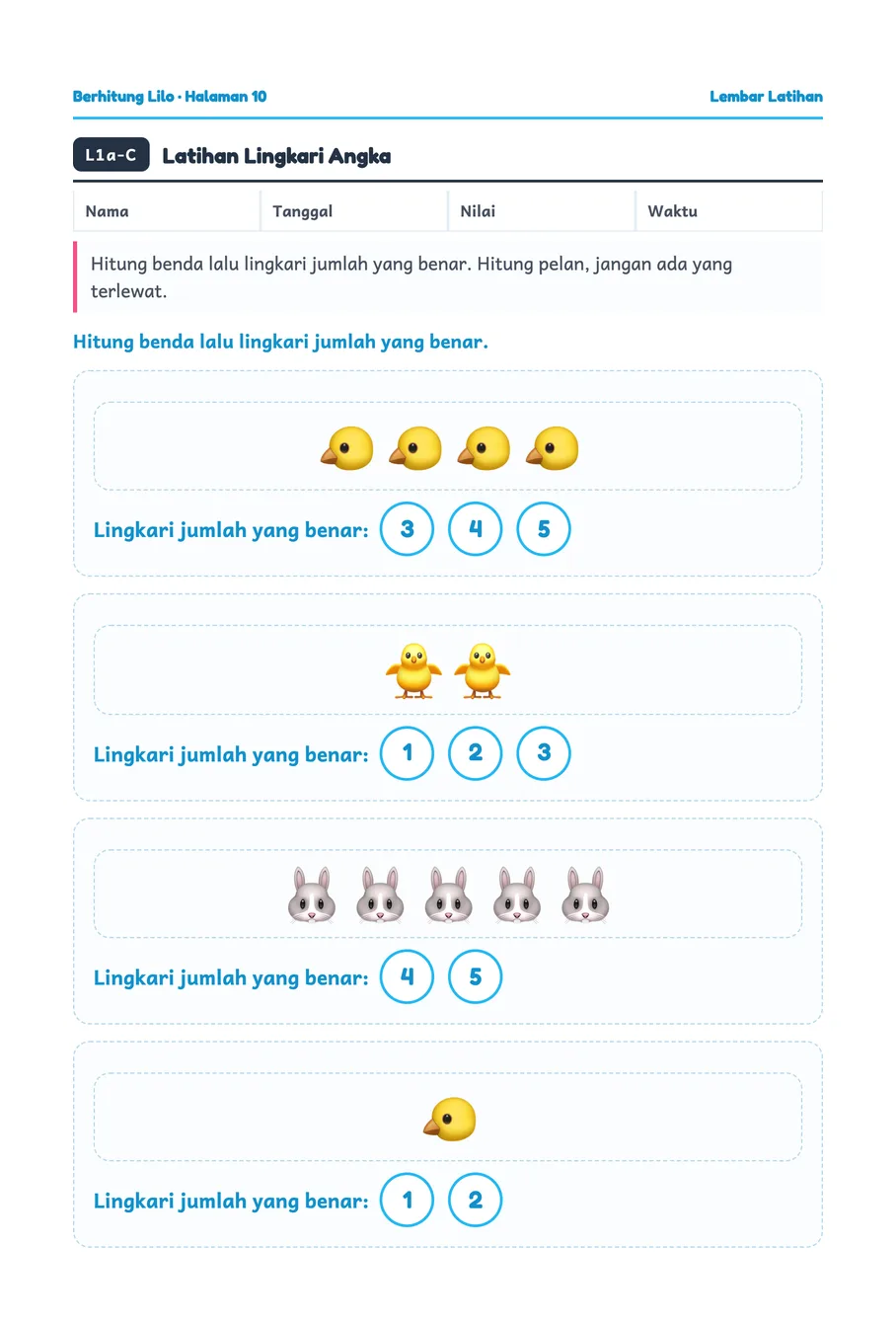
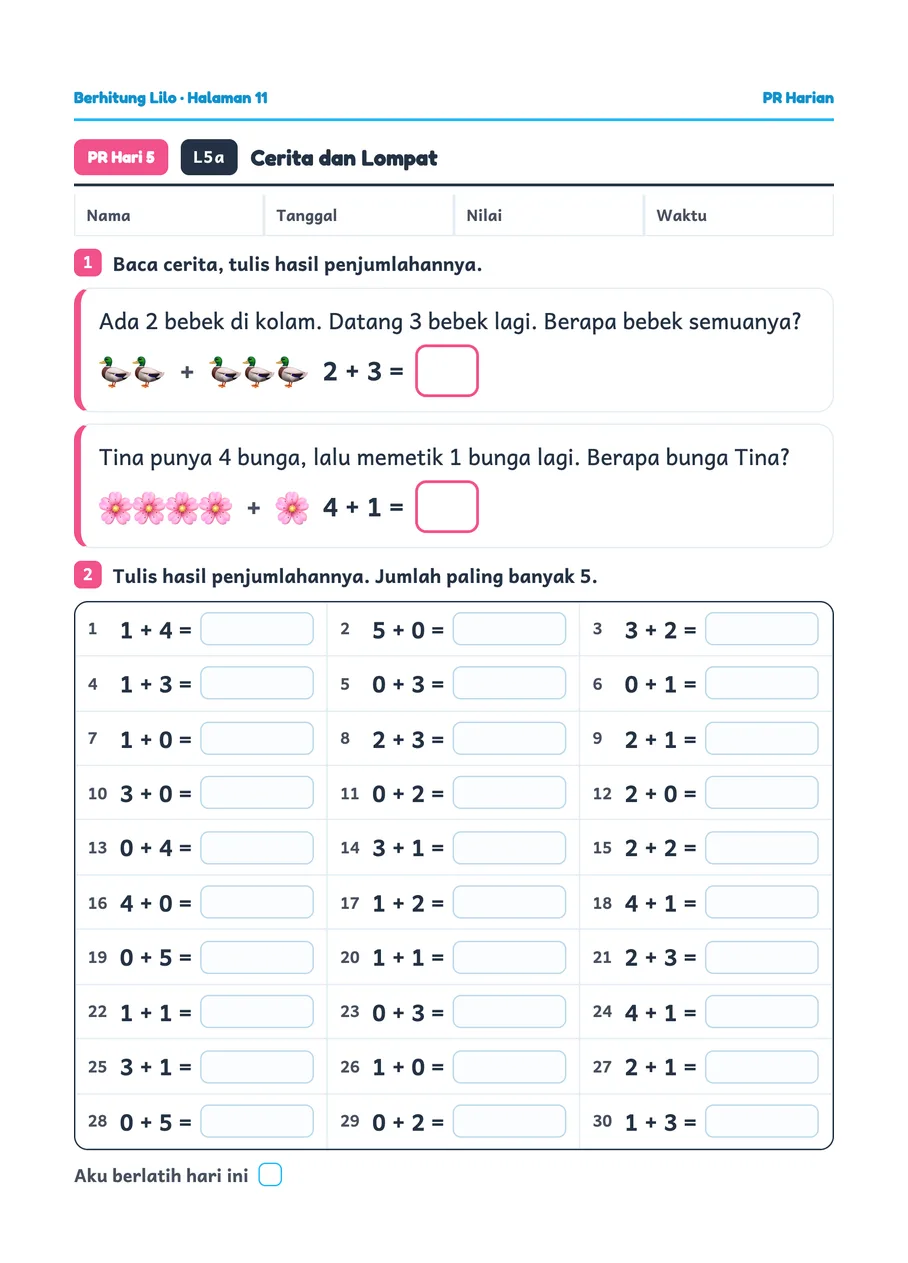
Eighteen materials covering three learning tracks, the diagnostic tools, and the supports for daily practice.
A five minute reading diagnostic, a writing readiness check, and a counting test with an automatic report. Used first so your child starts in the right place.
Letter recognition, syllable drills across twenty one consonants, one hundred flashcards, themed sentences, and a 30 day daily programme.
Line and pattern practice, tracing A to Z at three levels of dot thickness, then copying sentences on four ruled lines.
Numbers one to twenty, picture based addition and subtraction, a 120 page workbook, and the hundred board.
Number flashcards to one hundred, syllable flashcards, a 30 day study calendar, plus a certificate and medal to mark the end of a track.
 Pack Kenal Huruf Lengkap
 Jurus Suku Kata Lilo
 Kartu Kilat Suku Kata untuk Drilling Cepat (100+ Kartu)
 Baca Kalimat Pertamaku
 Membaca Lancar 30 Hari
 Jago Pegang Pensil
 Tracing A-Z Lengkap
 Lepas Titik: Menulis Huruf Mandiri di Garis Empat
 Menyalin Kalimat Rapi
 Jago Angka 1-20
 Penjumlahan Sampai 20
 Pengurangan Itu Mudah
 Buku Kerja Numerasi Lilo
 Flashcard Angka 1-100 Siap Cetak
 Kalender Belajar 30 Hari
 Paket Sertifikat Aku Lulus Calistung! + Medali Cetak
 Diagnostik Baca 5 Menit
 Menghitung Sampai 100
Everything inside is print ready, including flashcards you simply cut out and reuse.
Four steps, with steps two to four repeating through the year.
Set aside one afternoon for the reading, writing, and counting checks. The results tell you which track deserves the larger share of your week.
Focus on whichever track lags, while touching the other two twice a week so they stay fresh.
Five minutes of flashcards before a session keeps practice light, and your child arrives in a playful mood.
The 30 day calendar shows your child that the effort is visible, and that alone keeps momentum.
Three principles guided the design of this bundle.
Sheets that are too easy bore a child, sheets that are too hard defeat one. A short check at the start avoids both.
Children practise ba, bi, bu as complete sounds, so the habit of naming each letter separately never takes hold.
Writing practice runs alongside reading practice, because forming a letter strengthens the memory of the sound you model for them.
The placement checks inside the bundle give the clearest answer about where to begin. Before you run them, these signs help you guess which track will move quickly and which one deserves a gentle start.
These steps carry you from materials that have just appeared in your account to a weekly rhythm that runs on its own. Each step uses a tool already inside the bundle.
Your materials sit in your Lilo account at app.lilo.id. Begin by printing the three diagnostic tools: the five minute reading check, the writing readiness check and the counting test. Hold off on printing every sheet at once. The results decide which pages your child will actually use, so your paper and ink go to the sheets that fit.
Pick a time when your child has eaten and feels awake. Start with the reading check because it is the shortest, move on to the counting test, then finish with the writing check, which takes about fifteen minutes. Quietly note what your child does, including the pauses and the slips. Those small notes become very useful when you read worksheets later.
The results show you which sheet opens each track. Print the first week of sheets only, plus one set of syllable flashcards that you cut out together with your child. A thin pile tells your child that the work is manageable. That feeling of being able to finish is what brings them back to the same table the next day.
The track that lags furthest becomes the main course, for example writing for a child who already reads syllables comfortably. The other two tracks still get two short visits a week so they stay fresh. Open every session with a few flashcards, then let your child mark the 30 day calendar once the session ends, so the effort becomes something they can see.
Once the calendar fills up, run the same checks again and compare them with your notes from that first afternoon. A track that has climbed can step back into a supporting role, and a track that has stalled becomes next month's main course. You can repeat this cycle all year because every sheet can be reprinted whenever your child needs it.
A sheet covered in wrong answers holds the most honest information you will get about your child. Here is how to read those mistakes and respond so your child keeps trying.
Every mistake on a worksheet follows a pattern, and the pattern tells a story. A child who slips once on a page that is otherwise correct is usually tired or rushing. A child who makes the same slip again and again is telling you that one step has yet to settle. So before you correct anything, look at the whole page. Mark mistakes lightly in pencil, group the similar ones, then ask yourself a single question: does my child not know the method yet, or do they know it while their hand is still catching up? Each answer calls for a different response.
In the reading track, the most typical mistake is a child sounding out b, a and then struggling to blend it into ba. That shows the habit of naming letters is still strong. The response is simple: go back to the syllable flashcards, say the sound in one beat, and ask your child to echo it. Another common mistake is guessing a word from its first letter, reading buku as bola, for example. This child is already brave, and their eyes need encouragement to travel to the end of the word. Cover the word with your finger and reveal it one syllable at a time.
In the writing track, mixing up b and d is very common at this age. Letter direction has yet to settle in the hand, and young children still see a letter like an object that stays the same when flipped. Take your child back to the thickest dotted tracing for those two letters only, and say the movement together as they write: pull down first, then add the tummy. Letters that float above the line or sink through the bottom line show that the four ruled lines do not yet feel like a home for letters. Practise a few line patterns before returning to the letters.
In the counting track, watch how your child reaches the answer. A child who adds three and two by counting again from one has yet to discover counting on from the first number. The answer is correct, and the next step is inviting them to start straight from three. The answer key on the counting sheets helps you check quickly. Whatever the track, respond to mistakes calmly, circle the single most important one and leave the rest for another day. A child who feels safe being wrong keeps showing you how they think, and that is the best guide for choosing the next sheet.
These activities use cards and sheets from the bundle plus things you already have at home. Each one is short, so it slips easily into the time before a bath or while dinner cooks.
Spread ten syllable flashcards face down on the floor. Your child turns one over, reads it as a single sound, then hunts for something at home whose name begins with that sound. The card ma might lead to the table, written meja, and bu to a book, buku. The game links the sound on the card to objects your child knows, so syllables come alive.
10 syllable flashcards from the bundle, objects around the house
Pour a thin layer of flour or salt onto a tray. Your child traces a pattern from the line practice sheet with an index finger, starting with straight lines and moving on to curves. After three goes in the tray, ask your child to do the same pattern on the tracing sheet. A movement the finger already knows makes the pencil far easier to steer.
tray, flour or salt, one line pattern sheet from the bundle
Print the hundred board and set out a few small toys as goods for sale. Your child plays the shopper: they say a price, find that number on the board, then place a bottle cap on it as payment. For a child who only counts to twenty so far, use the first two rows. The game makes the layout of the board feel familiar and relaxed.
printed hundred board, small toys, bottle caps
Choose one short sentence from the sentence copying section, write it large on a sheet of paper and stick it on the fridge door. Each time you walk past, read it together. In the afternoon, your child copies it once on four ruled lines. A sentence the eyes already know is much easier for a learning hand to copy neatly.
paper, marker, one four line sheet from the bundle
Place some spoons or buttons on the table, matching your child's starting point in the counting track. Your child counts while touching each one, circles the correct total on the sheet, then writes the number underneath without help. This single activity trains three things together: counting, recognising the written numeral and forming it by hand. It suits days when your time is tight.
spoons or buttons, an object counting sheet from the bundle, pencil
Every child moves at their own pace, so these milestones describe a profile we often see at home. Use them as a companion for reading progress, and let the retest at the end of each month give the firm answer.
The first week is mostly about new habits: sitting at the same table, opening with flashcards and adding a mark to the calendar. The sheets come from the starting point the checks revealed, so your child succeeds often. Those early wins become the fuel for the harder sheets that follow.
For many children the second week brings a small, happy change. Your child starts reading ba, bi, bu as single sounds and lets go of spelling out letter names. In the writing track, lines look bolder. In the counting track, the finger touching each object keeps better time with the spoken number.
The 30 day calendar is complete and your child is ready to retest. Usually one track has clearly climbed while another has moved more slowly, which is perfectly normal. The results help you swap the main track for the coming month, so all three skills grow more evenly over time.
Many children move from thick dotted tracing to the thinner dots, then on to writing letters by themselves on four ruled lines. In the reading track, short themed sentences start to flow. Picture based addition up to twenty feels like a game for a child who already counts objects comfortably.
By now your child often writes a word they have just read, then counts the things that appear in the sentence. The three tracks begin to meet at one table. The hundred board and everyday sentence copying become the next challenge, and the printable medal at the end of a track gives your child a moment to celebrate.
If a milestone feels far away, return to the placement checks. They point to a better fitting starting point, and your child can pick up speed again from there.
This bundle works best when the conditions fit. These questions help you weigh it honestly, including the moments when your child would gain more from a guide in person.
The bundle shines for a child with one track lagging behind, because the placement checks separate the three skills. You can strengthen one track while your child keeps moving forward in the ones already mastered. If all three are just beginning, the bundle still works well as a single staircase built carefully from the very first step.
Home worksheets depend on an adult sitting alongside. Short, regular sessions build a habit, and that habit is what makes your child's skills stick. If your schedule is packed, think about who else at home could take turns, then share the check results so everyone knows which sheet comes next.
Everything in the bundle arrives as print ready files, including flashcards you cut out and reuse. Easy printing lets you print week by week according to the check results. It is also what lets the bundle serve a younger sibling later, simply by reprinting the sheets that child needs.
The materials are built for that span, from pre writing line patterns up to the hundred board and sentence copying. A four year old can start at the very beginning, while a grade 1 child can jump straight to the point the checks reveal. That wide range means a single purchase stays useful at home for a long time.
The bundle gives you diagnostic tools, an answer key for counting and a sequence that is already in order. The daily calls stay with you, such as when to repeat and when to move up. Parents who enjoy that role find the bundle works like a complete map, and the child gains a study partner who knows them best.
Some children try harder with someone from outside the home, and some tracks stay stuck even with steady practice. That is where a tutor helps most. Lilo offers 1-on-1 private calistung lessons with tutors whose profiles you can view before the first session, and the bundle keeps working as home practice between sessions.
It is a good place to begin. Line and pattern practice, letter recognition, and number card games all fit. Sentences and the hundred board can wait until your child is ready.
No. Many parents pick one main track each week and simply touch the other two. The order inside every track is already arranged.
No. Many parents print one consonant set first, use it until fluent, then print the next.
Yes, on the counting sheets, including addition, subtraction, and numbers one to twenty, so marking takes moments.
It holds the same eighteen materials sold separately. The bundle price sits far below their combined total, and the comparison figure comes from the real individual prices.
The materials stay in your account and never expire. Pause for a month and resume at the last sheet, or start again from the beginning for a younger sibling.
Your child does not need to pass a reading, writing or counting test to enter grade 1, because Permendikdasmen 3/2025 Article 11 paragraph 5 sets admission without one and selection uses age. Many parents still want their child to walk into class feeling confident. This bundle helps your child build those foundations at an enjoyable pace, free of test pressure.
Start at the sheet the check points to, even if it sits halfway along a track. Earlier sheets stay in your account and can be opened any time a step later turns out to need reinforcing. A child who starts at the right level stays keen, because each sheet feels challenging and still within reach to finish alone.
Yes, left handed children use the tracing sheets in the same way. Help by tilting the paper slightly clockwise so the hand does not cover the line being traced. Let your child choose a comfortable grip as long as the fingers hold the pencil steadily. If tracing still feels hard, repeat the line patterns at the thick dot level before moving on to letters.
Yes, and it fits nicely as extra practice on days without a session. Lilo tutors work from Lilo's own curriculum of 122 coded modules, and each session ends with one small task of about ten minutes. To match bundle sheets with the module your child is currently learning, ask through our free WhatsApp consultation.
For preschool and kindergarten children, fifteen to twenty minutes is plenty, opening with about five minutes of flashcards. Grade 1 children can usually manage a little longer. Stop while your child is still enjoying it, because a child who finishes happy is far easier to bring back the next day. One or two sheets per session is enough.
The report shows which parts your child has mastered and which part becomes the starting point in the counting track. Treat it as a first map, then compare it with your notes from watching the test. If it shows your child counts fluently yet hesitates when adding, begin with the picture based addition sheets while still touching real objects.
Yes, because every sheet is a print ready file you can reprint whenever you like. Each child takes their own placement checks, so an older and a younger sibling can begin at different points while sharing the same bundle. Keep each child's results and sheets in a separate folder so their journeys never get mixed up.
Lower the level and shorten the sessions for a few days. Refusal often comes from a sheet that feels too hard or a pile that looks too thick. Begin with flashcards or the line game in the flour tray, then offer one sheet your child is sure to finish. Once that sense of being able returns, raise the level gradually in line with the checks.
This pack already covers three tracks at once. The class below suits a child who needs live guidance on one of them, while the next two packs prepare for the final kindergarten year and for deeper counting work.
Start with the placement checks, then run the track your child needs most.