
Children aged 5 to 6
- Knows the letters, still hesitant when blending them into words
- Writes with dotted guides, still unsteady on four ruled lines
- Counts to twenty, needs more ground in tens and word problems
Everything a child needs during the last year of kindergarten: reading, writing, counting, reasoning, and practice for the entrance test and interview.
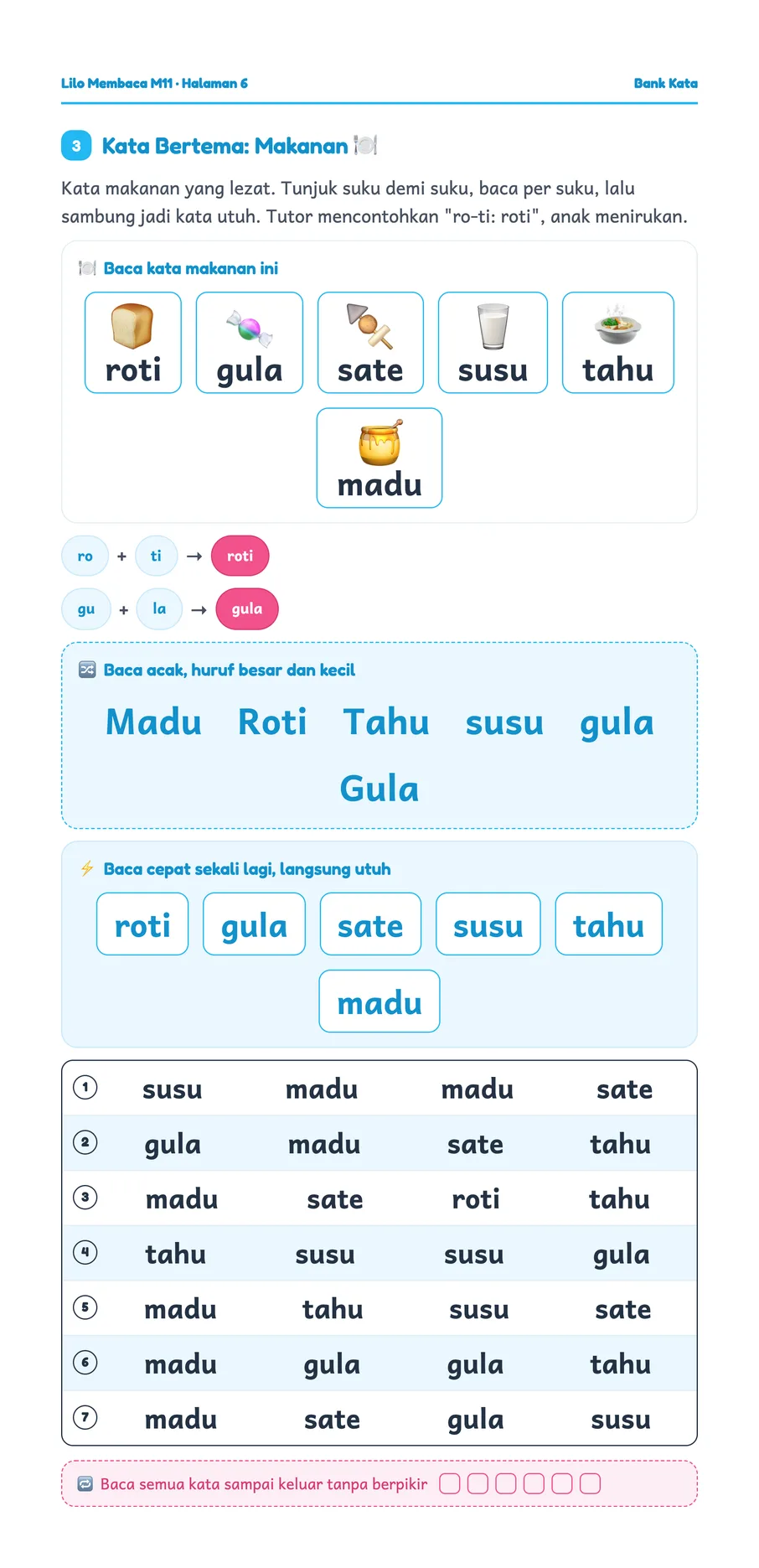
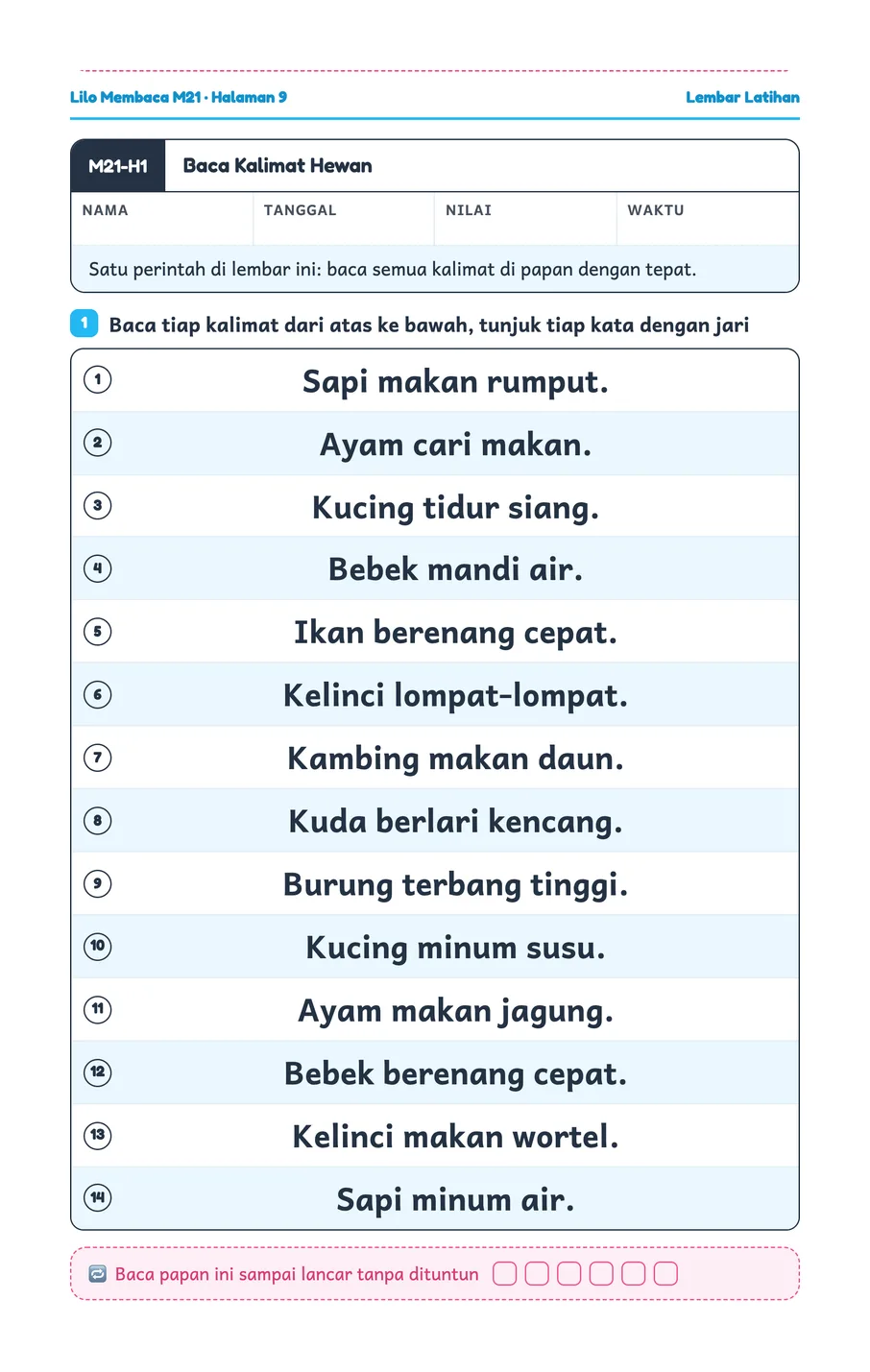
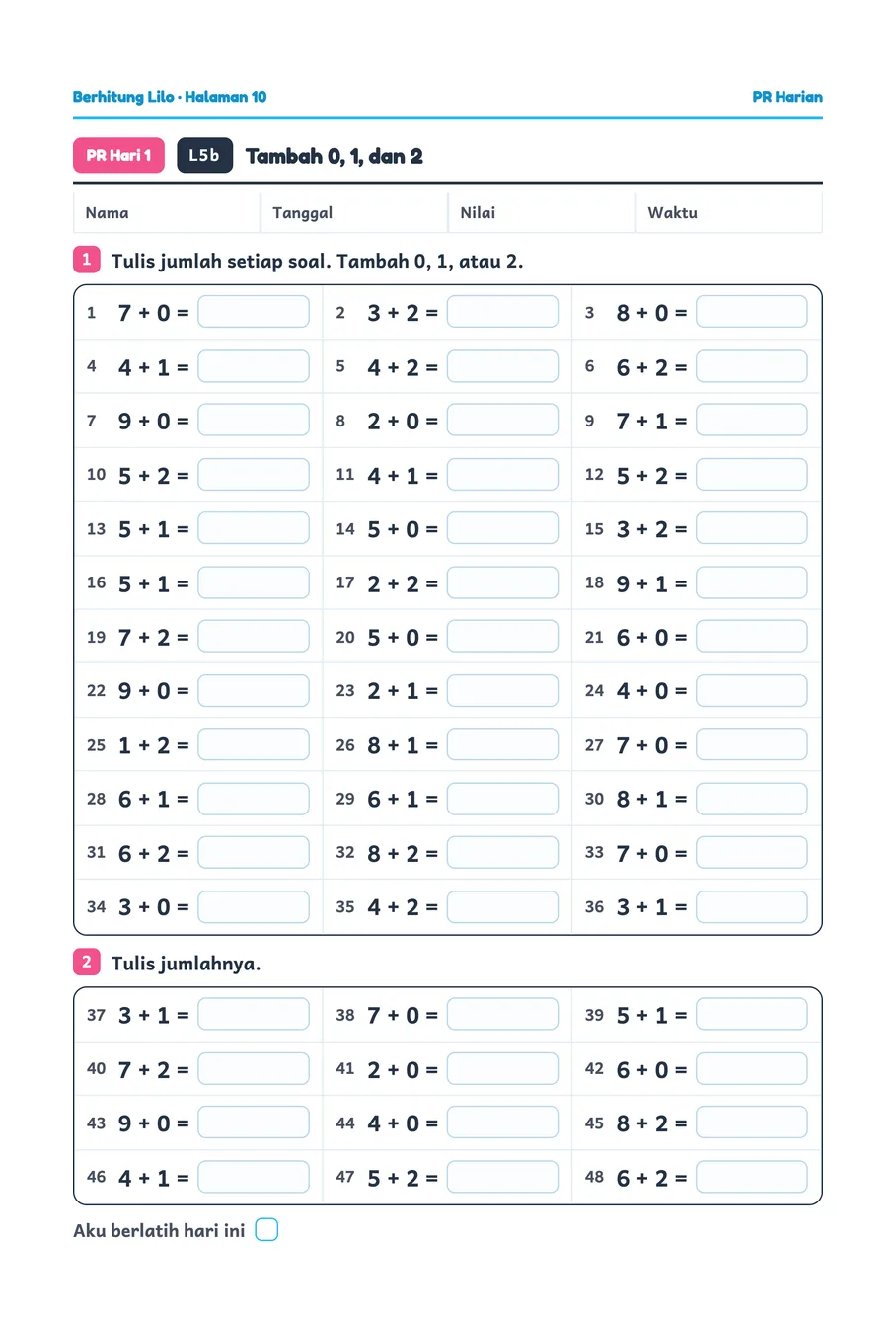
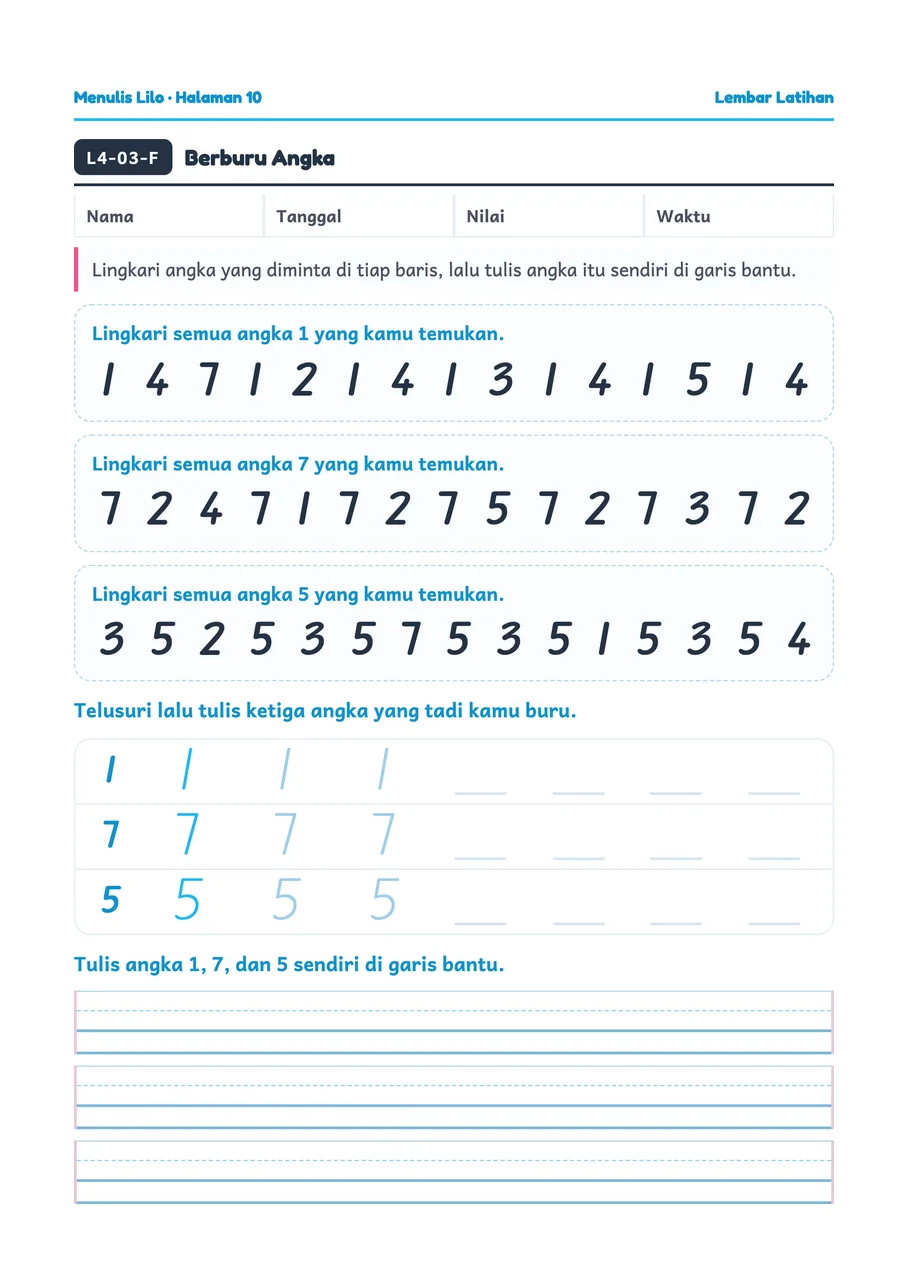 Real sheets from inside the pack
This pack gathers Lilo materials for children in their final kindergarten year. It covers reading from syllables to sentences, handwriting on four ruled lines, the guides that train letter heights, counting to one hundred, pattern and sequence reasoning, and simulations of the primary school entrance test and interview.
Registration opens, other children in the class already read fluently, and you start wondering whether your child will fall behind in the first month of grade 1. Almost every parent of a final year kindergarten child feels this.
This pack answers that worry with a clear order. Your child starts by blending two syllables, moves to words ending in consonants, then reads short themed sentences. On the writing track, the hand travels from tracing dots to copying sentences on four ruled lines. On the counting track, the journey runs from picture based addition to the hundred board, clock reading, and rupiah notes.
The part parents rarely prepare is here too: forty question and answer cards for interview practice, ten sample entrance test questions with an answer key, and a scheduled 30 day programme that turns all of it into a daily routine.
The value shows most clearly when your child sits at one of these points.
Real sheets from each track inside: reading, writing, counting, and sequencing practice.
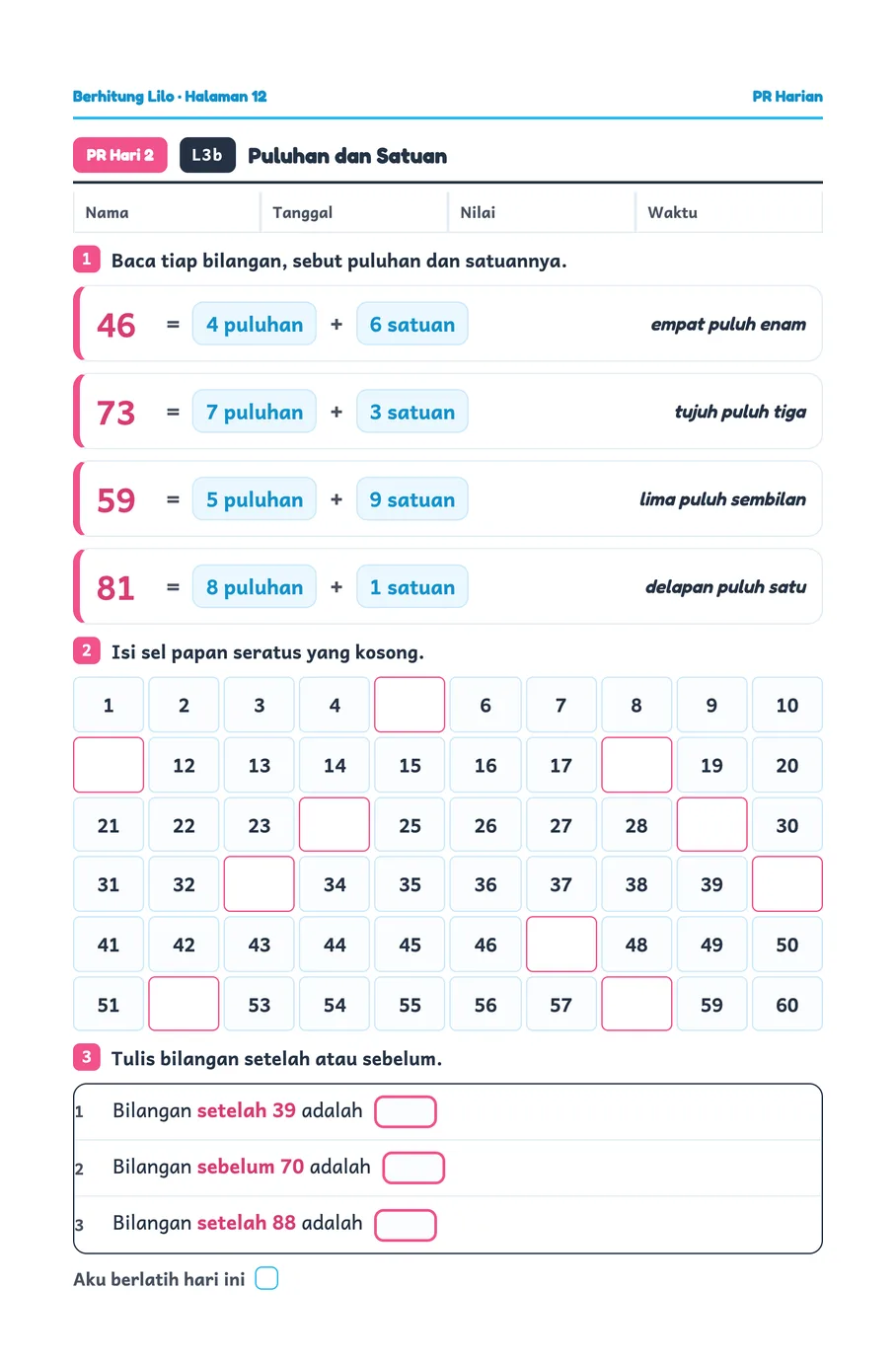
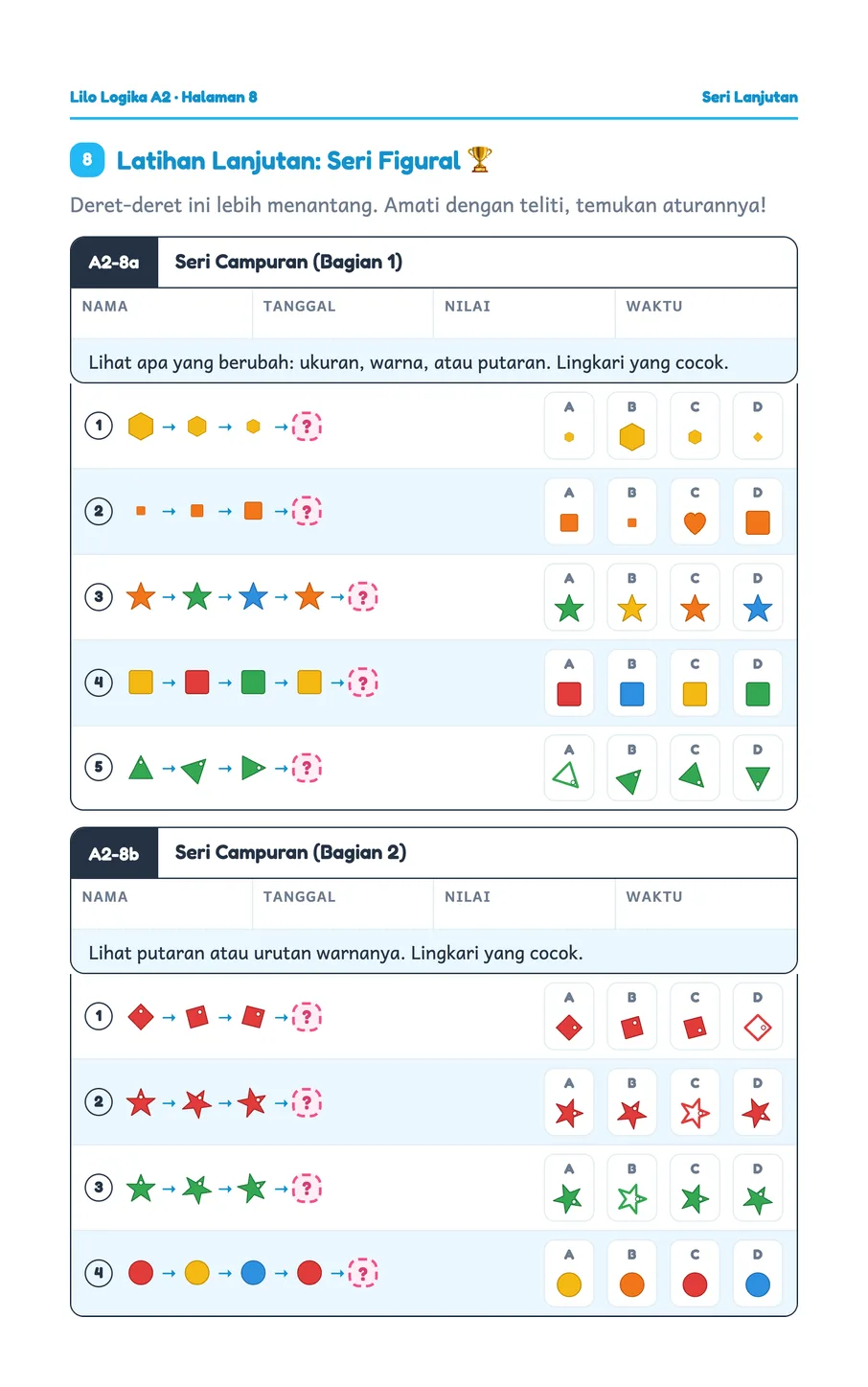
All of the materials below arrive with a single purchase. You download them from your Lilo account and print as many copies as your family needs.
From blending two syllables and words that end in consonants, through short themed sentences, into a 30 day daily reading programme.
Your child leaves the dotted guides behind, pairs capitals with lower case letters, then copies fifty everyday sentences.
Addition and subtraction to twenty, the hundred board, telling time, and working out change at the corner shop.
A 30 day programme, forty interview question cards with sample answers, and ten real style test questions with the key.
A printable certificate and medal for the moment your child finishes a track.
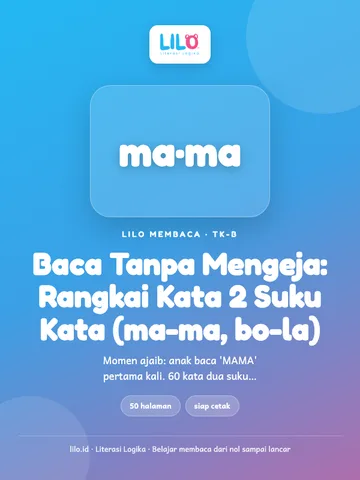 Baca Tanpa Mengeja
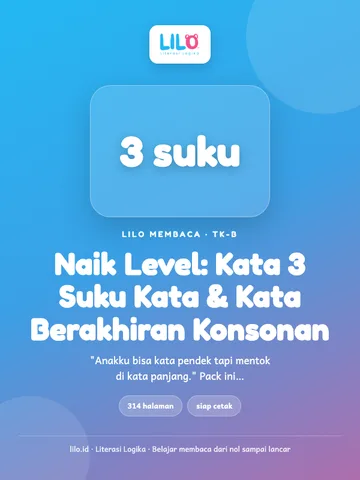 Naik Level: Kata 3 Suku Kata dan Kata Berakhiran Konsonan
 Baca Kalimat Pertamaku
 Membaca Lancar 30 Hari
 Lepas Titik: Menulis Huruf Mandiri di Garis Empat
 Huruf Besar dan Kecil
 Menulis Kata Bergambar
 Menyalin Kalimat Rapi
 Kata Pertamaku
 Penjumlahan Sampai 20
 Pengurangan Itu Mudah
 Menghitung Sampai 100
 Belajar Membaca Jam
 Kenal Uang Rupiah
 Master Pola AB-ABC
 Susun Ceritanya
 Lolos Tes Masuk SD
 Latihan Wawancara Masuk SD
 Bundle Persiapan Masuk SD
 Paket Sertifikat Aku Lulus Calistung! + Medali Cetak
 10 Soal Asli Tes Masuk SD + Kunci Jawaban (Gratis)
 Checklist Kesiapan Masuk SD (Sampel Gratis)
 Ceklis Kesiapan Fisik dan Kesehatan Masuk SD (Pra-Juli)
 Buku Kerja Numerasi Lilo
Everything inside is print ready, so you can reprint as often as your family needs.
Designed for twenty minutes a day, and the kitchen table works fine.
Begin with the school readiness checklist so you know which areas are already strong and which need more time.
Take seven days of sheets and keep them in one folder. Children like watching the pile shrink.
Follow the daily order. Each day carries one focus, so your child never faces three tracks at once.
Use the question cards in the car or before bed, until answering in full sentences feels ordinary.
Print the certificate and medal when a track is complete. Small recognition keeps children going.
Lilo materials follow the way children actually build understanding, moving from real objects to symbols.
Counting questions start with pictures and number lines before your child works with numbers on their own.
Children blend whole syllables, so they read the sound of a word, and the habit of naming each letter never forms.
Daily portions stay small and rise gradually, in the spirit of regular practice, with a look that children enjoy.
This pack pays off most once your child already holds a few early footholds. Match the signs below with what you see at home, then decide which track to print first.
| Your child says the sounds of most letters when spotting them on food packets or shop signs. |
| They start guessing short two syllable words, such as the name of a favourite animal or snack. |
| They happily listen to a short story and can retell the part they remember best. |
| They are curious about writing around them and often ask what a word says. |
| Your child holds a pencil with the fingertips and can draw a short straight line steadily. |
| They can trace dotted lines on simple letters without wandering far off the path. |
| They count objects up to ten while pointing at each one without skipping. |
| They recognise numbers one to twenty on a calendar or a neighbour's house number. |
| Your child can settle with one sheet for about ten to fifteen calm minutes. |
| They will answer simple questions about themselves, such as their name, age and hobby. |
| They can follow a two step instruction, such as pick up the pencil and write your name. |
| They are starting to finish a small task before moving on to another toy. |
A sequenced pack works best when you know when to step forward and when to pause. The signs show up in how your child works, long before they show up in the number of right answers.
The most honest sign that your child is ready to move on lies in how they begin a sheet. A ready child listens to the instructions once, then starts working without glancing at you after every question. They move at a calm pace, pause now and then, and carry on by themselves. On the reading track they blend syllables in a single breath and have left behind the habit of naming each letter in turn. On the counting track they start to let go of fingers or pictures for small sums. When this happens three days in a row, the next sheet is worth opening.
Signs that a sheet needs repeating also come from the process. A child who gets everything right but takes a very long time, or gets it right because you hinted on every line, is working at the edge of what they can do. On writing sheets, watch whether lower case letters drift above the middle line as your child tires, or whether they go back to tracing in a column that asks for independent writing. On reading sheets, sounding out a word letter by letter that flowed easily yesterday tells you the foundation has yet to settle. Repeating at this point lets your child feel how easy it can be, and that feeling fuels the next stage.
How you repeat shapes the result. Printing the exact same sheet can sometimes lead a child to memorise answers, so the progress you see stays on the surface. Instead, take a sheet from one step earlier on the same track, use it as a light warm up, then return to the sheet that caused trouble. You can also move the practice into a home activity, such as the kitchen syllable hunt, so the content stays the same while the form feels new. Because every file can be reprinted, repeating adds no cost at all, and you are free to give your child as many second rounds as they need.
The tracks inside the pack may also move at different speeds. Many final year kindergarten children race ahead in counting and need more time in writing, because finger muscles develop on their own schedule. Let one track climb while another repeats, and you can still follow the 30 day programme by swapping the order of days. Jot down one sentence after each session, such as smooth on three syllable words, unsure between b and d. Read back at the end of each week, those short notes give you a far clearer picture. If your child still stalls after two rounds of repetition, a tutor can help find the reason.
The road from your phone screen to your child holding a pencil is short. Here is what actually happens once you decide to use this pack at home.
Once payment is verified, every file in the pack appears in your Lilo account at app.lilo.id, linked to the email you entered at checkout, which is why an active address matters so much. You can open the account on a phone or laptop, browse the list of materials, and download only what this week needs.
Before printing any practice sheets, you and your child work through the school readiness checklist in a relaxed, question and answer game. The result is a small map: tracks that are already strong, tracks that need more time, and the right entry point on the reading path. A child who has just met the letters starts at the very first sheet, while a child who blends words can join midway.
You print seven days of sheets in the order of the 30 day programme and stack them in one folder with the day number in the corner. Daily preparation then takes almost no time at all. Your child also sees the pile shrink day by day, which gives them a sense of progress they can hold in their hands.
Each day your child works on the single focus the programme sets, such as reading words that end in a consonant or writing lower case letters on four ruled lines. You sit beside them, read the instructions aloud, then mark with the answer key. The session ends while your child is still keen, so tomorrow they come back to the table gladly.
Between sessions, the question cards come out in the car, in a queue or before bed, until answering in full sentences feels ordinary. When a track is finished, you print the medal and celebrate together, then choose the next track using the short notes you kept that week. A small celebration makes your child want to open the folder again.
Worksheets work best when their content also lives away from the table. These activities use things you already have at home and connect directly to the tracks inside the pack.
Ask your child to find syllables they know on food packets, such as su in susu or ro in roti. Write each syllable on a small slip of paper, shuffle them, and let your child rebuild the words. This links to the sheets on filling in missing syllables, and your child discovers that reading is useful in their own kitchen.
Food packets, a marker, small slips of paper
Stick simple price labels on a few household items, such as two, five or ten. Your child is the shopper, you run the shop, then you swap roles. They count their money, pay and receive change. This gives real meaning to the subtraction and money sheets, because numbers on paper turn into choices your child makes for themselves.
Play money or coins, a few household items, paper price labels
Pick just two question cards each night. Ask them in a relaxed voice and let your child answer in a full sentence, such as my name is Raka and I like drawing. Now and then swap roles so your child asks and you answer. Trading places helps your child understand how a conversation flows, and nerves around new adults slowly melt away.
Question cards from the pack
Each morning, ask your child what time breakfast is and what time they leave the house. Draw a clock face on paper and let them draw the hands for one event that day. When the moment arrives, compare the drawing with the wall clock. This ties the clock reading sheets to a routine your child lives every single day.
A wall clock with hands, paper, coloured pencils
Build a pattern from household things, such as red sock, blue sock, red sock, blue sock, then ask your child to continue it. Raise the challenge with three part patterns or patterns that change in size. Afterwards let them build a pattern for you to guess. This prepares your child for the AB and ABC pattern sheets while training care and a feel for order.
Socks, clothes pegs, coloured blocks or bottle caps
Every child moves at their own pace, so these milestones describe what often appears in final year kindergarten children who use the pack regularly. Treat them as a companion for reading progress, and keep them free of any deadline.
The first week is mostly about settling in. Your child learns that there is a set time for the folder and the pencil, and starts to recognise how the sheets look. On the reading track they blend familiar two syllable words, such as the names of things at home. Tiring quickly on day two or three is perfectly normal.
Around the second week, many children write a few letters on four ruled lines without dotted guides, even if the letter heights are still settling. On the counting track they add with picture support up to ten. You may notice your child fixing their own writing before you get the chance to point.
After one round of the daily programme, most children are used to sitting for twenty minutes and know how a session runs. Some read short themed sentences slowly, others are firming up three syllable words. Both are genuine progress. This is a good moment to fill in the readiness checklist again.
In the second month the counting track moves to the hundred board, telling time and recognising money. Your child starts using numbers for real tasks, such as working out change at the corner shop. On the writing track they copy daily sentences with tidier spaces between words, and the interview cards feel lighter.
As the first school day approaches, a child who has used the pack steadily usually has settled study habits: listening to instructions, writing on four ruled lines and answering a new adult in full sentences. Leftover sheets can go towards repeating the parts they loved most or the parts that once felt hard.
If your child seems to pause at one stage for more than two weeks, it is a good moment to repeat earlier sheets or ask for a free consultation on WhatsApp.
Primary school preparation packs come in many shapes. These questions help you judge whether a pack will genuinely get used at home all the way to the first day of school.
| Question to ask | Why it matters |
|---|---|
Is the order of the materials already decided? | Parents teaching at home most often get stuck on the question of what to do tomorrow. A pack without a sequence leaves you guessing, and a wrong guess leaves your child bored or overwhelmed. A planned order, especially one with a daily programme, moves that decision from your shoulders onto the design. This pack uses a scheduled 30 day programme for exactly that reason. |
Can the reading track start where my child is now? | Final year kindergarten children arrive at very different starting points. A pack that opens with sentences feels heavy for a child who has just met the letters, while a pack that stays too basic bores a child who already blends words. Look for a graded path with a checklist to find the entry point. Here the reading track begins with two syllables and climbs to themed sentences. |
Is there a clear answer key? | Without an answer key you may hesitate while marking, especially on pattern and story order questions where the answer can be less obvious. That hesitation passes easily to your child. A clear key makes marking quick and consistent, so the twenty minutes go to learning. The sample test questions in this pack come with their key. |
Does the pack prepare for the interview too? | Many parents prepare reading and counting, then forget that children also need to feel at ease talking with a new adult. Answering in full sentences helps during selection and keeps helping in grade 1, every time your child asks the teacher a question. This pack includes forty question and answer cards you can use anywhere. |
Can the files be printed again? | A child who needs to repeat a step needs a fresh sheet, and a sheet full of marks is hard to reuse. Files you can print again and again give you the freedom to repeat without a second thought, and they stay useful for a younger sibling later. Everything in this pack is a print ready file stored in your Lilo account. |
What is the next step if my child needs direct support? | Some children thrive on worksheets at home, while others need someone watching how they think up close. A good pack has a clear next step, so you never have to start again from zero. At Lilo, a private one to one tutor picks up from where your child is, with a progress report every week. |
No. The reading track opens with blending two syllable words, then rises slowly. A child who only recognises letters can still start from the first sheet.
About twenty minutes is enough. The 30 day programme inside breaks the material into small daily portions so your child stays willing and you stay sane.
As downloadable files. Once your payment is verified, the whole pack opens in your Lilo account at app.lilo.id, ready to download and print at any time.
Yes. You download once and print as often as your own family needs, including for the next child.
The pack holds the same 24 materials sold individually, at a price far below their combined total. You also get the sequence, so you never guess which sheet comes next.
The pack is built for independent use at home. If your child needs live guidance, you can continue into a Lilo programme with a tutor.
No, the admission rules for grade 1 do not require a reading, writing and counting test, and selection is based on age under Permendikdasmen 3/2025 Article 11 paragraph 5. Even so, being ready to read, write and count makes the first month of grade 1 feel much calmer for your child. This pack prepares for a chosen school that runs a simple test and for everyday classroom life alike.
The best time is a few months before the first day of school, so the 30 day programme can run at a relaxed pace with room left for repetition. If the day is already close, the pack still works when you focus on the tracks the readiness checklist flags as most needed. Starting early lets your child feel progress without deadline pressure and gives you time to read how they learn.
Days like that are normal and are best met with a shorter session. Offer a single question, or swap in a home activity linked to that day's sheet, then carry on tomorrow. Refusal that repeats over several days often signals the sheet is too hard, so try stepping back one stage. A child who feels successful usually returns to the table on their own.
Most sheets work best with you sitting beside your child, especially in the first weeks. Children at this age usually cannot read instructions alone yet, and a little guidance helps them understand what each sheet asks. After a few weeks, many children handle familiar sheet types with only light help. Marking is still best done together, because that is where your child learns from mistakes.
Yes, as long as each day keeps a single focus. If your child races ahead in counting and needs more time in writing, you can repeat the writing days and keep moving on the counting days. The programme order gives a safe route for most children, and your own notes about your child are a sound reason to adjust it. Simply avoid stacking three tracks into one session.
Interview practice works best when it happens in passing, with the feel of a game. Use one or two cards in the car, while waiting or before bed, and accept any answer as long as your child replies in a full sentence. Role play helps too, with your child as the teacher and you as the new pupil. That way questions from a new adult feel like a game they already know.
Yes, because the pack also covers writing on four ruled lines, counting to one hundred, patterns, story order and interview practice. A fluent reader can go straight to the themed sentence sheets after the readiness checklist, then spend the time on other tracks. Many children who read well turn out to need more time to write neatly on four ruled lines.
You can bring your notes from this pack to the first private lesson, where the tutor finds your child's starting point through play with no written test. Lilo lessons follow their own curriculum of 122 coded modules, so the pack sheets stay useful as extra practice at home. You can view the tutor's profile before the first session, and a free WhatsApp consultation helps you choose how many sessions fit.
This pack chases one deadline: your child first day at primary school. The classes below add rehearsal with a tutor, while the next two packs help when the reading or literacy foundation still needs work first.
One purchase opens every material in your Lilo account, ready to print again and again.