
Has just mastered syllables
- Reads ba, bi, bu fluently
- Hesitant about joining them into whole words
- Needs daily levelled practice
The last kindergarten year is where it shows. This pack carries a child from blending words to reading sentences, writing on four ruled lines, and counting to one hundred.
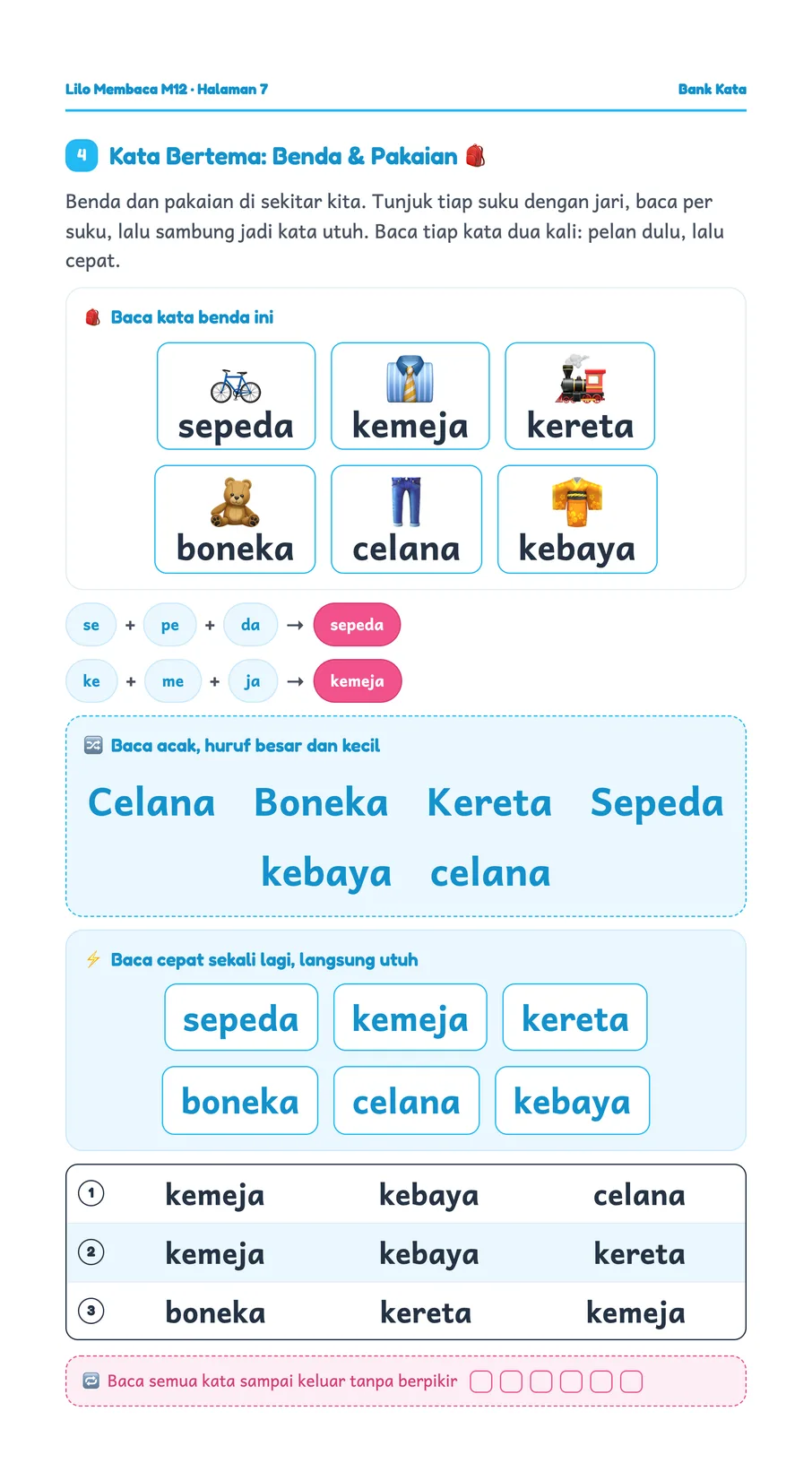
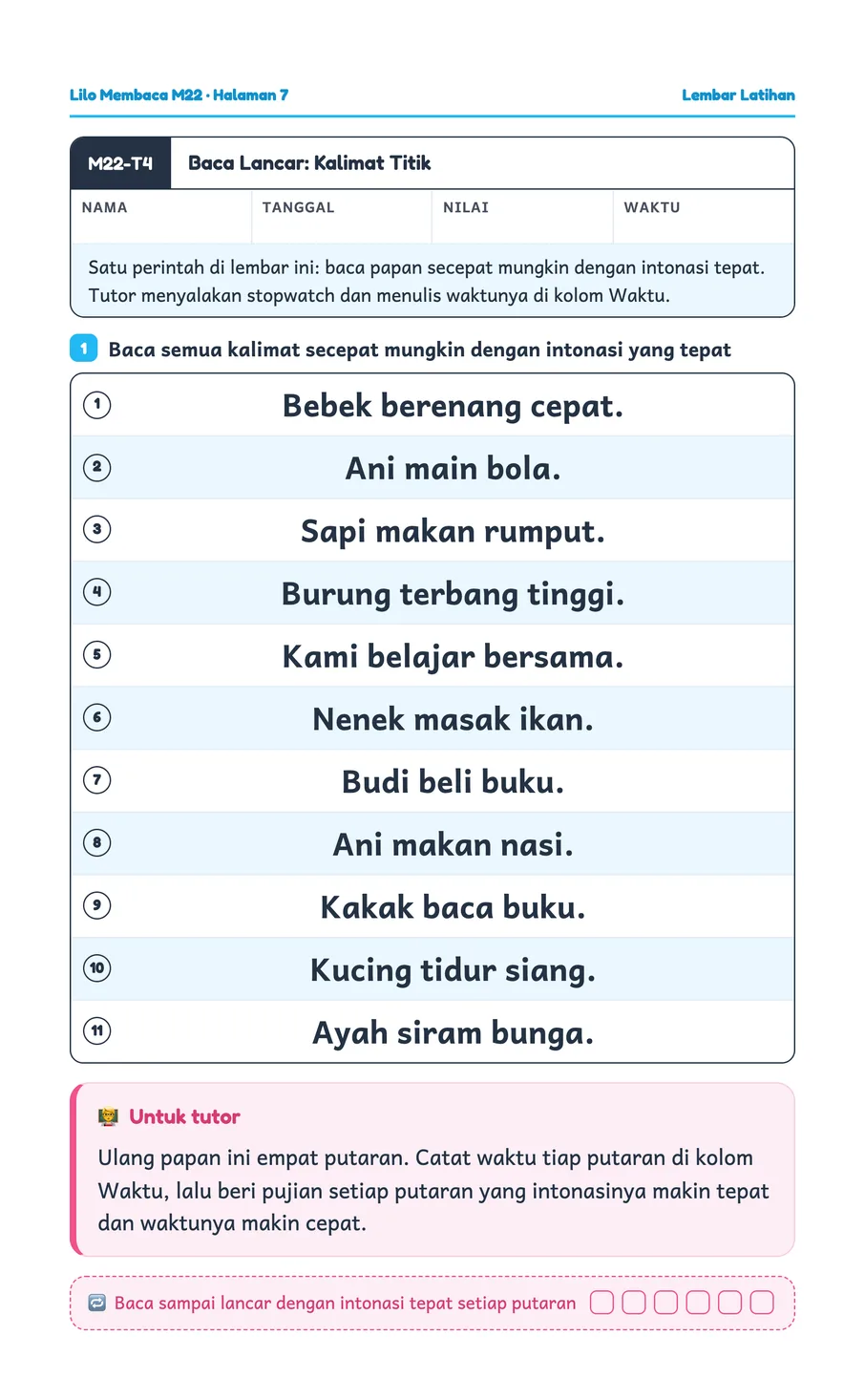
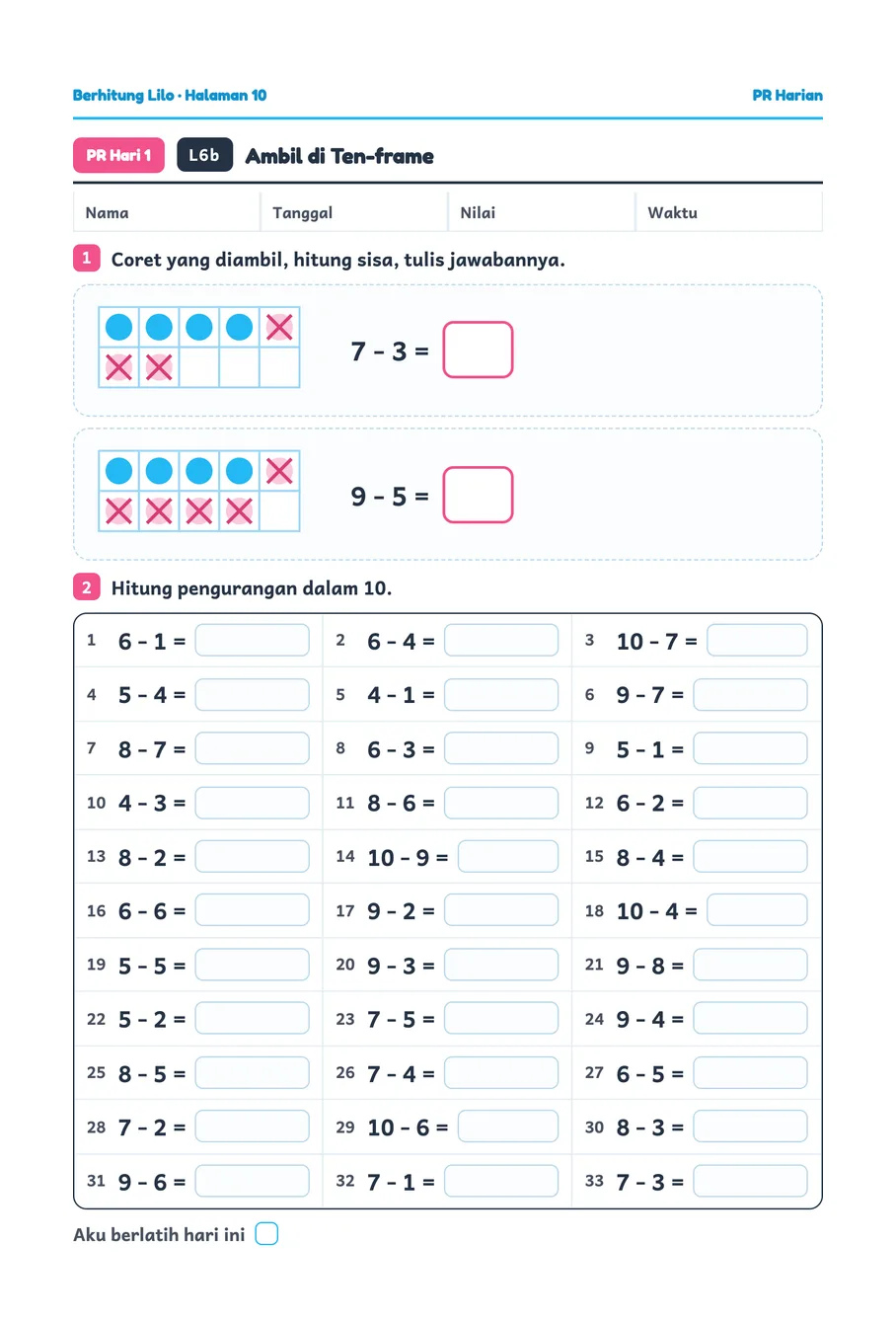
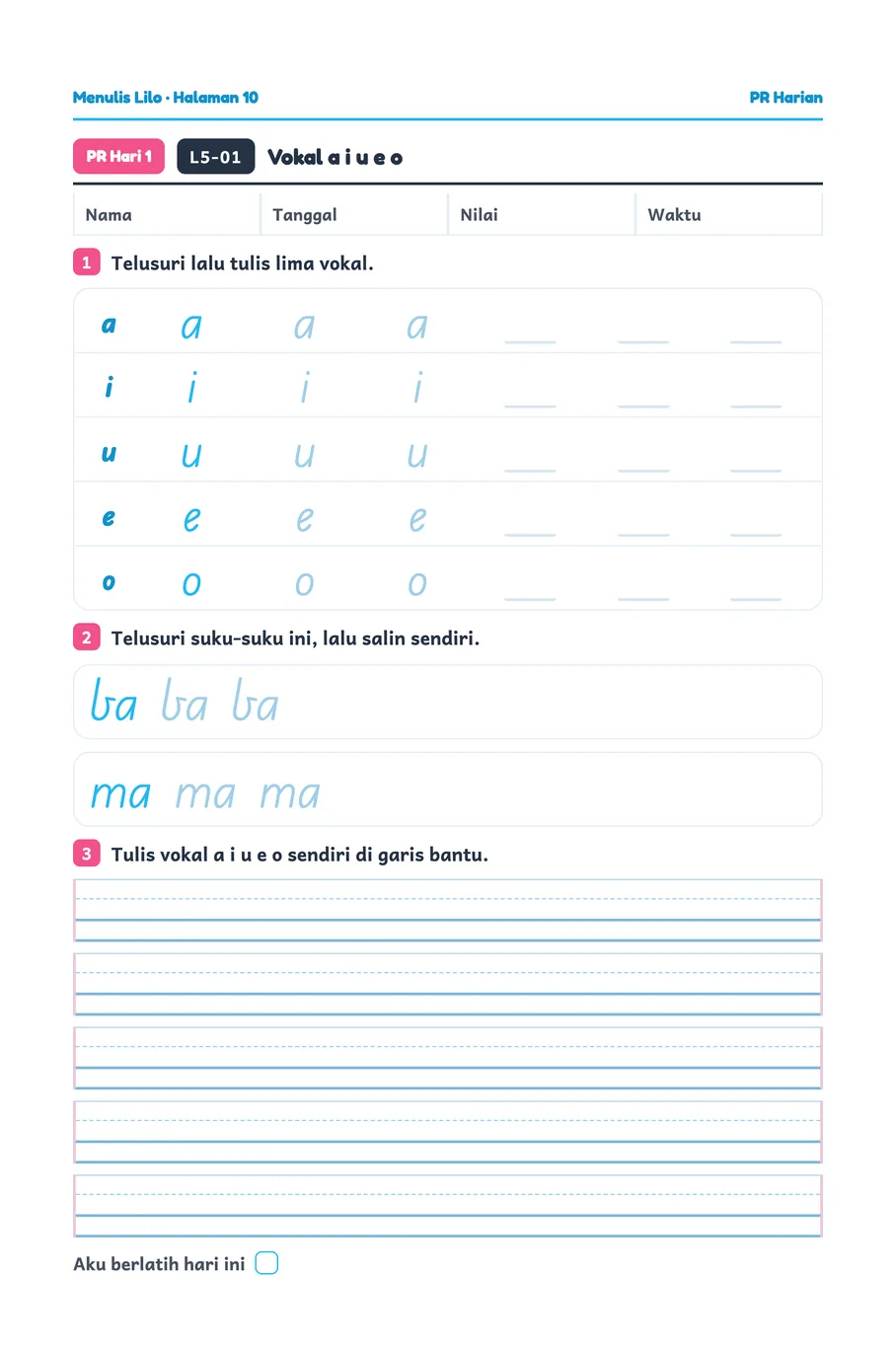 Real sheets from inside the pack
Before grade one, a child ideally blends syllables into words, reads short sentences, writes letters unaided on four ruled lines, adds and subtracts within twenty, and counts to one hundred. This pack trains all of it in order.
In the first kindergarten year, success is measured by recognition. In the final year the measure becomes fluency. A child is expected to read without long pauses, write without dotted guides, and calculate without always reaching for fingers.
So this pack moves briskly along three tracks at once. Reading runs from two syllable words up to three syllable words and words ending in consonants, conquers ng, ny, kh, and sy, then enters short themed sentences. Writing drops the dotted guides, pairs capitals with lower case letters, then covers one hundred themed words. Counting reaches addition and subtraction within twenty, the hundred board, and telling time.
What keeps the year light is the layer of games: eighty picture sudoku boards, deduction grids, cause and effect cards, fifteen origami folds, and profession cards that open up the world of work. All of them train a child to hold back an answer and check first, the habit a teacher later relies on during word problems.
Three common situations in the final kindergarten year.
Six samples showing the leap of this year: words, sentences, unaided writing, and calculating within twenty.
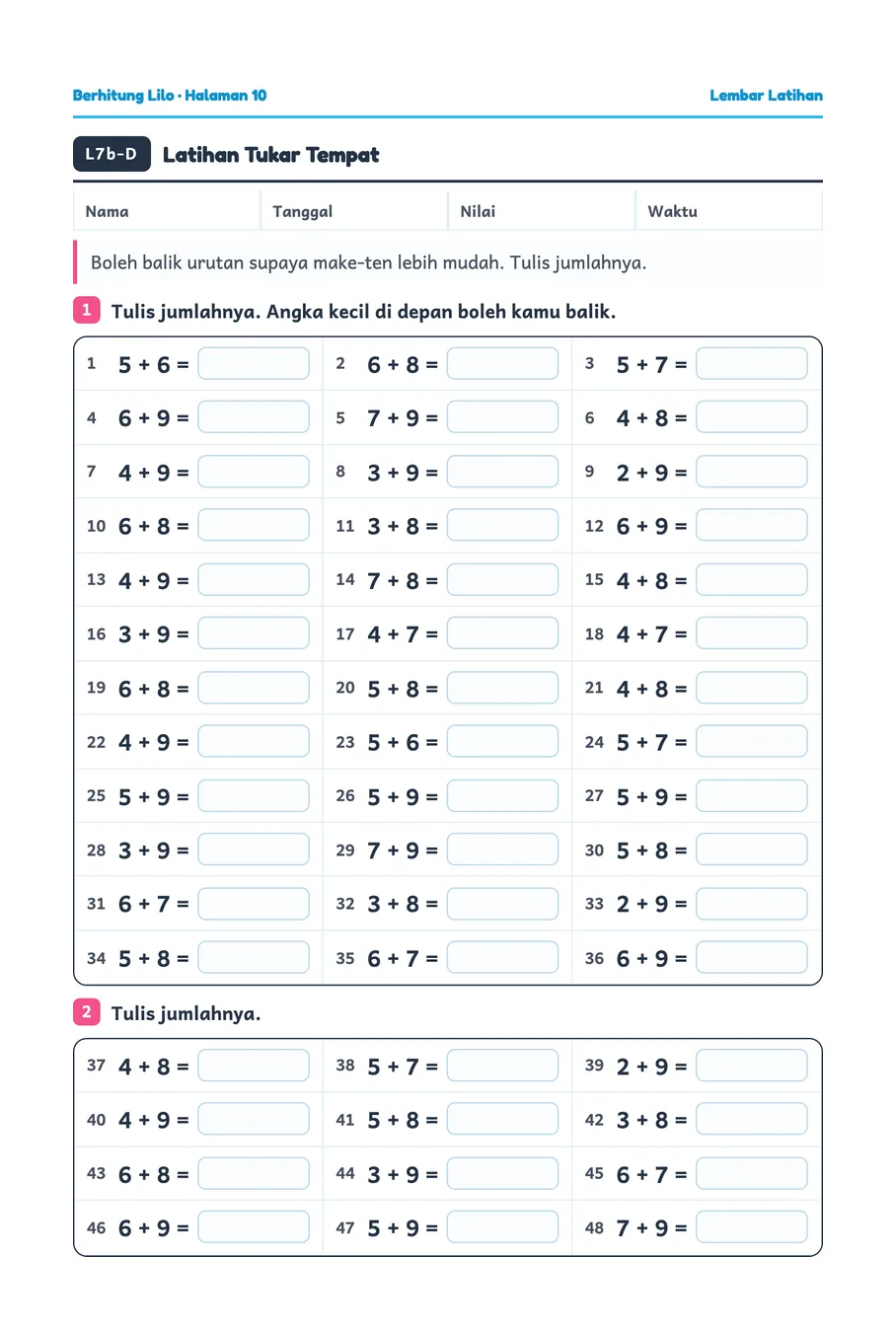
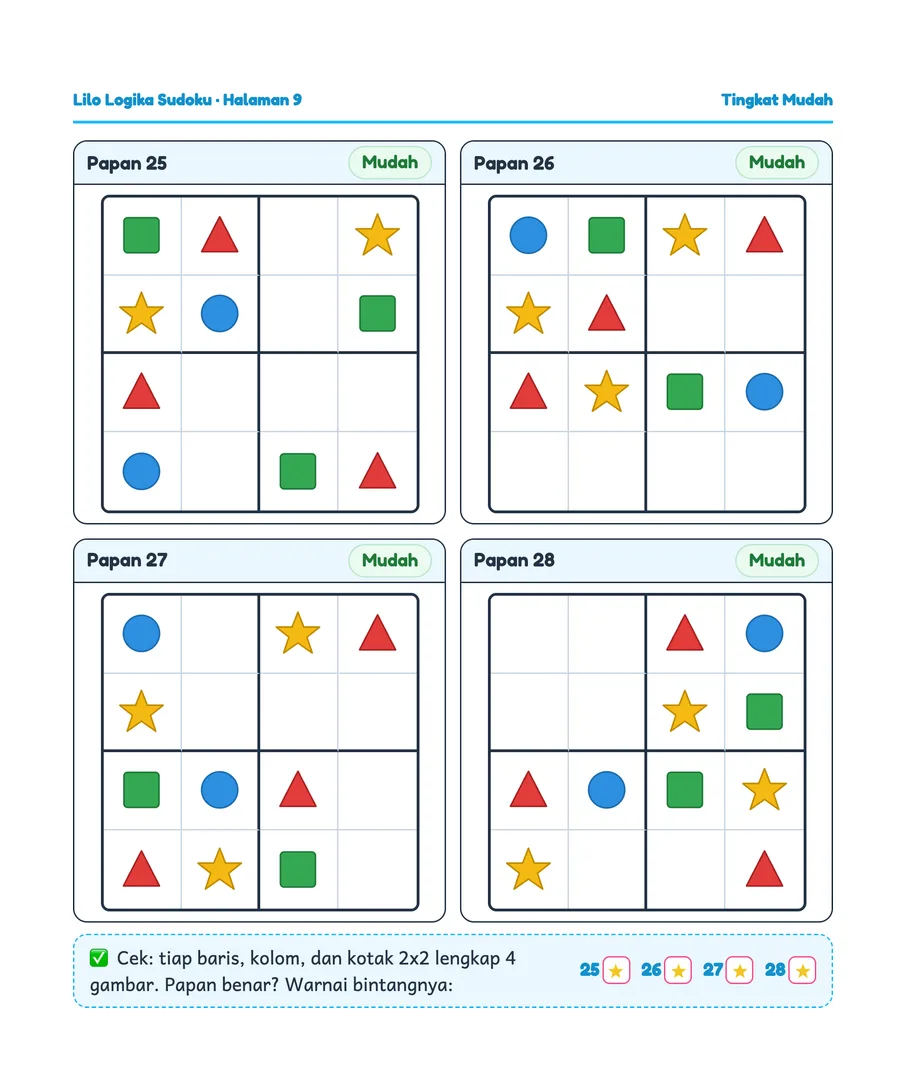
Three learning tracks plus a thinking games layer, closing with readiness markers.
Two syllable words, three syllable and consonant ending words, tricky consonants, themed sentences, and syllable cards for rapid practice.
Dropping the dots on four ruled lines, capital and lower case pairs, themed word writing, and one hundred themed words.
Addition and subtraction within twenty with answer keys, the hundred board with skip counting by two, five, and ten, and telling time.
Eighty picture sudoku boards, deduction grids, cause and effect cards, number pattern puzzles, and story sequencing.
A 30 day study calendar, a write your own name sheet, a seven day sample calendar, and ten sample entrance questions with the key.
 Baca Tanpa Mengeja
 Naik Level: Kata 3 Suku Kata dan Kata Berakhiran Konsonan
 Baca Kalimat Pertamaku
 Flashcard Suku Kata ba-bi-bu
 Kalender Belajar 30 Hari
 Lepas Titik: Menulis Huruf Mandiri di Garis Empat
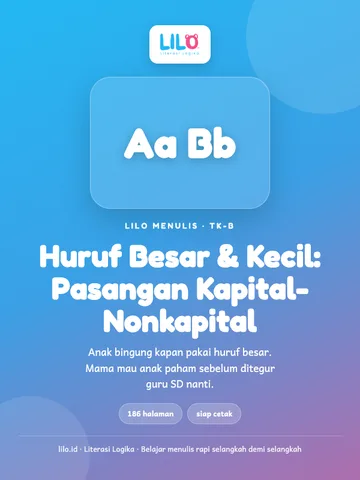 Huruf Besar dan Kecil
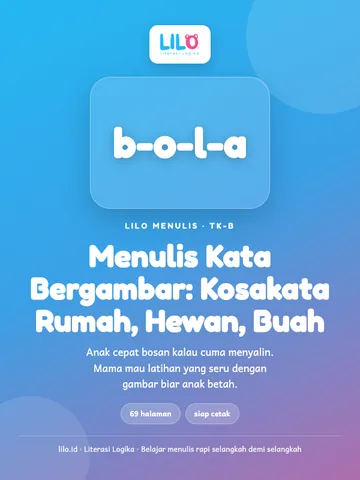 Menulis Kata Bergambar
 Kata Pertamaku
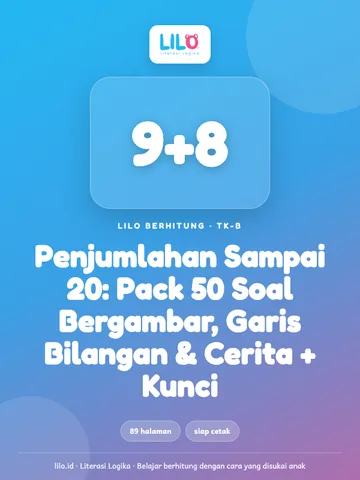 Penjumlahan Sampai 20
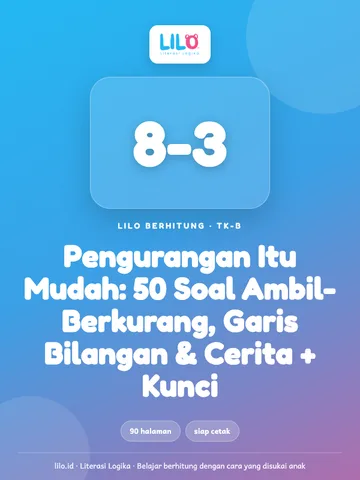 Pengurangan Itu Mudah
 Menghitung Sampai 100
 Belajar Membaca Jam
 Tebak Polanya
 Sudoku Gambar Anak
 Teka Grid: Puzzle Logika Deduksi untuk Anak
 Kenapa Begitu?
 Origami Pemula
 Aku Ingin Jadi Apa? 24 Kartu Profesi + Alat Kerja dan Tempat Bekerjanya
 Sampel Kalender Belajar 7 Hari (Coba Gratis)
 10 Soal Asli Tes Masuk SD + Kunci Jawaban (Gratis)
Everything inside is print ready, so it can be reprinted whenever your child needs another pass.
Twenty minutes a day, with one weekend day given to thinking games.
Follow the order of words, tricky consonants, then sentences. Swap in the syllable cards when your child wants a change.
One ruled line sheet a day. Small portions keep the hand fresh and the writing tidy.
Work an addition or subtraction sheet and check it against the key on the same page.
Open picture sudoku, a deduction grid, or origami. Your child practises ordered steps without feeling taught.
The name sheet works as a closing celebration, while the 30 day calendar shows how far your child travelled across the year.
Three considerations behind the contents.
Ten minutes of reading every day outperforms an hour once a week by a wide margin.
Your child copies words they can already read, so letter shapes and sounds are stored side by side.
Sudoku, cause and effect, and sequencing train a child to hold back an answer and check first, exactly the habit grade one word problems demand.
This pack builds on what grew during the first kindergarten year. The signs below help you see which track your child can start straight away and which one is better warmed up first.
| Says syllable sounds such as ba, bi, bu without a long wait. |
| Tries joining two syllables, even if the word still comes out in pieces. |
| Points at a word in a storybook and asks what it says. |
| Enjoys guessing a word from the picture printed beside it. |
| Traces dotted letters with a fairly tidy line and without rushing. |
| Holds a pencil with three fingers and stays with a few lines of writing. |
| Notices that a capital and a lower case letter can share one sound. |
| Wants to try writing their own name, even with uneven letters. |
| Counts objects up to twenty while pointing at each one. |
| Understands that adding objects makes the total grow. |
| Happily matches pictures or fits pieces together until the end. |
| Loves asking why things happen, such as why ice in a glass melts. |
The pack arrives as print ready files, so the first steps happen in your own home. Here is the smoothest order, from the day you buy it to the day the daily rhythm runs by itself.
Once payment is complete, the materials open with the email address you entered at checkout and then sit in your Lilo account at app.lilo.id. Keep the files in one folder and split them by track: reading, writing, counting and thinking games. When your child needs another pass at a sheet, you simply open the right folder and print it again.
Before printing a big stack, sit with your child over a few sheets from the seven day sample calendar. Watch where they move easily and where they start to sigh. A child who already reads two syllable words comfortably can step up to three syllable words, while a child still blending sounds settles in better with the syllable cards.
Print roughly two weeks of sheets and leave the rest in the folder. A thin pile tells your child the task is something they can conquer. Put the 30 day study calendar where your child can see it, on a bedroom door or the wall by the table, so they can tick off each day they have completed by themselves.
The counting sheets carry an answer key on the same page. When a sheet is done, let your child match their answers while you sit beside them. Any answer that missed becomes a short chat about which part felt confusing and what they might try next time. This checking habit is exactly what travels with them into grade one.
At the end of each week, sort the finished sheets. Sheets that felt easy can stay behind, and sheets that still made your child hesitate get printed again for the following week. Because every file can be printed at any time, your child gets another go straight away, and you can see their progress on two copies of the same sheet.
How you respond to a finished sheet shapes how your child sees learning. A short conversation after the work can become the most valuable part of those twenty minutes.
In the final kindergarten year, children begin to sense that their work is being judged. They glance at your face as they hand over a sheet, waiting for a sign that it is good. A quick word like clever feels lovely, yet what your child absorbs is that the result is what counts. When the next problem is harder, a child used to praise for results tends to give up quickly, because a mistake feels like losing a title. Talking about the process gives a sturdier footing. Your child learns that trying again, checking and choosing a method are what make them succeed.
A good question opens a story. Try asking which part was hardest today, how they got through it, or which letter they liked best on today's writing sheet. On a four ruled line sheet, ask your child to circle the one letter they think is neatest, then ask what made that letter work. They might say they wrote it slowly, or that its tail reached all the way to the bottom line. When your child names their own method, they are storing it away to use again tomorrow.
The answer key on the counting sheets is a wonderful conversation tool. Let your child do the checking, then treat any answer that missed as a puzzle you solve together. An invitation like shall we find where the path turned sounds friendly and sparks curiosity. Picture sudoku and deduction grids offer the same chance: ask how they knew that picture had to go in that square. A child used to explaining their reasons is practising the habit of holding back an answer and checking first, exactly what they will need for word problems in grade one.
Evidence of the journey makes that pride real. Keep the earliest sheets in one folder, and now and then lay them beside the newest ones. Let your child spot the difference by themselves, perhaps letters that now sit neatly on the line, or a sentence once sounded out that is now read whole. The 30 day calendar full of ticks and the name writing sheet at the end of the year become the high point of that story. A child who sees the trail of their own effort steps into grade one believing that hard things can be learned, little by little.
Worksheets mean more once their contents step off the paper. These short activities turn your child's finished work into conversation, play and a small exhibition at home.
At the end of each week, ask your child to choose the one sheet they feel proudest of. Stick it on the wall, then ask them why they picked it. Perhaps the letters are the neatest, perhaps the problem was the hardest. Listen to the whole reason, then say it back in your own words so your child knows their effort was seen and valued.
Finished sheets, paper tape, a wall or the fridge door
Your child reads sentences from a sheet they have already mastered to their favourite soft toy. Being the one who teaches makes them read more slowly and clearly. For question sentences, invite them to try the voice of someone asking. Afterwards, ask which sentence was the most fun to read and what they liked about it.
Short sentence sheets, a soft toy or favourite figure
Your child checks their own counting sheet against the answer key and circles each matching answer in coloured pencil. For any answer that missed, invite them to play detective: redo that problem while telling you each step out loud. Very often your child finds the slip on their own, and that discovery feels deeply satisfying to them.
A finished counting sheet, coloured pencils
Once an origami model is finished, ask your child to teach you how to make it while you fold alongside them. They need to remember the order, pick words like fold to the middle or turn it over, and stay patient when you are slow. This builds the skill of putting steps into words, which they will use later when explaining how they solved a problem.
Origami paper or square scrap paper, a previously folded model
Pick one profession card and let your child pretend to be someone who does that job. You ask which tools they use and where they work. At the end of the game, your child writes one word about that profession on lined paper. A word that grows out of their own story is usually written with real enthusiasm.
Profession cards from the pack, lined paper, a pencil
Every child moves at their own pace. These milestones sketch a typical path for a child using the pack for about twenty minutes a day, so you can spot the small steps forward that are easy to miss.
Your child learns the order of the daily session and starts ticking the calendar on their own. They may still sound words out slowly and glance at the model while writing. What deserves celebrating this week is the habit itself: sitting down, working, then checking together with you.
Many children begin reading two syllable words without stopping halfway. On the writing track, a few letters can now be formed on four ruled lines with no dotted guide. On the counting track, small additions are worked out with fingers appearing less and less often.
The sounds ng, ny, kh and sy start to be recognised inside words. Your child writes picture words with letters that sit in more even sizes. Smaller picture sudoku boards often get finished without help, and your child begins explaining how they found the answer.
Your child reads short themed sentences and starts giving question sentences a questioning tone. Subtraction within twenty is worked out with a method they choose themselves, and the hundred board becomes a place to skip count by two, five and ten.
The write your own name sheet becomes a closing celebration. Your child can lay their first sheets beside their latest ones and see for themselves how their writing has changed. A study calendar full of ticks stands as proof of the year they travelled.
If your child moves a little slower or faster than this picture, that is perfectly normal. Repeat the sheets they need, and WhatsApp consultation is always open.
Plenty of worksheets circulate in the run up to primary school. These questions help you judge whether a pack truly suits your child and the rhythm of your home.
| Question to ask | Why it matters |
|---|---|
Do the sheets climb in steps from words to sentences? | Children in the final kindergarten year stand at very different points. A levelled pack lets your child begin where they are and climb gently, so they reach sentences once two syllable words feel light. The Lilo pack moves from two syllable words to three syllable words, tricky consonants and finally short themed sentences. |
Can my child check their own answers? | The ability to check is an important thing to carry into grade one. An answer key within easy reach lets your child match answers independently, and talking about mistakes becomes part of learning. In the Lilo pack, the addition and subtraction sheets come with the answer key on the same page. |
Are reading, writing and counting practised together? | The three tracks strengthen one another. A child who copies words they can already read stores the letter shapes and their sounds together. A pack that brings all three into one daily rhythm is also far easier to run at home. The Lilo pack spreads twenty minutes a day across those three tracks. |
Is there thinking practice that feels like play? | Children this age learn best when they feel they are playing. Building, pattern guessing and folding games train carefulness and the patience to follow steps. The Lilo pack holds picture sudoku, deduction grids, cause and effect cards, origami and profession cards for weekend sessions. |
Can I see inside before I buy? | Seeing sample sheets helps you judge whether the style, letter size and difficulty match your child. A decision built on real sheets feels calmer. Lilo offers a seven day sample calendar and ten sample primary school entrance questions with the key, ready to try first. |
Where do we go if my child needs someone alongside them? | Some children flow happily with worksheets, while others need a person sitting beside them who reads the movement of their hand. Knowing the next path from the start brings peace of mind. Lilo offers fully managed one to one private lessons with one tutor for one child, with free consultation over WhatsApp. |
Yes, starting from the syllable cards and two syllable words. If your child still needs letters from scratch, begin with the First Kindergarten Year Pack.
Swap that day for syllable cards or picture sudoku. Both still train care and attention, and your child feels like they are playing.
Work through the ruled line sheets and the capital with lower case pairs. Letter size usually settles itself once a child has used guide lines for a few weeks.
Both train a child to follow ordered steps and check their own result. That habit keeps them calmer when longer questions arrive in grade one.
It is built for one school year. Most families use it across eight to ten months at twenty minutes a day.
Comprehension and word problems. The Lilo Reading and Lilo Maths programmes continue that path with a tutor.
It is not required. Under Permendikdasmen 3/2025 Article 11 paragraph 5, grade 1 admission does not require a reading, writing and counting test, and selection is based on age. Even so, a child who is comfortable reading short sentences and counting to twenty usually settles into lessons more calmly in the first months. This pack helps your child reach that comfortable point through a light daily rhythm.
The materials open with the email address you entered at checkout, so make sure it is correct and active. Once payment is complete, every file is available in your Lilo account at app.lilo.id. From there you can download and print any sheet whenever your child needs it. If anything gets in the way of opening the materials, the Lilo team is ready to help over WhatsApp.
Invite your child to find where the answer slipped, in a calm and curious tone. A phrase like shall we look at the steps again turns the mistake into a puzzle. Let your child redo the problem while talking it through. When they find the slip, name the effort they made, for example how carefully they checked again. Your child learns that checking is something to be proud of.
Shrink the portion first so writing feels light again. One line on the four ruled paper is enough for that day. Pick a word your child loves from the hundred themed words, or let them write the name of the origami animal they have just folded. Small hands tire quickly at this age, so a small portion finished happily builds the will to write, day by day.
Treat the questions as a guessing game you play together, in a relaxed mood with no time limit. Work through two or three in one sitting, then check them with the answer key side by side. Any question your child cannot answer yet points to the sheets worth repeating. Call it a question game in front of your child, so they meet the format with curiosity.
Keep finished sheets in one folder in date order, and mark one best sheet each week. Now and then, open the folder with your child and compare the first sheets with the latest ones. Your child can see for themselves that their letters are tidier or their problems more challenging. The folder also helps when you decide which sheets to print again.
Yes, it still fits well as a review of the foundations. Start with the part that trips your child most often, such as three syllable words or the tricky consonants, then move up to short sentences. The twenty minutes a day rhythm still applies. If your child needs someone who reads their habits up close, Lilo reading lessons with a private tutor can carry that path forward.
Yes, and the two complement each other. Lilo tutors teach from Lilo's own curriculum of 122 coded modules, and every session closes with one small task of about ten minutes. The sheets in this pack can fill the days between sessions. Monthly lesson packages run from Starter with 4 sessions, Regular with 8, Intensive with 12, up to Complete with 24, and you can talk through the choice over WhatsApp.
The final kindergarten year asks for many things at once, and this pack arranges them. The classes below help with the parts that stall most often, while the next two packs sharpen school readiness or revisit the basics.
Twenty one materials for the final kindergarten year, from blending words to counting a hundred.